

Billing & claims
Oncology Charge Validation Software
Check every oncology charge line against the record, NCCI and MUE edits, waste modifier rules, coverage articles and the approval on file before it becomes a claim.
Oncology Charge Validation Software checks each charge from a cancer treatment day before it reaches a claim. It confirms drug units against the dose and vial, waste modifiers against the vial type, administration times against the codes, diagnoses against coverage rules, and drugs and units against the approval on file. Charges that fail go to a coder with the reason.



 6,500+ specialty providers

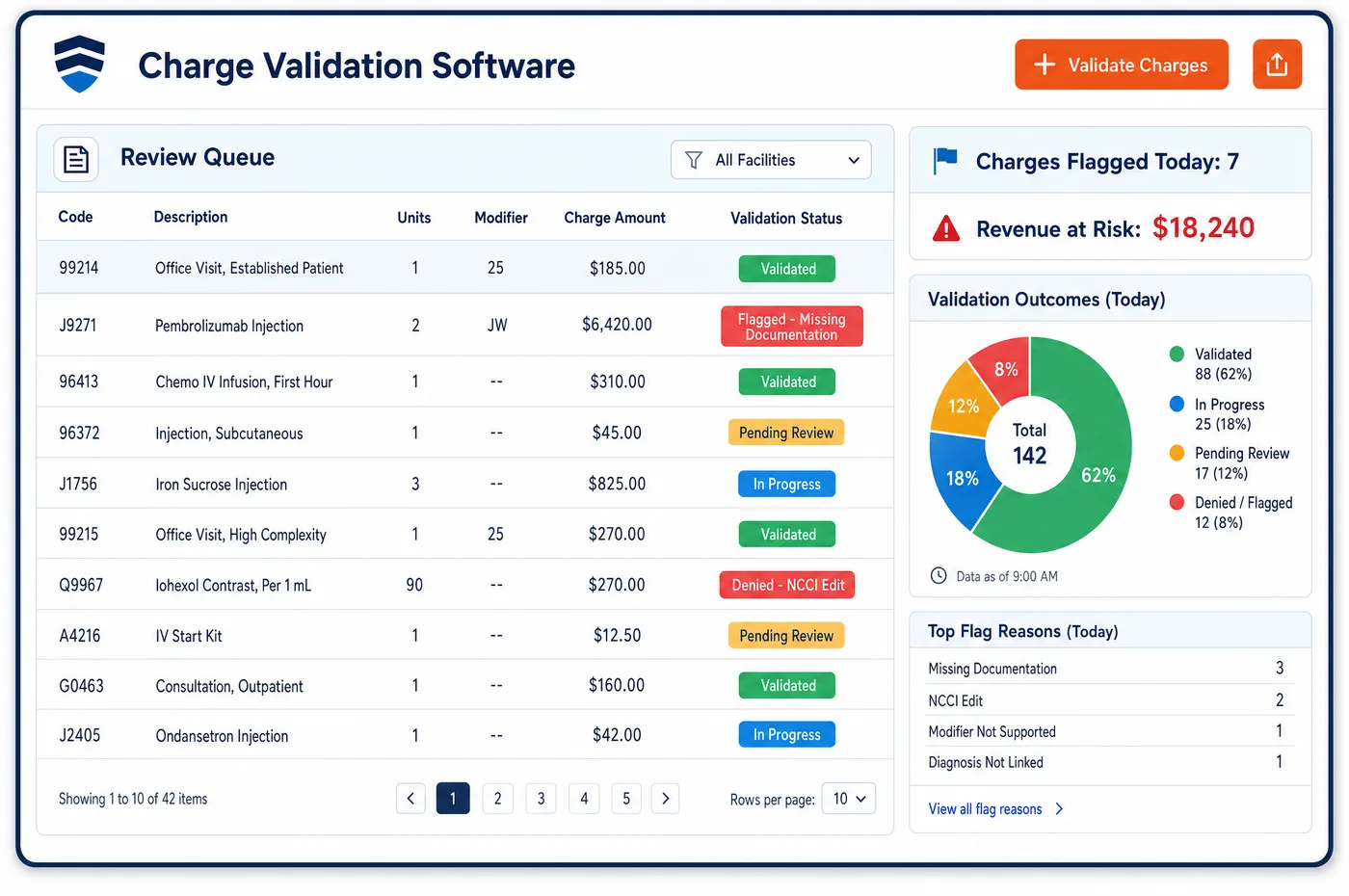
Charge Validation in a Oncology Practice
Validation in medical oncology is where a costly error is still cheap to fix. A charge set arrives from the treatment day with drug, waste, administration and visit lines. Each drug line is checked for units that match the dose, an NDC that matches the product, and a unit count under the MUE for that code. Waste lines are checked for JW only on single-dose containers, and drug lines without waste need JZ for Medicare. Administration codes are checked against documented times, so an add-on hour is billed only when the time supports it. NCCI pairs are checked across the claim, such as a port flush billed with an infusion. The diagnosis is checked against the payer's coverage article for that drug, and off-label uses are checked for compendia support. Finally, the drug, dose and date are compared with the approval on file. Oncology charge validation holds any line that fails, with the reason, so a coder can fix it before submission.
Why Is Charge Validation Different in Oncology?
Oncology charges carry more ways to fail than most. A single line can be wrong on units, NDC, modifier, diagnosis or approval, and any one of those can deny a drug that cost the practice a great deal. Many of these errors don't show up as clinical mistakes. They are math, rules and paperwork, which is why charge validation in oncology has to check each line, not just sample them.
The rules are also layered. Medicare sets NCCI pairs, MUEs and JW and JZ policy for Part B. Each MAC publishes coverage articles that tie drugs to diagnoses and doses. Commercial plans add their own preferred products, unit limits and approval terms. A charge can pass one payer's rules and fail another's, so validation has to know who is paying before it decides what is right.
Documentation has to back every code. Add-on hours depend on stop times, sequential codes depend on separate drugs, and an E/M with modifier 25 depends on a note that shows separate work. Validation compares the charge to the record behind it, not only to coding rules. A charge that is coded well but not documented will not survive an audit.
What Oncology Charge Validation Software Handles
- NCCI procedure-to-procedure edits
- NCCI bars separate billing of services that are part of another, such as a port flush with a drug administration service. Validation runs NCCI edits on every claim and holds pairs that need a modifier or should be dropped. (CMS NCCI Policy Manual for Medicare Services, Chapter XI, Section N (Chemotherapy Administration), revised 1/1/2026)
- Medically Unlikely Edits on drug codes
- An MUE caps the units of a HCPCS code that a provider would report for one patient on one day. High-dose drug lines over the MUE limit are held for review of the dose and the unit math. (CMS: Medicare NCCI Medically Unlikely Edits (MUEs))
- JW and JZ policy checks
- JW and JZ apply only to separately payable Part B drugs from single-dose containers or single-use packages. Validation checks the product type, so JW isn't used on a multi-dose vial and JZ isn't left off when no drug was thrown away. (CMS: Discarded Drugs and Biologicals, JW and JZ modifier policy)
- Coverage articles for drug and dose
- MAC billing articles tie a drug to its covered uses and say dose and frequency should follow the FDA label or a recognized compendium. If the drug is denied as not reasonable and necessary, its injection code is denied too, so both are checked as a pair. (CMS Medicare Coverage Database, Billing and Coding Article A52370: Bevacizumab and biosimilars)
- Compendia support for off-label use
- For Medicare, an off-label anticancer use is medically accepted when, for example, NCCN rates it Category 1 or 2A. Validation checks that support is on file before an off-label drug line goes out. (CMS Medicare Benefit Policy Manual, Chapter 15, Section 50.4.5: off-label use in an anti-cancer chemotherapeutic regimen)
- Add-on hour time check (96415)
- Code 96415 is billed only when the infusion runs more than 30 minutes past the first hour. Validation compares the documented start and stop times with the units billed, and holds lines the times don't support. (CMS Medicare Claims Processing Manual, Chapter 12, Section 30.5: Chemotherapy Administration and Nonchemotherapy Injections and Infusions)
How Does Oncology Charge Validation Software Work?
1. Receive the charge set
Charges arrive from oncology charge assembly with the infusion record attached. Each line keeps a link to the note, dose or time behind it.
2. Run coding edits
NCCI pairs, MUEs and modifier rules are checked across the whole claim. Failed lines are tagged with the rule that caught them.
3. Check drug detail
Units, NDC, product type and waste modifiers are checked for each drug line, using the rules for the JW and JZ modifiers.
4. Check coverage and approval
The diagnosis is checked against the payer's coverage rules for each drug. The drug, units and date are compared with the approval on file.
5. Route exceptions
Lines that fail go to a coder queue with the reason and the record attached. Repeat failures feed oncology denial management so the root cause is fixed.
Oncology Charge Validation Software vs. Generic Software
| Area | Generic approach | Unlimited Systems |
|---|---|---|
| Drug units | Checked only when a payer denies the line. | Compared with the dose, vial and MUE before submission. |
| Waste modifiers | JW added by habit, even on multi-dose vials. | JW and JZ checked against the product type. |
| Add-on time | Add-on hours billed from the planned regimen. | Add-on hours checked against documented stop times. |
| Coverage | Diagnosis checked against a generic list. | Diagnosis checked against the payer's coverage rules per drug. |
| Approvals | Approval assumed to cover any dose given. | Drug, units and date compared with the approval on file. |
Who Uses It in a Oncology Practice
- Oncology coder: A queue of only the lines that failed, each with the rule, the record and the fix in view.
- Compliance officer: Charges that match documentation, with a trail showing which edits ran and what was changed.
- Billing manager: Fewer drug denials for units, waste and approval mismatches, with repeat errors traced back to their cause.
Oncology Charge Validation Software FAQs
Charge validation checks that the HCPCS units match the dose given, the NDC matches the product, and the units fall under the MUE for that code. It checks the waste modifier against the vial type, the diagnosis against the payer's coverage rules, and the drug, units and date against the approval. Any line that fails is held for a coder.
Validation checks the product type for each drug. JW and JZ apply only to separately payable Part B drugs from single-dose containers or single-use packages. If JW is on a multi-dose vial, or a single-dose drug has neither JW waste nor JZ, the line is held so the coder can correct it before the claim goes to Medicare.
Validation compares the documented start and stop times with the administration units on the claim. Code 96415 needs more than 30 minutes beyond the first hour. If the times don't support the add-on, or a stop time is missing, the line is held and the nurse or coder is asked to check the record.
Each drug line is compared with the approval on file for that drug, its approved units and its date range. A dose above the approved amount, a date past the end date or a drug that was never approved is flagged before the claim leaves. Staff can then update the approval or correct the charge.
When a drug is used off-label in a cancer regimen, validation looks for compendia support on file, such as an NCCN Category 1 or 2A rating for Medicare. If none is attached, the line is held. The authorization team can then add the citation, which also helps if the payer later asks for records.
Charges that fail are routed to a coder queue with the rule that failed and the record behind the charge. The coder fixes the line or sends it back to the nurse for missing detail. Repeat failures are grouped by cause, so the practice can fix the template, order set or habit that keeps creating them.
Related Oncology Software
Billing & claims
In the revenue cycle
Charge Validation for related specialties
Sources
- CMS NCCI Policy Manual for Medicare Services, Chapter XI, Section N (Chemotherapy Administration), revised 1/1/2026
- CMS: Medicare NCCI Medically Unlikely Edits (MUEs)
- CMS: Discarded Drugs and Biologicals, JW and JZ modifier policy
- CMS Medicare Coverage Database, Billing and Coding Article A52370: Bevacizumab and biosimilars
- CMS Medicare Benefit Policy Manual, Chapter 15, Section 50.4.5: off-label use in an anti-cancer chemotherapeutic regimen
- CMS Medicare Claims Processing Manual, Chapter 12, Section 30.5: Chemotherapy Administration and Nonchemotherapy Injections and Infusions
GET STARTED
See Unlimited Systems in Action
Whether you're actively evaluating new technology or simply preparing for your next vendor renewal, Unlimited Systems can help you understand where your current workflows may be creating avoidable revenue risk.