

Billing & claims
Oncology Denial Management Software
Prevent, sort, appeal and trace oncology drug denials for approvals, units, NDCs, waste modifiers and medical necessity, starting with the costliest.
Oncology Denial Management Software finds the claims most likely to deny before they leave and works the ones that still do, starting with the costliest drug lines. It sorts denials by cause, such as missing approval, units, NDC or medical necessity, builds appeals with compendia and clinical support, and traces each cause back to the step that created it.



 6,500+ specialty providers

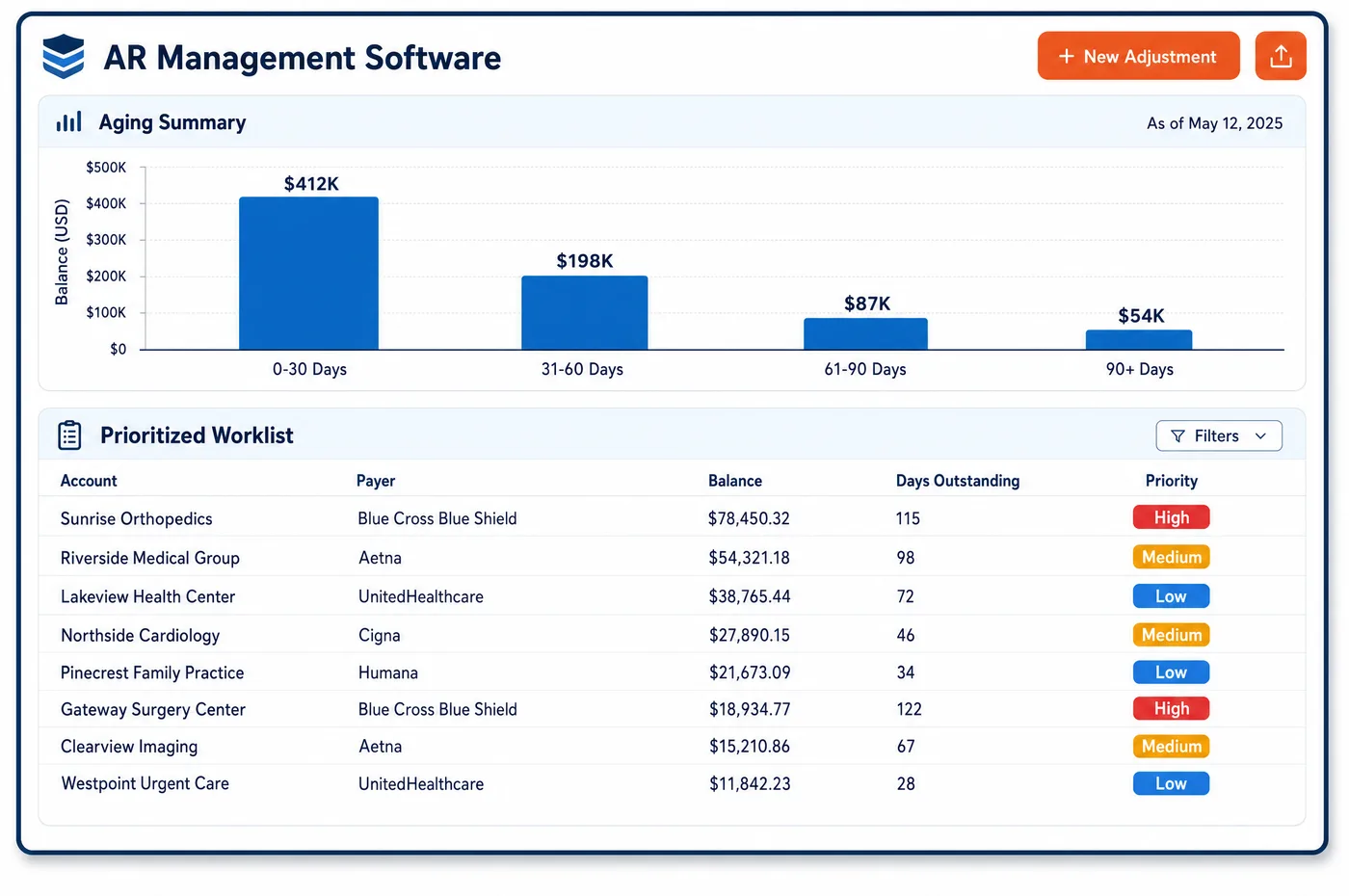
Denial Management in a Oncology Practice
Denials in medical oncology tend to fall into a few groups. Approval denials come when a drug was given without an approval, or with more units or later dates than the approval allowed. Coding denials come from units above an edit, a missing or invalid NDC, or a waste modifier that doesn't fit the vial. Coverage denials come when the diagnosis doesn't match the payer's policy, or an off-label use lacks support. Oncology denial management software reads the reason and remark codes on each remittance and sends each denial to the right queue. Drug denials worth the most, or closest to the filing limit, are worked first. Appeals pull the approval, the treatment plan, pathology, staging and the compendia citation behind the regimen. Before claims go out, the same patterns are used to flag new claims that look like ones that denied before. Over time, the reports show which payer, drug or step keeps causing trouble, so the fix happens upstream.
Why Is Denial Management Different in Oncology?
An oncology denial is rarely small. When a payer denies an infusion claim, the practice has already bought and given the drug, so it is out the full cost until the appeal is won. A backlog of drug denials is a cash problem, not just a workload problem. Denial management in oncology has to start with the claims that hold the most money and the least time.
Many oncology denials can be prevented, because they repeat. The same payer denies the same drug for the same missing approval detail, or the same NDC format, month after month. Working each denial alone fixes the claim but not the cause. Grouping denials by payer, drug, code and reason shows which front-end or coding step to change.
Appeals also need oncology-specific proof. A medical necessity denial on a regimen may be overturned with the compendia rating, the biomarker result and the guideline that supports it. A Medicare Advantage denial may call for a peer-to-peer talk between the oncologist and the plan's reviewer. The appeal packet has to pull those records together quickly, before the deadline at each level passes.
What Oncology Denial Management Software Handles
- Missing approval (CARC 197)
- A CARC 197 code signals that no precertification or authorization was on record. These denials are matched to the approval history for that drug, so staff can tell a true miss from an approval that was on file but not on the claim, a common CO-197 pattern. (X12: Claim Adjustment Reason Codes (CARC 50, 151, 197, 198))
- Approval exceeded (CARC 198)
- CARC 198 means the service went beyond what was precertified or authorized, such as extra units or dates past the end. The denial is shown next to the approved units and dates, so staff can ask for an update or a retro review. (X12: Claim Adjustment Reason Codes (CARC 50, 151, 197, 198))
- Units or frequency (CARC 151)
- CARC 151 means the payer found the information did not support that many units or that frequency. For Medicare drug lines, units are compared with the MUE and the documented dose to see whether a corrected claim or an appeal fits. (X12: Claim Adjustment Reason Codes (CARC 50, 151, 197, 198))
- Missing or invalid NDC (RARC M119)
- RARC M119 marks a missing, invalid or withdrawn NDC. These are routed as correctable errors, with the vial record attached, and the fix is logged so the NDC on file can be updated. (X12: Remittance Advice Remark Codes (M119))
- Medical necessity and compendia (CARC 50)
- CARC 50 means the payer did not deem the service a medical necessity. For Medicare, an off-label anticancer use backed by a listed compendium, such as an NCCN Category 1 or 2A rating, should not be denied for lack of FDA labeling alone, so appeals cite it. (CMS Medicare Benefit Policy Manual, Chapter 15, Section 50.4.5: off-label use in an anti-cancer chemotherapeutic regimen)
- Drug denial reasons under CMS-0057-F
- The federal rule that makes payers give a specific reason for prior authorization denials does not apply to drugs. Staff may need to ask the plan for the full reason on a drug approval denial before they appeal. (CMS fact sheet: Interoperability and Prior Authorization Final Rule (CMS-0057-F))
How Does Oncology Denial Management Software Work?
1. Flag risk before submission
New claims are checked against patterns from past denials, such as a payer that keeps denying one drug's units. Claims that match are held with the reason so a biller can fix them.
2. Sort denials as they post
Reason and remark codes from each remittance route the denial to a queue: approvals, coding, coverage or eligibility. Each denial shows its dollar value and filing limit.
3. Work the costliest first
Drug denials with the most money at stake or the closest deadline rise to the top. Correctable errors are fixed and resent, and the rest move to appeal.
4. Build the appeal
The packet pulls the approval, treatment plan, pathology, staging, compendia citation and notes. Staff track each Medicare appeal level or plan appeal step, and a peer-to-peer review is set up when a plan offers one.
5. Fix the cause upstream
Denials are grouped by payer, drug, code and reason. Approval gaps go back to oncology financial clearance, and coding gaps go back to charge validation.
Oncology Denial Management Software vs. Generic Software
| Area | Generic approach | Unlimited Systems |
|---|---|---|
| Work order | Denials worked oldest first, whatever the value. | Costliest drug denials and nearest deadlines first. |
| Sorting | One general queue for all denials. | Queues by cause, set by reason and remark codes. |
| Appeals | Each appeal packet assembled by hand. | Approval, plan, pathology and compendia pulled into the packet. |
| Repeat denials | Fixed claim by claim, again and again. | Grouped by payer, drug and reason, then fixed upstream. |
| Prevention | Denials seen only after the payer says no. | New claims checked against past denial patterns first. |
Who Uses It in a Oncology Practice
- Denial specialist: Queues sorted by cause and value, with the records for each appeal already gathered.
- Authorization lead: A list of approval denials by payer and drug, showing where requests or updates keep falling short.
- Practice owner: A view of drug dollars tied up in denials, and which causes are shrinking after fixes upstream.
Oncology Denial Management Software FAQs
Denial management in oncology centers on drug claims. Common causes are missing or exceeded approvals, units over an edit or the documented dose, missing or invalid NDCs, waste modifier errors and diagnoses that don't meet the payer's coverage policy. Because each denied line can be costly, these are sorted by cause and worked in order of value and deadline.
Each denial shows its dollar value and the time left to appeal or correct it. Drug denials with the most money at stake and the nearest deadlines are moved to the top of the queue. Lower-value denials are still worked, but staff time goes first to the claims the practice can least afford to lose.
An oncology appeal packet usually includes the approval or request history, the signed treatment plan, pathology and staging, biomarker results, the notes for the treatment day and the compendia or guideline support for the regimen. Pulling these together from the record saves time, so appeals go out well before the deadline.
Many oncology denials repeat, so new claims are checked against patterns from past denials before they are sent. A claim that looks like ones that denied before, such as the same payer, drug and unit count, is held with the reason. A biller can fix it first, which avoids the denial and the delay.
For Medicare, an off-label anticancer use should not be denied only because it is not on the FDA label if a listed compendium supports it. Appeals cite that support, such as an NCCN Category 1 or 2A rating, with the pathology and biomarker results. Commercial plans may follow their own policies, so the plan's criteria are attached too.
Root-cause reports group denials by payer, drug, code and reason. They show, for example, that one plan keeps denying a drug for an approval detail, or that NDC errors come from one site. The practice can then fix the request template, the charge rule or staff training, so the same denial stops coming back.
Related Oncology Software
Billing & claims
In the revenue cycle
Denial Management for related specialties
Sources
- X12: Claim Adjustment Reason Codes (CARC 50, 151, 197, 198)
- X12: Remittance Advice Remark Codes (M119)
- CMS: Medicare NCCI Medically Unlikely Edits (MUEs)
- CMS Medicare Benefit Policy Manual, Chapter 15, Section 50.4.5: off-label use in an anti-cancer chemotherapeutic regimen
- CMS fact sheet: Interoperability and Prior Authorization Final Rule (CMS-0057-F)
GET STARTED
See Unlimited Systems in Action
Whether you're actively evaluating new technology or simply preparing for your next vendor renewal, Unlimited Systems can help you understand where your current workflows may be creating avoidable revenue risk.