

Front office
Oncology Financial Clearance Software
Verify benefits, authorize each regimen, check step therapy and compendia support, estimate drug coinsurance and line up copay help before the first cycle.
Oncology Financial Clearance Software confirms that a cancer regimen is covered and affordable before the drugs are mixed. It verifies medical and pharmacy benefits, files prior authorization for each drug, checks step therapy and compendia support, and estimates what the patient will owe. Counselors then match the patient to copay help that fits their coverage.



 6,500+ specialty providers

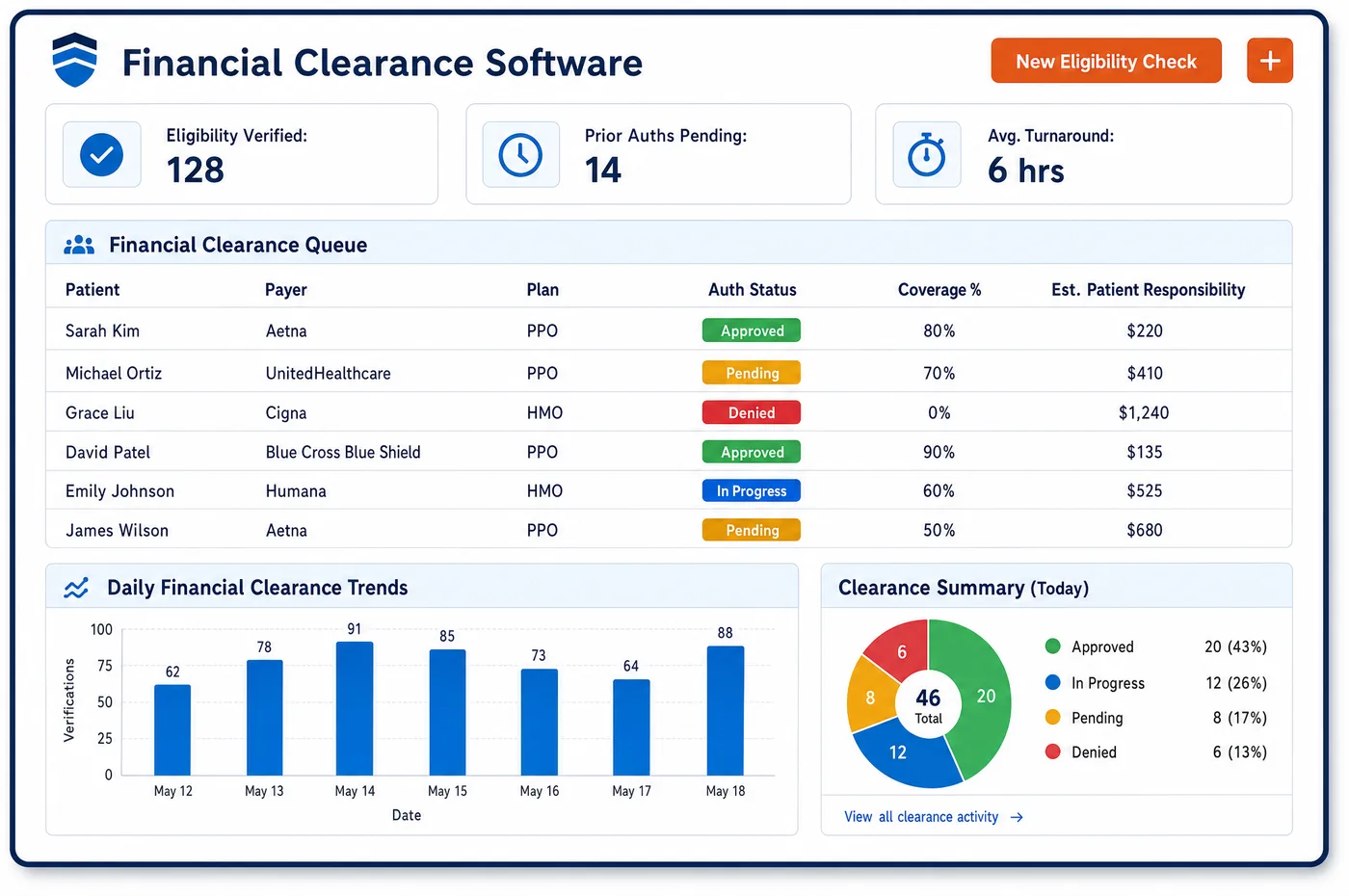
Financial Clearance in a Oncology Practice
Clearance for medical oncology starts when the oncologist signs a treatment plan. Staff run eligibility on each plan and confirm which drugs bill to the medical benefit and which go through a specialty pharmacy. For each infused drug, they check whether the plan needs approval, what it covers and for how many doses. An approval request goes out with the diagnosis, stage, biomarker results and the guideline that backs the regimen. If the plan wants a biosimilar or another drug tried first, the request has to match. Oncology financial clearance software tracks each request, its status and its end date against the cycle calendar. It holds a treatment visit whose approval is pending or about to lapse. Once approvals are in, the patient's share is estimated from the plan's benefits and the drug's allowed amount. A financial counselor then reviews that estimate with the patient and looks for help the patient can lawfully use.
Why Is Financial Clearance Different in Oncology?
Few specialties put this much money at risk before a single claim is sent. The practice buys the drug, mixes it and gives it, then waits to be paid. If the approval was missing, covered the wrong drug or ran out after the third cycle, the drug cost may never come back. Clearance is the step where an oncology practice protects its largest expense.
Coverage rules are also tied to the regimen, not just the patient. A payer may approve a drug only for one stage or biomarker. It may want a preferred biosimilar, or apply step therapy to a new start. For Medicare, off-label anticancer use depends on support in a listed compendium such as NCCN. Each drug in a combination can have its own answer, so financial clearance works drug by drug.
Then there is the patient's share, which can be large on Part B drugs and on oral agents. Help comes from several places, and the rules differ by payer type. Manufacturer copay coupons are off limits for patients on federal programs, while independent charities may help them. Clearance has to sort out what the patient owes and which help fits before the first cycle, not after the first statement.
What Oncology Financial Clearance Software Handles
- Compendia support for off-label regimens
- Medicare should not deny an off-label anticancer use that a listed compendium supports, such as an NCCN Category 1 or 2A rating. Staff attach the compendium citation to the approval request and keep it for appeals. Category 3 uses are not medically accepted. (CMS Medicare Benefit Policy Manual, Chapter 15, Section 50.4.5: off-label use in an anti-cancer chemotherapeutic regimen)
- Medicare Advantage step therapy for Part B drugs
- Medicare Advantage plans may apply step therapy to Part B drugs only for new starts. The plan's pharmacy and therapeutics committee must approve the program first. Clearance checks the plan's step rules before a new drug starts, including any preferred biosimilar. (42 CFR 422.136: Medicare Advantage and step therapy for Part B drugs)
- Prior authorization rule scope (CMS-0057-F)
- The CMS prior authorization rule sets decision and denial-reason duties for Medicare Advantage, Medicaid, CHIP and exchange plans. It does not apply to drugs. Drug approvals still follow each plan's own process, so staff track them by plan. (CMS fact sheet: Interoperability and Prior Authorization Final Rule (CMS-0057-F))
- Reduced Part B coinsurance on rebatable drugs
- Under the Medicare inflation rebate program, some Part B drugs carry a lower coinsurance in a given quarter. CMS now lists those amounts in the quarterly ASP files, so estimates use the current quarter's coinsurance for each drug. (CMS: Medicare Inflation Rebate Program (Part B coinsurance adjustments))
- Manufacturer copay coupons
- OIG says copay coupons implicate the anti-kickback statute when a federal program such as Medicare Part D pays for the drug. Counselors offer coupons only to patients with commercial coverage and point federal patients to other options. (HHS-OIG Special Advisory Bulletin: Pharmaceutical Manufacturer Copayment Coupons (September 2014))
- Independent charity assistance
- OIG's supplemental bulletin explains when independent charities may help federal program patients. It also warns about funds tied too closely to one donor's drugs. Counselors record each grant, its end date and the drugs it covers in the patient assistance program file. (Federal Register: OIG Supplemental Special Advisory Bulletin, Independent Charity Patient Assistance Programs (2014))
- Medicare Prescription Payment Plan for oral drugs
- All Part D plans must offer the Medicare Prescription Payment Plan, which spreads a patient's out-of-pocket drug costs into monthly payments. For a costly oral cancer drug, counselors explain this option along with charity help. (CMS: Medicare Prescription Payment Plan)
How Does Oncology Financial Clearance Software Work?
1. Verify benefits on each plan
A 270/271 check runs on every plan on file. Staff confirm which drugs bill to the medical benefit and which go to a specialty pharmacy.
2. Build the approval request
Each drug in the regimen is checked for approval rules. The request carries the diagnosis, stage, biomarkers, dose and compendia support, and goes out by electronic prior authorization where the payer accepts it.
3. Match approvals to the cycle calendar
Approved drugs, units and dates are tied to the cycles they cover. A treatment visit is held on the oncology infusion schedule when its approval is pending or ending.
4. Estimate the patient's share
The estimate uses the plan's deductible, coinsurance and out-of-pocket limit with each drug's allowed amount. Patients paying for themselves receive a good faith estimate.
5. Find help that fits the coverage
Counselors screen for manufacturer programs, open charity funds and payment plans that suit the patient's payer type. Approved help is recorded so it can be applied when the bill comes.
Oncology Financial Clearance Software vs. Generic Software
| Area | Generic approach | Unlimited Systems |
|---|---|---|
| Approvals | One approval tracked per patient, not per drug. | Each drug's approval, units and dates tied to the cycles it covers. |
| Expiring approvals | Discovered only after a claim denies. | Treatment visit held when an approval is pending or ending. |
| Off-label regimens | Compendia support looked up after a denial. | Compendia citation attached to the first request. |
| Patient estimates | Patients learn their share from the first statement. | Share estimated from benefits and allowed amounts before the first cycle. |
| Copay help | Coupons offered to every patient alike. | Help matched to payer type, with coupons kept to commercial patients. |
Who Uses It in a Oncology Practice
- Authorization specialist: One queue of approval requests by drug and plan, with end dates checked against the cycle calendar.
- Financial counselor: Estimates built from current benefits and drug amounts, plus a screen of help each patient can lawfully use.
- Practice owner: Fewer drugs given without coverage, and fewer write-offs on the practice's costliest purchases, tracked in oncology RCM reporting.
Oncology Financial Clearance Software FAQs
Financial clearance for a chemotherapy regimen checks each drug on its own. Staff confirm the benefit each drug bills to, file approvals with the diagnosis, stage and guideline support, and tie each approval to the cycles it covers. The patient's share is then estimated, and a counselor looks for help that fits the patient's coverage before treatment starts.
Combination regimens mix drugs that payers treat in different ways. One drug may need approval, another may need a preferred biosimilar, and a third may be covered without review. Tracking each drug, its approved units and its end date keeps one lapsed approval from turning a whole treatment day into a denied claim.
Manufacturer copay coupons should not be used when Medicare or another federal program pays for the drug. OIG says that use implicates the anti-kickback statute. Counselors use them for patients with commercial coverage. Federal program patients may qualify for independent charity help or, for oral drugs, the Medicare Prescription Payment Plan.
When a plan prefers a biosimilar or applies step therapy, clearance flags it before the first dose. The oncologist can switch to the preferred product or ask for an exception with supporting records. Medicare Advantage plans may apply step therapy to Part B drugs only for new starts, so patients already on a drug are treated differently.
The CMS prior authorization rule sets decision and denial-reason duties for several payer types. It excludes drugs. Approvals for infused cancer drugs still follow each payer's own process and timelines. That is why drug requests are tracked by plan, with follow-up when a decision is slow.
Estimates for infused drugs combine the plan's deductible, coinsurance and out-of-pocket limit with the allowed amount for each drug and service. For Medicare, a few Part B drugs carry reduced coinsurance in a given quarter under the inflation rebate program. The counselor reviews the estimate with the patient and notes any help that applies.
Related Oncology Software
Front office
In the revenue cycle
Financial Clearance for related specialties
Sources
- CMS Medicare Benefit Policy Manual, Chapter 15, Section 50.4.5: off-label use in an anti-cancer chemotherapeutic regimen
- 42 CFR 422.136: Medicare Advantage and step therapy for Part B drugs
- CMS fact sheet: Interoperability and Prior Authorization Final Rule (CMS-0057-F)
- CMS: Medicare Inflation Rebate Program (Part B coinsurance adjustments)
- HHS-OIG Special Advisory Bulletin: Pharmaceutical Manufacturer Copayment Coupons (September 2014)
- Federal Register: OIG Supplemental Special Advisory Bulletin, Independent Charity Patient Assistance Programs (2014)
- CMS: Medicare Prescription Payment Plan
GET STARTED
See Unlimited Systems in Action
Whether you're actively evaluating new technology or simply preparing for your next vendor renewal, Unlimited Systems can help you understand where your current workflows may be creating avoidable revenue risk.