

Payments & AR
Oncology Payment Posting Software
Post every drug, waste, administration and visit line, and check each Part B drug payment against its quarterly ASP limit and your cost.
Oncology Payment Posting Software applies ERA payments to every line of an infusion claim: the drug, the JW waste line, each administration code and the visit. It compares drug payments with the expected rate and the practice's cost, so a drug paid below what the practice paid for it is caught as the remittance posts.



 6,500+ specialty providers

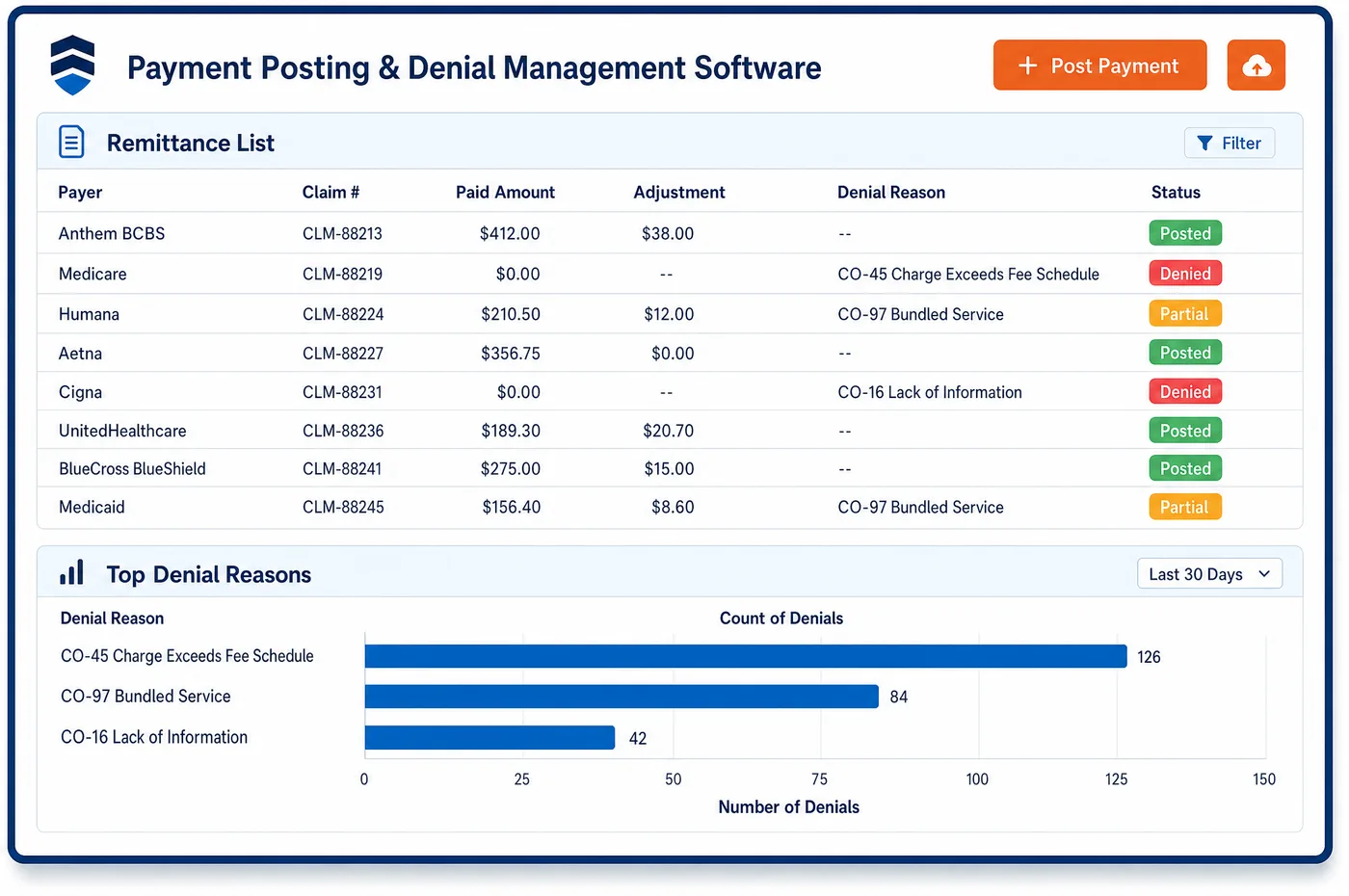
Payment Posting in a Oncology Practice
A medical oncology remittance is long. One infusion visit can carry a chemotherapy drug, a separate JW line for the unused part of a single-dose vial, antiemetics, hydration, the initial and sequential administration codes, and an office visit. Each line is paid, cut or denied on its own. Oncology payment posting software reads the 835, matches each line to the charge it pays, and books contractual adjustments, sequestration and patient amounts. Drug lines are checked against the expected rate. Under Medicare Part B that is the payment limit from the quarterly ASP file, and for a commercial plan it is the contract. Lines paid short go to a follow-up list, and denials go to oncology denial management with the reason code attached. Medigap crossovers are tracked so the second payment posts against the same line. Deposits are matched to the ERA, and the totals flow to the general ledger.
Why Is Payment Posting Different in Oncology?
Drugs drive both revenue and cost in a medical oncology practice. The practice buys the drug, gives it, and then waits to be paid, so every drug line is a margin question. A payment that looks right in total can hide one drug paid at an old rate or one waste line denied. Posting at the claim level misses that. Posting by line, and checking each drug against its rate as it posts, finds it while the claim can still be fixed.
Medicare remittances add their own pieces. Payment on Part B lines is cut by sequestration, shown as CARC 253, which is expected and should not be worked as an underpayment. The JW line for discarded drug is paid or denied apart from the administered line. If the practice is in the Enhancing Oncology Model, monthly M0010 payments for enhanced services arrive on their own lines, and each has to land on the right patient and month.
Then there is the secondary. Many Medicare patients on chemotherapy carry a Medigap or other supplement to cover Part B coinsurance on costly drugs. Claims often cross over to the supplement on their own, so the second payment comes on a different remittance. Posting has to tie it back to the original line, close the coinsurance, and only then move what is left to the patient through patient billing.
What Oncology Payment Posting Software Handles
- Sequestration adjustments (CARC 253)
- Medicare lines reduced by sequestration carry CARC 253. Posting rules book it as an expected adjustment, so staff aren't sent to chase a cut that every Medicare claim takes. (X12 Claim Adjustment Reason Codes (CARC 253: Sequestration, reduction in federal payment))
- JW discarded-drug lines
- When a single-dose vial is only partly used, Medicare Part B wants the discarded amount on its own line with the JW modifier. Posting keeps that line separate, so a denied waste line shows up instead of hiding inside the drug total. (CMS: Discarded Drugs and Biologicals (JW and JZ modifiers))
- EOM monthly payments (M0010)
- Practices in the Enhancing Oncology Model bill M0010 for each attributed patient each month. CMS told MACs to pay these lines whether or not the patient is an inpatient, so an M0010 line denied for an inpatient stay is routed for review. (CMS Transmittal R12480DEMO: Payment of M0010 EOM MEOS Claims for Beneficiaries Receiving Care in an Inpatient Setting)
- Medigap crossover payments
- Medicare sends many claims straight to supplemental insurers under the Coordination of Benefits Agreement. The crossover payment is matched to the line Medicare already paid, closing the coinsurance before any balance moves to the patient. (CMS: Coordination of Benefits Agreement (claims crossover))
- Provider-level adjustments (PLB)
- A Medicare check equals the claim payments less any provider-level adjustments, and each 835 must balance at the line, claim and provider level. Provider-level entries post on their own, so the deposit still ties out to the remittance. (Medicare Claims Processing Manual, Chapter 22: Remittance Advice)
- ASP payment limits for drug lines
- Most separately payable Part B drugs are paid at a limit based on the average sales price, which CMS publishes each quarter. Each drug line is compared with the limit for its HCPCS code and date of service, and short pays are flagged. (CMS: Medicare Part B Drug Average Sales Price)
How Does Oncology Payment Posting Software Work?
1. Import the 835
ERAs from Medicare, Medicare Advantage, Medicaid and commercial plans load as they arrive. Each one is matched to the claims it pays, down to the line.
2. Post each line with its codes
Payments, contractual adjustments, sequestration and patient amounts post to the drug, waste, administration and visit lines. The CARC and RARC codes stay attached to each adjustment.
3. Check drugs against rate and cost
Every drug line is compared with its expected rate and the practice's purchase cost. Lines paid short, or paid below cost, are flagged for the billing team and for oncology accounting.
4. Route denials and short pays
Denied lines go to the right queue with the reason code, such as a missing authorization or a unit question. Underpaid lines go to a follow-up list with the expected amount shown.
5. Post the secondary and reconcile
Crossover and secondary payments post against the same lines, and any remaining balance moves to the patient. Deposits are matched to ERAs, and out-of-balance entries are flagged before the day closes.
Oncology Payment Posting Software vs. Generic Software
| Area | Generic approach | Unlimited Systems |
|---|---|---|
| Drug line checks | Payments posted in bulk with no rate check. | Each drug line checked against its ASP limit or contract rate. |
| Waste lines | JW lines lumped in with the drug total. | JW lines posted and tracked on their own. |
| Sequestration | CARC 253 cuts worked as underpayments. | Sequestration booked as an expected Medicare adjustment. |
| Crossovers | Medigap payments posted to the account, not the line. | Crossover payments tied back to the original Medicare line. |
| Deposits | ERA and bank totals compared at month end. | Deposits matched to ERAs, with out-of-balance entries flagged. |
Who Uses It in a Oncology Practice
- Payment poster: Remittances that post line by line, with sequestration, waste lines and crossovers handled by rule, so only real exceptions need a person.
- Billing manager: A daily list of drug lines paid short or denied, with the expected amount, ready to hand to AR follow-up.
- Practice administrator: Drug payments compared with cost as they post, so a margin problem on one drug or payer is seen early rather than at year end.
Oncology Payment Posting Software FAQs
Payment posting treats the administered drug and the discarded amount as two lines. The administered line posts with its own payment and adjustments, and the JW line posts on its own. If Medicare pays one and denies the other, the denied waste line goes to follow-up instead of being buried in a net total for the drug.
The payment limit in the quarterly ASP file is only the starting point. The patient's deductible and coinsurance come off, and sequestration cuts the Medicare payment, which the remittance shows as CARC 253. The software books sequestration as an expected adjustment, so staff only look at drug lines that are short for some other reason.
Each drug payment can be compared with the practice's purchase cost for that drug as it posts. When a payer pays less than the drug cost, the line is flagged with the payer and HCPCS code. Over time the flags show which drugs and contracts lose money, which helps in payer talks and in buying decisions.
Medicare sends many claims straight to the patient's Medigap plan through the crossover process. When the supplement pays, its payment is matched to the same lines Medicare paid, closing the coinsurance it covers. Only the amount left after both payers moves to the patient's balance, so patients are not billed for amounts their supplement will pay.
Practices in the Enhancing Oncology Model bill M0010 each month for each attributed patient. Those payments post to the patient and month they cover. CMS has told its contractors to pay M0010 even when the patient is in the hospital, so an M0010 line denied for an inpatient stay is sent for review and correction.
Deposits are matched to the ERAs they belong to, including provider-level adjustments. When a deposit and its remittance don't agree, the entry is flagged before the day is closed. Posted payments and adjustments then flow to the general ledger as balanced entries, so finance and billing staff work from the same numbers.
Related Oncology Software
Payments & AR
In the revenue cycle
Payment Posting for related specialties
Sources
- X12 Claim Adjustment Reason Codes (CARC 253: Sequestration, reduction in federal payment)
- CMS: Discarded Drugs and Biologicals (JW and JZ modifiers)
- CMS Transmittal R12480DEMO: Payment of M0010 EOM MEOS Claims for Beneficiaries Receiving Care in an Inpatient Setting
- CMS: Coordination of Benefits Agreement (claims crossover)
- Medicare Claims Processing Manual, Chapter 22: Remittance Advice
- CMS: Medicare Part B Drug Average Sales Price
GET STARTED
See Unlimited Systems in Action
Whether you're actively evaluating new technology or simply preparing for your next vendor renewal, Unlimited Systems can help you understand where your current workflows may be creating avoidable revenue risk.