

Payments & AR
Oncology AR Management Software
Work open oncology claims by drug value, payer and filing deadline, from Medicare Part B lines to commercial immunotherapy claims.
Oncology AR Management Software ranks every open insurance balance by value, age, payer and filing deadline, so a high-cost immunotherapy claim is worked before a small visit balance. It checks claim status in bulk, files secondaries once the primary pays, and shows each collector the claims most at risk of aging out.



 6,500+ specialty providers

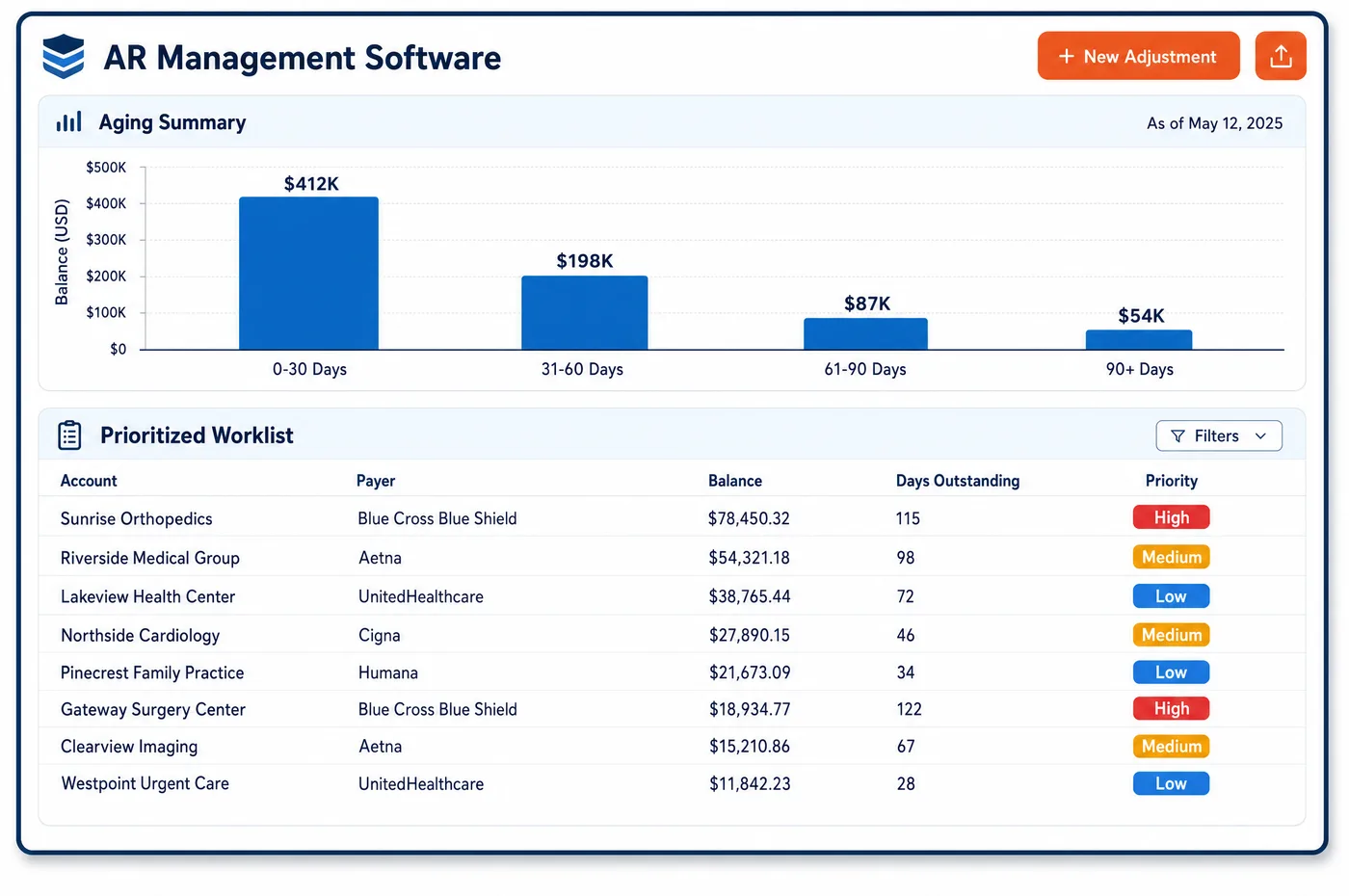
AR Management in a Oncology Practice
Open AR in medical oncology is lumpy. A few drug claims hold most of the dollars, and each has its own deadline and payer rules. AR management software for oncology builds the worklist from the claim data rather than the age column. Each claim carries its value, payer, aging bucket and the date it must be filed or appealed by. Bulk 276 status checks run against the payers, so collectors start from the payer's answer instead of a phone queue. A claim pending for records, denied for authorization, or paid with no secondary filed goes to its own queue with its own next step. Medicare's timely filing limit for most claims is one calendar year after the date of service, and commercial plans set their own limits in their contracts. The software tracks each one by payer, so a costly claim is not lost to the calendar.
Why Is AR Management Different in Oncology?
Value is packed into few claims. One infusion claim for an immunotherapy drug can be worth more than a full week of office visits. A worklist sorted by age puts it next to a small copay balance, and both get the same attention. In oncology, AR management has to rank by what is at stake, so the claim that would hurt most if lost is worked first.
Drug claims also stall for reasons other specialties see less often. A Medicare Advantage plan may hold a claim while it checks the regimen given against the approval. A commercial plan may ask for the treatment plan or pathology before it pays for an off-label use. Medicare may deny a line for units above an edit. Each needs a different fix, and each fix has to land before the payer's filing or appeal window closes, or the work moves to denial management for oncology.
Secondary balances are large too. Part B coinsurance on a costly drug can be a big number, and for many Medicare patients a supplement owes it, not the patient. When the primary pays, that secondary claim has to go out at once and be watched like any other. Practices that let secondaries sit end up billing patients for amounts a supplement would have paid, or writing them off.
What Oncology AR Management Software Handles
- Medicare timely filing (one calendar year)
- Medicare claims must generally be filed within one calendar year after the date of service, under 42 CFR 424.44. The worklist shows the filing date for every unbilled or rejected Medicare claim, so corrected claims go out in time. (Medicare Claims Processing Manual, Chapter 1, Section 70: Time Limitations for Filing Part A and Part B Claims)
- Off-label regimens and compendia
- Medicare Part B covers off-label anticancer uses supported by listed compendia, such as an NCCN Category 1 or 2A rating, or by peer-reviewed literature. Claims pending or denied on this point are routed with the regimen, so staff can attach the compendia support. (Medicare Benefit Policy Manual, Chapter 15, Section 50.4.5: Off-Label Use of Drugs and Biologicals in an Anti-Cancer Chemotherapeutic Regimen)
- Authorization denials (CARC 197)
- CARC 197 means precertification or authorization was absent. On drug claims it often means the drug, dose or dates billed don't match the approval on file. These claims go to a queue that shows the approval and the treatment record side by side. (X12 Claim Adjustment Reason Codes (CARC 197: Precertification/authorization absent))
- Unit edits on drug lines (MUEs)
- Medicare MUEs set the most units a claim can report for a HCPCS code on one date of service. A drug line denied for units is flagged with the dose given and the billing unit, so staff can see whether the claim needs a fix or an appeal. (CMS: Medicare NCCI Medically Unlikely Edits)
- EOM M0010 months after hospice or death
- Under the Enhancing Oncology Model, M0010 is billed for each month of the episode unless the patient elects hospice or dies. M0010 balances for months after those events are flagged for reversal, not chased as unpaid. (CMS Transmittal R12480DEMO: Payment of M0010 EOM MEOS Claims (billing for each month of the episode unless the beneficiary elects hospice or dies))
How Does Oncology AR Management Software Work?
1. Build the worklist from value and deadline
Each open claim is sorted by balance, payer, aging bucket and its filing or appeal date. Collectors see the costly, close-to-deadline claims at the top of their list.
2. Check status in bulk
Bulk 276 status requests return the payer's 277 answer before anyone calls. Claims that are paid, pending or denied are sorted into their own queues.
3. Route by reason
Claims pending for records go to staff who can pull the treatment plan and pathology. Authorization and unit problems go to their own oncology work queues with the source documents attached.
4. File the secondary at once
When the primary ERA posts, the secondary or patient amount is worked out and the secondary claim is sent. Secondary claims then age on their own line in the worklist.
5. Escalate before the window closes
Claims near a filing or appeal limit are raised to a lead. Repeat payer problems are logged, so the billing manager can take them up with the payer or in contract talks.
Oncology AR Management Software vs. Generic Software
| Area | Generic approach | Unlimited Systems |
|---|---|---|
| Sort order | Oldest claims first, whatever their value. | Sorted by value, payer and filing deadline. |
| Status checks | Calling payers or checking portals claim by claim. | Bulk 276 requests, with 277 answers sorted into queues. |
| Secondaries | Filed by hand when someone notices. | Sent when the primary remittance posts. |
| Filing limits | One limit assumed for every payer. | Each payer's limit tracked on every claim. |
| Records requests | Answered with whatever notes are at hand. | Treatment record, approval and coverage criteria gathered with the claim. |
Who Uses It in a Oncology Practice
- Collector: A worklist that starts with the claims worth the most and closest to a deadline, with payer status already checked.
- Billing manager: Aging by payer, bucket and reason, with repeat payer problems logged, plus AR trends in oncology analytics that show which payers slow cash.
- Physician owner: Fewer drug claims lost to filing limits, which matters most when the practice paid for the drug before it was given.
Oncology AR Management Software FAQs
AR management ranks each open claim by balance, payer, aging bucket and the date it must be filed or appealed by. A large immunotherapy claim near its deadline rises to the top, while a small visit balance waits. Collectors work the list in that order, and the ranking updates as payments post and status checks return.
Medicare generally requires claims to be filed within one calendar year after the date of service, with a few exceptions set out in the claims manual. Commercial and Medicare Advantage plans set their own limits in their contracts, and many are shorter. The software tracks the limit for each payer on each claim, so staff can see what is close.
Medicare Part B covers off-label anticancer uses supported by listed compendia or by peer-reviewed literature. For NCCN, a Category 1 or 2A rating counts and Category 3 does not. When a claim pends or is denied for medical necessity, staff attach the regimen, pathology and compendia support, and the claim is tracked until it is paid or appealed.
Bulk 276 claim status requests go to the payers, and the 277 replies come back with the status of each claim. Paid, pending and denied claims are sorted into their own queues. Collectors call only when the electronic reply is not enough, such as a long pend with no reason given.
When the Medicare remittance posts, the remaining coinsurance is worked out and the secondary claim is sent, unless Medicare already crossed it over to the supplement. The secondary then ages on its own line. If the supplement doesn't pay, the claim comes up on the worklist like any other open balance.
A drug line denied for units is flagged with the dose given, the vial sizes used and the billing unit of the HCPCS code. Staff check whether the units were billed right. If the claim is wrong it is corrected, and if the units were right but exceed a Medicare MUE, staff decide with the billing manager whether to appeal.
Related Oncology Software
Payments & AR
In the revenue cycle
AR Management for related specialties
Sources
- Medicare Claims Processing Manual, Chapter 1, Section 70: Time Limitations for Filing Part A and Part B Claims
- Medicare Benefit Policy Manual, Chapter 15, Section 50.4.5: Off-Label Use of Drugs and Biologicals in an Anti-Cancer Chemotherapeutic Regimen
- X12 Claim Adjustment Reason Codes (CARC 197: Precertification/authorization absent)
- CMS: Medicare NCCI Medically Unlikely Edits
- CMS Transmittal R12480DEMO: Payment of M0010 EOM MEOS Claims (billing for each month of the episode unless the beneficiary elects hospice or dies)
GET STARTED
See Unlimited Systems in Action
Whether you're actively evaluating new technology or simply preparing for your next vendor renewal, Unlimited Systems can help you understand where your current workflows may be creating avoidable revenue risk.