

Billing & claims
Oncology Medical Billing Software
Build, scrub, submit and track infusion claims with drug lines, NDCs, waste modifiers and administration codes that each payer will accept.
Oncology Medical Billing Software turns a cancer treatment day into a clean professional claim. It builds drug lines with HCPCS units and NDC detail, adds JW or JZ for single-dose vials, pairs administration codes with the right E/M, and scrubs the claim before it goes to the clearinghouse. It then tracks each claim to payment.



 6,500+ specialty providers

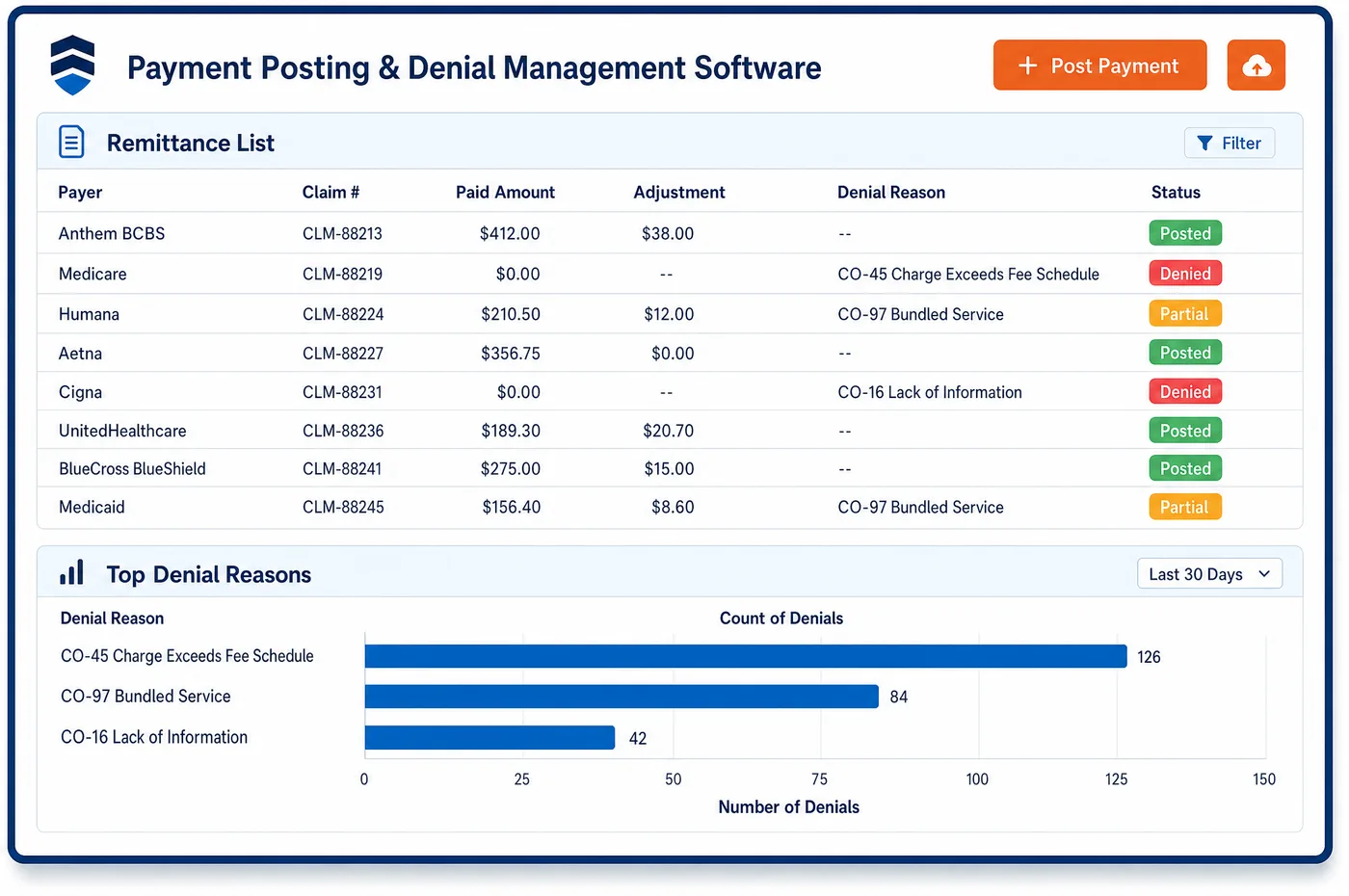
Medical Billing in a Oncology Practice
A single infusion claim in medical oncology can carry many lines. There may be an E/M visit with modifier 25, a first-hour chemotherapy code, add-on hours, a sequential drug, a push of an antiemetic, and the drugs themselves, each with HCPCS units. Medicaid and many commercial plans also want the NDC on each drug line, with its own quantity and unit of measure. Discarded drug from a single-dose vial needs its own JW line for Medicare. Oncology medical billing software builds that claim from validated charges and runs payer edits before it leaves. Errors such as a missing NDC, units over an MUE or two initial codes without a modifier are held for a fix. Clean claims go out as 837P files through the clearinghouse. Acknowledgments and status replies come back and update each claim. Secondary claims go to the supplement or Medicaid once the primary pays, so drug coinsurance is not left behind.
Why Is Medical Billing Different in Oncology?
Oncology claims are long, costly and full of rules that interact. The administration codes follow a hierarchy, the drug lines depend on dose and vial size, and payer rules decide whether an NDC, a waste line or a biosimilar code is needed. One mistake on one line can hold up payment for a whole treatment day worth far more than a typical office claim.
Payers also differ on drug detail more than in most fields. Medicare Part B wants JW or JZ on single-dose drugs. Medicaid programs collect NDCs to bill manufacturer rebates, and some states set exact NDC formats. Commercial plans may want their preferred biosimilar code. Medical billing for oncology has to apply the right rule set for each payer on each line.
Secondary billing matters more here, too. Many patients have Medicare with a Medigap plan or Medicaid behind it, and the coinsurance on a costly drug is large. If the crossover fails or the secondary claim is never sent, that balance either goes unpaid or lands on a patient who shouldn't owe it. Claim follow-up has to cover every payer on the account, not just the first.
What Oncology Medical Billing Software Handles
- E/M with chemotherapy (modifier 25, no 99211)
- For Medicare, 99211 is not paid with chemotherapy or other drug administration codes, since those codes include its work. A separate, significant E/M such as 99213 can be billed with modifier 25, and a different diagnosis isn't required. (CMS NCCI Policy Manual for Medicare Services, Chapter XI, Section N (Chemotherapy Administration), revised 1/1/2026)
- Single initial administration code rule
- Only one initial code, such as 96413 or 96409, is reported per encounter unless a second IV site is medically necessary. In that case the second initial code needs an NCCI-associated modifier, and Medicare instructs modifier 59. (CMS Medicare Claims Processing Manual, Chapter 12, Section 30.5: Chemotherapy Administration and Nonchemotherapy Injections and Infusions)
- NDC detail on drug lines
- North Dakota Medicaid, for example, requires an 11-character NDC on physician-administered drug lines, entered in loop 2410, LIN03 of the 837P. Billing builds the NDC, quantity and unit of measure from the vial used, along with the HCPCS units. (North Dakota Medicaid Billing and Policy Manual: Physician Administered Drugs (NDC in 837P loop 2410, LIN03))
- Missing or invalid NDC rejections (M119)
- RARC M119 means the NDC was missing, invalid or withdrawn. When a remit carries M119, the claim is routed with the NDC on file, so staff can correct it and resubmit. (X12: Remittance Advice Remark Codes (M119))
- Clinical trial claims (NCT number)
- For Medicare, the 8-digit NCT number goes in loop 2300 REF02 of the 837P with no CT prefix, and routine costs carry modifier Q1 with diagnosis Z00.6. Trial patient claims are checked for these before submission. (CMS: Mandatory Reporting of the National Clinical Trial (NCT) Identifier Number on claims)
- Drug administration in the office setting
- NCCI states that physicians report drug administration codes for services in the office, not in a hospital outpatient department. Claims are checked for place of service, so administration lines are not billed for hospital-based treatment. (CMS NCCI Policy Manual for Medicare Services, Chapter XI, Section N (Chemotherapy Administration), revised 1/1/2026)
How Does Oncology Medical Billing Software Work?
1. Pull validated charges
Drug, waste, administration and visit lines come from chemotherapy charge assembly after validation. Each line carries its codes, units, modifiers and NDC detail.
2. Apply payer rules
The claim is built to the payer's rules for NDCs, waste modifiers and biosimilar codes. Medicaid plans get state NDC formats, and Medicare Part B gets JW or JZ lines.
3. Scrub before submission
Edits check NCCI pairs, MUEs, missing NDCs and diagnosis support. Failed claims go to a queue with the reason attached.
4. Submit and track
Clean claims go out as 837P files through the clearinghouse. Acknowledgments and 277CA claim status replies update each claim.
5. Bill the secondary
When the primary payer remits, the secondary claim goes to the supplement or Medicaid. Balances move to the patient only after every payer has paid, feeding the wider oncology RCM picture.
Oncology Medical Billing Software vs. Generic Software
| Area | Generic approach | Unlimited Systems |
|---|---|---|
| Drug lines | Units and NDCs typed by hand from the MAR. | Units, NDC and quantity built from the documented dose and vial. |
| Waste | Discarded drug left off the claim. | JW lines for Medicare waste, JZ when none was discarded. |
| Payer rules | One claim format for every payer. | NDC, waste and biosimilar rules applied per payer. |
| Edits | Errors found when the payer rejects the claim. | NCCI, MUE and NDC edits run before submission. |
| Secondary claims | Crossovers missed and coinsurance left open. | Secondary claims sent off the primary remit. |
Who Uses It in a Oncology Practice
- Oncology biller: Claims built from validated charges, with payer rules already applied and errors held for a fix before they leave.
- Billing manager: Status on every claim from submission to payment, including secondaries, with rejections sorted by cause.
- Practice owner: Faster payment on costly drug claims and fewer write-offs from missed secondaries or rejected NDC lines.
Oncology Medical Billing Software FAQs
Medical billing for an infusion claim checks each drug line for HCPCS units, NDC detail and any JW or JZ modifier. It checks the administration codes for one initial service, correct add-ons and sequential codes. It also checks the E/M for modifier 25, runs NCCI and MUE edits, and confirms the diagnosis supports each service.
For Medicare, 99211 is not paid with chemotherapy or other drug administration codes, because those codes already include that work. If the physician or another qualified practitioner provides a separate, significant E/M service, a code such as 99213 or 99214 can be billed with modifier 25. The claim scrubber flags any 99211 billed with administration codes.
On an 837P claim, the NDC goes in loop 2410 with its quantity and unit of measure, alongside the HCPCS code and units. Most state Medicaid programs require it to bill manufacturer rebates, and many commercial plans ask for it too. The NDC must match the package the drug actually came from.
Two initial administration codes can be billed on one day only when a second IV site is medically necessary or the patient returns for a separate encounter. In those cases the second code needs a modifier, such as 59 for Medicare. Otherwise, later services are reported with sequential, concurrent or add-on codes.
Once the primary payer remits, the secondary claim is sent to the Medigap plan, Medicaid or other payer on file. Drug coinsurance on infused cancer drugs is often large, so a missed crossover leaves real money unpaid. Each secondary claim is tracked to payment before any balance moves to the patient.
A rejection or remark code such as M119 means the NDC was missing, invalid or withdrawn. The claim is routed to a biller with the NDC on file and the vial record. The biller corrects the NDC, quantity or unit of measure and resubmits, and the fix is noted for future claims.
Related Oncology Software
Billing & claims
In the revenue cycle
Medical Billing for related specialties
Sources
- CMS NCCI Policy Manual for Medicare Services, Chapter XI, Section N (Chemotherapy Administration), revised 1/1/2026
- CMS Medicare Claims Processing Manual, Chapter 12, Section 30.5: Chemotherapy Administration and Nonchemotherapy Injections and Infusions
- North Dakota Medicaid Billing and Policy Manual: Physician Administered Drugs (NDC in 837P loop 2410, LIN03)
- X12: Remittance Advice Remark Codes (M119)
- CMS: Mandatory Reporting of the National Clinical Trial (NCT) Identifier Number on claims
GET STARTED
See Unlimited Systems in Action
Whether you're actively evaluating new technology or simply preparing for your next vendor renewal, Unlimited Systems can help you understand where your current workflows may be creating avoidable revenue risk.