The Best Healthcare Analytics & Business Intelligence Software in 2026
Compare healthcare analytics and business intelligence platforms by data coverage, dashboards, benchmarking, decision support, specialty metrics, and ease of use.
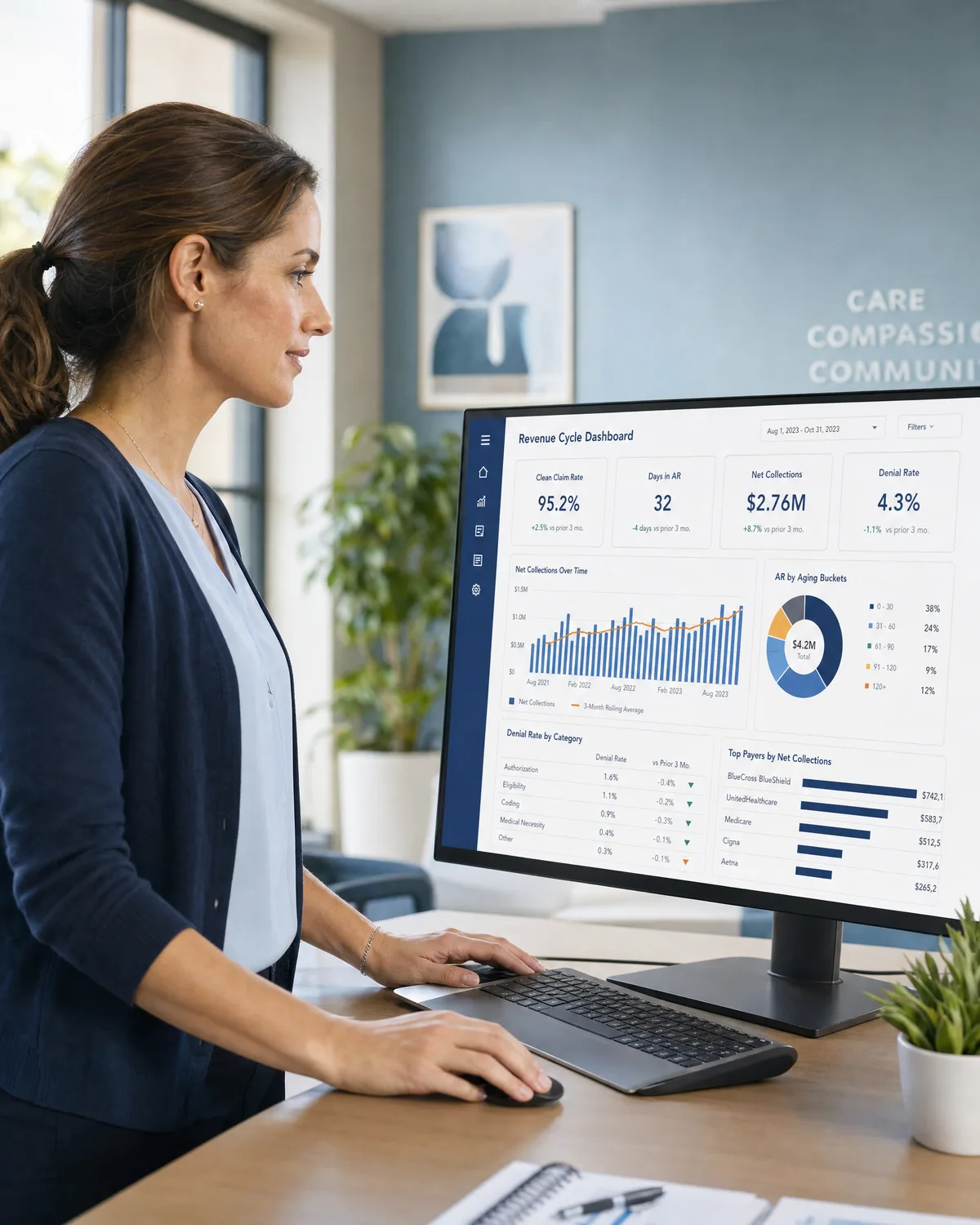
Healthcare organizations generate enormous amounts of operational, financial, and clinical data, but most of it sits in disconnected systems. The best healthcare analytics software in 2026 brings that data together so leaders can see what's actually happening across their organization.
For specialty practices, generic dashboards often fall short. Specialty operations involve unique workflows, infusion scheduling, prior authorization turnaround, drug margin tracking, that general-purpose BI tools weren't built to measure.
So, what is the best healthcare analytics software in 2026?
The answer depends on whether you're a specialty practice that needs operational and financial analytics tied to billing, or a large health system that needs a data platform for population health and value-based care.
This guide compares leading healthcare analytics platforms by best-fit use case.
Short answer
For specialty practices, Unlimited Market Intelligence adds Power BI dashboards and specialty peer benchmarks to the data in Unlimited Financials. Health systems often evaluate Health Catalyst, Innovaccer, and Arcadia; teams building their own BI use Tableau, Qlik, or Power BI; and Epic organizations use Cogito.
How this guide was built
Disclosure: Unlimited Systems publishes this guide and sells Unlimited Market Intelligence and Unlimited Analytics, which compete in this category. No vendor paid to be included. Vendor descriptions come from each company's public materials, linked under every profile, and contain no ratings or scores of our own.
We compared vendors on:
- Data coverage
- Dashboards and self-service
- Benchmarking
- Drill-down to source records
- AI and natural-language analysis
- Specialty metrics
- Integration
- Pricing transparency
What Is Healthcare Analytics Software?
Healthcare analytics software collects data from across an organization, scheduling, billing, EHR, claims, and patient engagement systems, and turns it into reports and dashboards that help leaders make decisions. The best platforms go beyond static reports to provide real-time visibility into operational and financial performance.
For specialty practices, the right question is not just:
Can this system build dashboards?
The better question is:
Can this system connect our scheduling, billing, and clinical data into metrics that matter for our specialty?
Best Picks at a Glance
Picks follow the criteria in the disclosure above. Most organizations pair an operational analytics tool with a general BI platform.
Best for specialty revenue cycle analytics
Unlimited Market Intelligence
Specialty peer benchmarks and drill-down from a KPI to the claims behind it.
Best enterprise data platform
Health Catalyst or Innovaccer
Data aggregation and analytics for large health systems.
Best for population health
Arcadia
Analytics for value-based contracts and risk.
Best general-purpose BI
Tableau or Qlik
Flexible dashboards for teams with analysts.
Best for Epic organizations
Epic Cogito
Analytics native to the EHR.
Best Healthcare Analytics Software Options in 2026
1. Unlimited Market Intelligence by Unlimited Systems
Best for specialty healthcare practices that need revenue cycle analytics with specialty benchmarks
Unlimited Market Intelligence is the analytics extension of Unlimited Financials, the practice management platform from Unlimited Systems. It turns the revenue cycle and operational data Financials already holds (billing, denials, A/R, payer performance, and scheduling) into Power BI dashboards, drill-down reports, Microsoft Co-Pilot answers, and variance and underpayment alerts.
It compares results against de-identified specialty peer benchmarks drawn from $70+ billion in annual charges across 4,500+ specialty locations, so practices can see not just what a number is but whether it's good. Unlimited Analytics, built into Financials, provides pre-built specialty reports; Market Intelligence adds the benchmark layer and a Microsoft Fabric data warehouse.
Consider Unlimited Market Intelligence if you need:
- Analytics built on billing, denial, A/R, and scheduling data
- Specialty peer benchmarks for clean claims rate, days in A/R, and denial trends
- Power BI dashboards and plain-language answers through Microsoft Co-Pilot
- Drill-down from a benchmark gap to the underlying claims
Bottom line: For specialty practices already using or considering Unlimited Financials, Unlimited Market Intelligence offers analytics that are pre-connected to the data that matters most. Each user needs a Power BI license.
2. Health Catalyst
Best for health systems wanting a data platform plus analytics applications
Health Catalyst provides a data platform along with a library of analytics applications covering clinical, financial, and operational use cases for hospitals and health systems.
Consider Health Catalyst if you need:
- A data platform that aggregates data from multiple source systems
- Pre-built analytics applications for clinical and operational use cases
- A vendor experienced with large health system data
Bottom line: Health Catalyst suits large health systems with the resources to implement a comprehensive data platform.
3. Innovaccer
Best for health systems wanting a unified patient data platform
Innovaccer offers a data activation platform that unifies patient data across systems, with analytics focused on population health and care management.
Consider Innovaccer if you need:
- A unified patient data platform across multiple sources
- Population health and care management analytics
- Tools to support value-based care initiatives
Bottom line: Innovaccer is well suited to organizations focused on population health and value-based care.
4. Arcadia
Best for organizations focused on value-based care analytics
Arcadia provides analytics focused on population health, quality measures, and value-based care contract performance.
Consider Arcadia if you need:
- Population health and quality measure reporting
- Analytics tied to value-based care contracts
- Risk stratification and care gap identification
Bottom line: Arcadia is a strong fit for organizations with significant value-based care contracts.
5. Tableau
Best for organizations wanting flexible, general-purpose BI
Tableau is a widely used business intelligence tool that can connect to many data sources and build custom dashboards, often used alongside dedicated healthcare data platforms.
Consider Tableau if you need:
- Flexible, general-purpose dashboards
- A BI layer on top of an existing data warehouse
- Strong visualization capabilities
Bottom line: Tableau works best when paired with a healthcare-specific data model rather than as a standalone solution.
6. Qlik
Best for organizations wanting BI plus data integration tools
Qlik provides BI and dashboarding tools along with data integration capabilities, used by some healthcare organizations to combine data from multiple systems.
Consider Qlik if you need:
- BI dashboards combined with data integration tools
- Flexibility to connect many data sources
- An alternative to Tableau for general-purpose BI
Bottom line: Qlik is a capable general-purpose option that, like Tableau, benefits from a healthcare-specific data model.
7. athenaOne by athenahealth
Best for ambulatory practices wanting analytics built into their EHR and billing platform
athenaOne includes built-in reporting and analytics covering clinical, financial, and operational metrics alongside its EHR and practice management functionality.
Consider athenahealth if you need:
- Reporting built into your existing EHR platform
- Basic operational and financial dashboards
- Analytics without a separate platform to manage
Bottom line: athenahealth's built-in reporting works for practices that don't need deep specialty-specific analytics.
8. Epic Cogito
Best for Epic-based health systems
Epic Cogito provides analytics and reporting tools designed to work with data from the Epic EHR, used by health systems already on the Epic platform.
Consider Epic Cogito if you need:
- Analytics tightly integrated with Epic data
- Reporting tools from your existing EHR vendor
- A solution that doesn't require a separate data integration project
Bottom line: Epic Cogito is a natural fit for organizations already standardized on Epic.
Healthcare Analytics & BI Software Comparison
Scroll sideways to see every column.
| Software provider | Best for | Core features | AI & automation | Specialty support | Integrations | Pricing | Considerations |
|---|---|---|---|---|---|---|---|
| Unlimited Market Intelligence by Unlimited Systems | Specialty practices that want revenue cycle analytics with specialty peer benchmarks | Power BI dashboards, drill-down reports, specialty benchmarks, variance and underpayment alerts | Microsoft Co-Pilot answers; anomaly and variance detection; performance trend modeling | De-identified benchmarks from $70B+ in annual specialty charges across 4,500+ locations | Built on Unlimited Financials data; Microsoft Fabric data warehouse | Custom quote; each user needs a Power BI license | Analytics extension of Unlimited Financials, not a standalone data platform |
| Health Catalyst | Health systems that want an enterprise data platform and improvement services | Data platform, analytics applications, improvement services | Confirm current AI features | Health systems | Aggregates data from many source systems | Not published; request a quote | Enterprise implementation |
| Innovaccer | Health systems with multi-EHR data and value-based care programs | Healthcare data platform, population health analytics, care management | Agents of Care and copilots (2025) | Health systems and value-based organizations | Aggregates data across EHRs | Not published; request a quote | Platform-scale project |
| Arcadia | Organizations focused on population health and value-based contracts | Data aggregation, population health and risk analytics | Confirm current AI features | Value-based care organizations | Claims and clinical data aggregation | Not published; request a quote | Less focused on practice revenue cycle operations |
| Tableau | Analytics teams that build their own healthcare dashboards | General-purpose visual analytics and BI | Salesforce AI features; confirm scope | General-purpose | Connects to most data sources | Published pricing tiers | You build and maintain the healthcare data model |
| Qlik | Organizations that want associative BI and data integration | BI, analytics, and data integration | Confirm current AI features | General-purpose | Connects to most data sources | Published pricing tiers | Requires analytics expertise |
| athenaOne by athenahealth | Ambulatory practices wanting analytics inside their EHR and PM | Practice performance analytics and benchmarks | AI-native PM and RCM features (2025); ambient and patient agents rolling out in 2026 | Broad ambulatory; specialty depth varies | Native to athenaOne; marketplace partners | Not published | Analytics tied to athenaOne data |
| Epic Cogito | Health systems on Epic | Analytics, dashboards, and data warehouse within Epic | Epic AI features, including Cosmos-based insights | Broad, including specialty modules | Native to Epic | Part of Epic licensing | Epic customers only |
Why Specialty Practices Need More Than Generic Dashboards
Specialty practices often need analytics that cover:
- Provider productivity and scheduling efficiency
- Denial trends by payer, denial type, and location
- Drug margin and infusion utilization
- Prior authorization turnaround times
- AR aging and underpayment recovery
- Patient volume and referral trends by specialty
A general-purpose BI tool can technically display this data, but only after significant data modeling work. Purpose-built platforms like Unlimited Market Intelligence come with these metrics defined from the start.
Best Healthcare Business Intelligence Software: Analytics vs. BI vs. Reporting
The terms overlap, but buyers usually mean three different things. Healthcare business intelligence (BI) is the organization-wide view: dashboards that monitor business performance across locations, service lines, and payers. Healthcare analytics goes deeper to explain why numbers move and what to do next. Healthcare reporting produces the regular, defined reports teams run every day and month, covered in our healthcare reporting software guide.
For BI, organizations typically choose between general-purpose platforms (Microsoft Power BI, Tableau, Qlik) that need a healthcare data model built on top, and healthcare-specific platforms (Health Catalyst, Innovaccer, Arcadia, Epic Cogito, Unlimited Market Intelligence) that arrive with healthcare data structures. Unlimited Market Intelligence runs on Power BI and Microsoft Fabric, so practices get healthcare-specific content in a BI tool their teams may already know.
When comparing BI software, ask:
- Which source systems feed it, and how fresh is the data?
- Who maintains the data model when payers, codes, or workflows change?
- Can executives drill from a dashboard to the accounts behind a number?
- Are benchmarks available, and are they from comparable organizations?
How to Choose the Best Healthcare Analytics Software in 2026
1. Identify your core data sources
List the systems your analytics platform needs to pull from, practice management, billing, EHR, scheduling, and patient engagement.
2. Decide between purpose-built and general-purpose BI
Purpose-built platforms come with healthcare metrics pre-defined; general-purpose BI tools offer flexibility but require more setup.
3. Evaluate specialty-specific reporting needs
If your practice has specialty-specific workflows, confirm the platform can report on the metrics that matter most to your specialty.
4. Check how analytics connects to your billing and RCM data
Analytics that's pre-connected to billing data reduces the time it takes to surface financial insights.
5. Consider implementation effort
Data platforms for large health systems can take months to implement; specialty-built platforms connected to your existing practice management system can move faster.
6. Plan for population health and value-based care needs
If value-based care contracts are a priority, confirm the platform supports the quality measures and risk stratification you need.
Final Recommendation
For large health systems building comprehensive data platforms, Health Catalyst, Innovaccer, and Arcadia are strong options, particularly for population health and value-based care. Tableau and Qlik offer flexible BI for organizations with data engineering resources. athenaOne and Epic Cogito work well for organizations standardized on those EHR platforms.
But for specialty healthcare practices that need analytics connected directly to operational, financial, and clinical data, without a lengthy data platform project, Unlimited Market Intelligence by Unlimited Systems should be one of the first platforms on the shortlist.
Healthcare Analytics by Specialty
Specialty analytics needs specialty metrics: drug margin and waste, authorization turnaround, procedure mix, and payer performance on high-cost claims. Generic averages hide most of this, which is why specialty peer benchmarks matter.
Analytics by specialty
How Unlimited Systems Approaches Analytics
Unlimited Analytics, built into Unlimited Financials, reports on the work the platform is already doing. Unlimited Market Intelligence adds Power BI dashboards, a Microsoft Fabric data warehouse, Microsoft Co-Pilot answers, variance and underpayment alerts, and de-identified specialty peer benchmarks drawn from $70+ billion in annual charges across 4,500+ specialty locations. Every benchmark drills back to the accounts in Financials where the work gets done.
- Unlimited Market IntelligenceDashboards and specialty benchmarks.
- Unlimited AnalyticsReporting built into Unlimited Financials.
- BenchmarkingCompare performance against specialty peers.
- Stronger financial visibilityNumbers leaders can act on.
Frequently Asked Questions
What is the best healthcare analytics software in 2026?
It depends on the type of organization. For specialty healthcare practices, Unlimited Market Intelligence by Unlimited Systems adds specialty benchmarks and Power BI analytics to the revenue cycle data in Unlimited Financials. For large health systems, Health Catalyst, Innovaccer, and Arcadia are commonly used for population health and data platform needs. Tableau, Qlik, athenaOne, and Epic Cogito are also worth evaluating depending on your existing systems.
What should specialty practices look for in healthcare analytics software?
Specialty practices should look for analytics that connect operational data (scheduling, throughput), financial data (billing, denials, AR), and clinical data in one place, with reporting tailored to specialty-specific metrics rather than generic dashboards.
Is general-purpose BI software like Tableau or Qlik enough for healthcare analytics?
General-purpose BI tools like Tableau and Qlik can build powerful dashboards, but they typically require significant setup and data engineering work to model healthcare-specific data. Purpose-built healthcare analytics platforms come with healthcare data models and metrics already defined.
Why is Unlimited Market Intelligence a strong option for specialty practices?
Unlimited Market Intelligence turns the revenue cycle data in Unlimited Financials into Power BI dashboards, Microsoft Co-Pilot answers, and variance and underpayment alerts, and compares results with de-identified specialty peer benchmarks drawn from $70+ billion in annual charges across 4,500+ specialty locations. Benchmarks drill back to the accounts where the work gets done.
What is healthcare business intelligence software?
Healthcare business intelligence software gives leaders an organization-wide view of performance through dashboards and KPIs across locations, service lines, providers, and payers. It overlaps with healthcare analytics, which focuses on explaining why performance changes.
Should we use a general BI tool or a healthcare analytics platform?
General BI tools are flexible but require someone to build and maintain healthcare data models. Healthcare platforms arrive with healthcare structures and metrics. Many organizations use a healthcare platform for operational analytics and a general BI tool for custom executive views.
Related Software Guides & Resources
- Best Healthcare Reporting SoftwareOperational, financial, and quality reporting.
- Best Revenue Cycle Management SoftwareWhere revenue cycle data comes from.
- Best AI Healthcare Management SoftwareAI across healthcare operations.
- Value-based care readiness checklistData and reporting for value-based contracts.
Looking for healthcare analytics built for specialty practices?
See how Unlimited Market Intelligence connects operational, financial, and clinical data in one platform.
See Unlimited Financials in ActionRelated buyer's guides
More 2026 vendor comparisons for specialty healthcare software.