

Analytics & value-based care
Oncology Value-Based Care Software
Run EOM episodes, MIPS oncology measures and payer risk contracts from the same data your practice bills from.
Oncology Value-Based Care Software helps a medical oncology practice manage the Enhancing Oncology Model, MIPS and commercial oncology contracts. It tracks each six-month episode. It records the care plan, symptom and social needs data the model asks for. It flags patients at risk of an ER visit and follows episode cost against target.



 6,500+ specialty providers

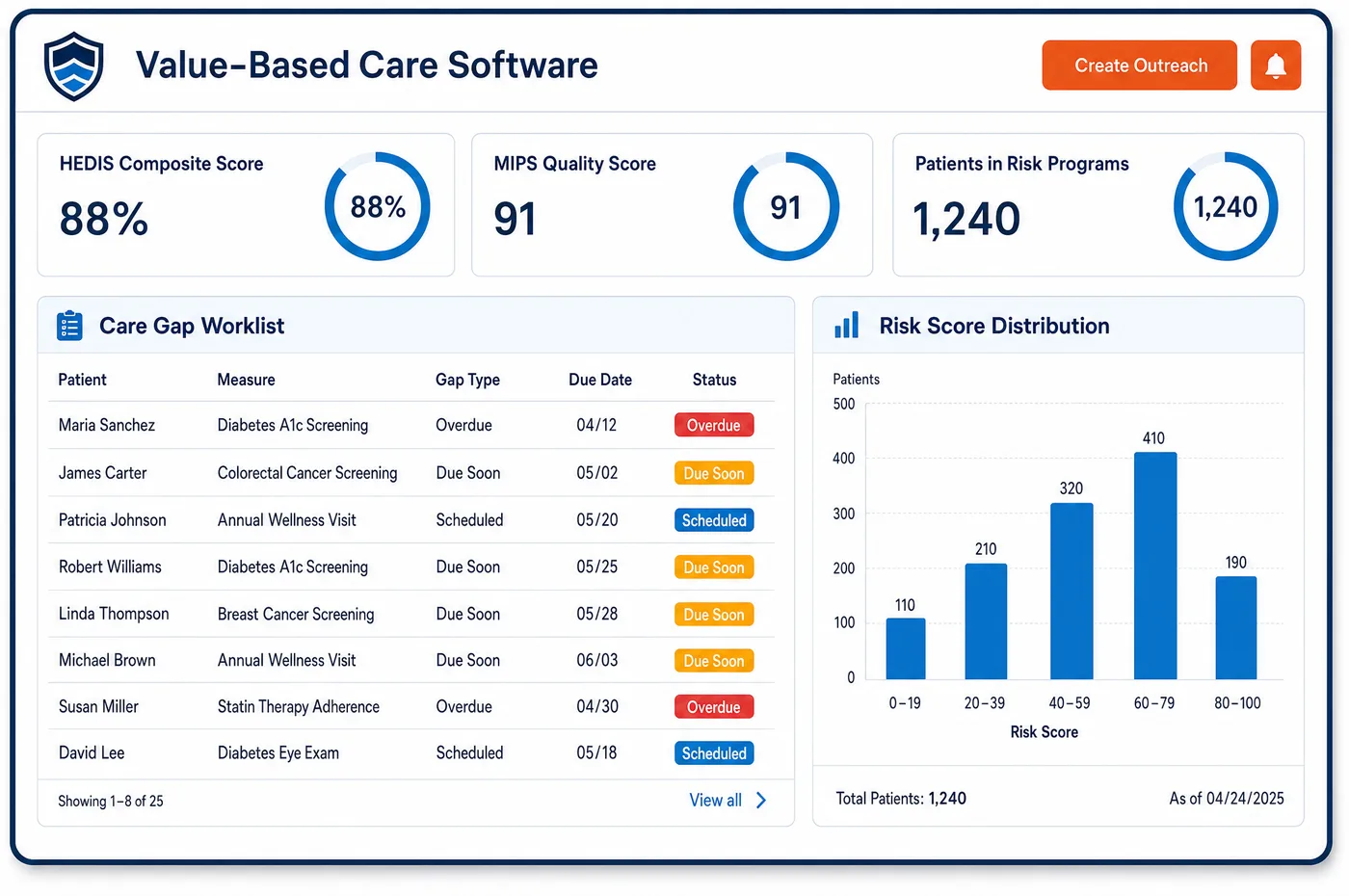
Value-Based Care in a Oncology Practice
Under the Enhancing Oncology Model, an episode starts when a Medicare patient begins chemotherapy for one of seven cancer types, and it runs six months. The practice can bill a monthly M0010 payment for enhanced services, and later shares savings or repays part of the excess based on cost and quality. Oncology value-based care software keeps each episode in view. It lists attributed patients, the months billed, and the redesign work done, such as care plans, navigation, ePRO collection and social needs screening. Patient-reported symptoms come in over FHIR and are sorted by severity, so triage nurses call the sickest patients first. Patients at risk of an emergency visit or admission are flagged on the schedule. MIPS measures such as pain intensity and pain plan are checked while the visit is still open. Episode cost and expected shared savings are tracked in the ledger.
Why Is Value-Based Care Different in Oncology?
Oncology value-based care is built on the episode, not the visit. One patient's six months of chemotherapy, drugs, imaging, hospital stays and emergency visits all count toward the cost the model measures. Drug cost is a large part of that total, so pathway and product choices show up in results. A practice that only sees its own claims misses the hospital costs that can swing the outcome.
The model also asks for new work. EOM lists eight redesign activities, including round-the-clock access to a clinician with the patient's record, patient navigation, care plans, ePRO collection and social needs screening. Each must be done and shown. When the proof lives in scattered notes, the practice does the work but can't prove it, and quality data for CMS is pieced together at the deadline.
Timing decides a lot. A patient with a fever partway through a cycle can be seen in the clinic or end up in the emergency room. Symptom reports that reach a nurse quickly, and a schedule that flags who is at risk, turn the model's goal of fewer avoidable acute care visits into daily practice. The same outreach also supports oncology patient engagement.
What Oncology Value-Based Care Software Handles
- EOM episodes and timeline
- EOM episodes last six months and are triggered by chemotherapy for one of seven cancer types. Cohort 1 began in July 2023 and cohort 2 in July 2025, and both now run to June 30, 2030. (CMS: Enhancing Oncology Model Frequently Asked Questions)
- Monthly Enhanced Oncology Services (M0010)
- Practices bill M0010 for each attributed patient for each month of the episode, unless the patient elects hospice or dies. The software lists which patients and months have been billed and which are still due. (CMS Transmittal R12480DEMO: Payment of M0010 EOM MEOS Claims)
- Participant redesign activities
- EOM requires eight redesign activities. They include round-the-clock access to a clinician with the chart, navigation, care plans, ePROs and social needs screening. Each activity is logged on the patient record, so the practice can show it was done. (CMS: Enhancing Oncology Model Frequently Asked Questions)
- Two risk arrangements
- EOM has two risk arrangements with different levels of downside risk, and Risk Arrangement 2 meets Advanced APM criteria. Expected savings or repayments are tracked in the ledger under the arrangement the practice chose, with the two-sided risk shown plainly. (CMS Fact Sheet: Update, Enhancing Oncology Model)
- MIPS 143 and 144 pain measures
- Quality 143 checks that pain intensity is quantified at visits by patients on chemotherapy, and Quality 144 checks for a plan of care when pain is present. The visit flags a missing pain score or plan while it can still be added. (CMS Quality Payment Program: 2026 MIPS CQM Quality ID #143, Oncology: Medical and Radiation, Pain Intensity Quantified)
- EOM quality domains
- EOM quality measures cover patient experience, avoidable acute care use, symptom and toxicity management, psychosocial health and end-of-life care. Dashboards track the data behind each domain during the episode, not after it. (CMS: Enhancing Oncology Model Frequently Asked Questions)
How Does Oncology Value-Based Care Software Work?
1. Find attributed patients
Patients starting chemotherapy for an EOM cancer type are flagged when the first dose is billed. Their episode start and end months are set on the record.
2. Do and log the redesign work
Care plans, navigation contacts, ePRO enrollment and social needs screening are logged as they happen. Gaps show on a worklist for the care team.
3. Watch symptoms and risk
ePRO responses arrive over FHIR and are sorted by severity before the patient reaches the clinic. Patients at risk of an emergency visit or admission are flagged on the schedule for a nurse call.
4. Close quality gaps at the visit
MIPS pain measures and EOM documentation fields are checked while the visit is open. Missing items are flagged to the clinician before checkout, and the data feeds quality reports to CMS.
5. Track cost and settlement
Episode cost is followed against target through each period. Expected savings or repayments are tracked in the ledger, so the practice isn't surprised at reconciliation.
Oncology Value-Based Care Software vs. Generic Software
| Area | Generic approach | Unlimited Systems |
|---|---|---|
| Episode tracking | Episodes known only from CMS reports later. | Each episode tracked from the first dose. |
| Redesign activities | Work done but scattered across notes. | Each activity logged on the patient record. |
| Symptom reports | Paper or PDF surveys typed in by nurses. | ePROs over FHIR, sorted by severity. |
| Quality capture | Charts reviewed after the visit is closed. | Missing fields flagged before checkout. |
| Financial view | Shared savings guessed in a spreadsheet. | Savings and repayment risk tracked in the ledger. |
Who Uses It in a Oncology Practice
- Nurse navigator: Patients sorted by symptom severity and risk, with navigation and care plan tasks in one place.
- Quality lead: Episode, redesign activity and MIPS gap views, with data ready for CMS submissions.
- Physician owner: Episode cost against target and expected savings or repayment, tracked with practice accounting, so the model's effect on margin is clear.
Oncology Value-Based Care Software FAQs
For most medical oncology practices, value-based care means the Enhancing Oncology Model, MIPS reporting and some commercial episode or pathway contracts. Each ties part of payment to cost and quality over time instead of to visits alone. The practice needs to see episode cost, quality data and patient risk during the year, not after it closes.
The Enhancing Oncology Model is active. Its first cohort began in July 2023, and a second cohort joined in July 2025. CMS gave the model a two-year extension, so both cohorts now run until June 30, 2030. Episodes last six months and are triggered by chemotherapy for one of seven cancer types.
EOM lists eight participant redesign activities. They include round-the-clock access to a clinician who can see the patient's record, patient navigation, care plans, collecting and monitoring ePROs, and screening for health-related social needs. The software logs each one on the patient record, so the practice can show the work was done.
Patients report symptoms through ePRO surveys, which arrive over FHIR and are sorted by severity before the patient reaches the clinic. Nurses call the most severe cases first. Patients at higher risk of an emergency visit are flagged on the schedule, so the team can act early with a same-day visit or a call.
Two common oncology MIPS measures are Quality 143, which checks that pain intensity is quantified at visits for patients on chemotherapy, and Quality 144, which checks for a plan of care when pain is present. Both are counted visit by visit, so checking for them while the visit is open is far easier than fixing charts later.
Expected shared savings, or repayment when spending runs over the target, are tracked in the ledger for each period. EOM has two risk arrangements with different downside risk, and the practice's choice sets how the numbers are shown. Finance and clinical leaders see the same view of where episode results stand.
Related Oncology Software
Analytics & value-based care
In the revenue cycle
Value-Based Care for related specialties
Sources
- CMS: Enhancing Oncology Model Frequently Asked Questions
- CMS Transmittal R12480DEMO: Payment of M0010 EOM MEOS Claims
- CMS Fact Sheet: Update, Enhancing Oncology Model
- CMS Quality Payment Program: 2026 MIPS CQM Quality ID #143, Oncology: Medical and Radiation, Pain Intensity Quantified
- CMS Quality Payment Program: 2026 MIPS CQM Quality ID #144, Oncology: Medical and Radiation, Plan of Care for Pain
GET STARTED
See Unlimited Systems in Action
Whether you're actively evaluating new technology or simply preparing for your next vendor renewal, Unlimited Systems can help you understand where your current workflows may be creating avoidable revenue risk.