

Analytics & value-based care
Diabetes Care Value-Based Care Software
Track MIPS diabetes measures, health plan quality gaps and risk-contract results beside the revenue they affect.
Diabetes Care Value-Based Care Software follows the quality, cost and risk programs that increasingly set diabetes pay. It follows MIPS measures 001, 117 and 488, health plan HEDIS gaps and shared-savings or capitated contracts, and shows each against the billing data, so staff close care gaps while the encounter or the quarter is still open.



 6,500+ specialty providers

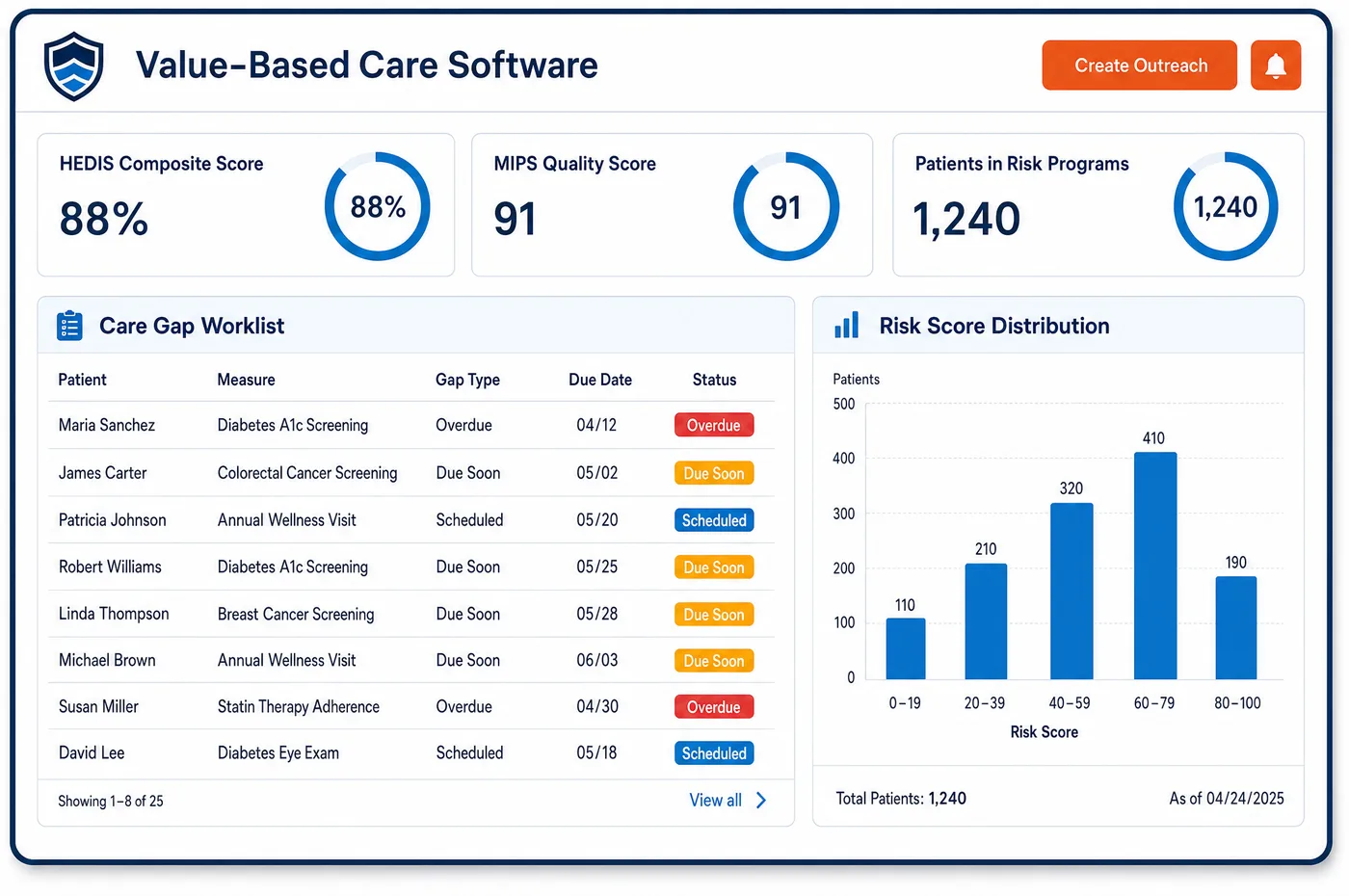
Value-Based Care in a Diabetes Care Practice
Diabetes is one of the most measured conditions in medicine, which makes value-based care a daily matter for a diabetes practice. A patient with no recent A1c, no eye exam or no kidney test is a gap in more than one program at once. Value-based care software lists those gaps by patient and by program, so one outreach call or one order can close several. MIPS measures are tracked with their own reporting codes and the plan measures with the plan's logic. Where a contract pays shared savings or a monthly capitation amount, the contract is set up in the ledger beside the fee-for-service revenue, so leaders can see what quality results are worth next to what visits bring in. Staff work gap lists as queues, and each closed gap updates the measure. Risk lists point to patients with high A1c, missed visits or frequent emergency use, so the care team can reach out before a costly episode.
Why Is Value-Based Care Different in Diabetes Care?
Quality measures in diabetes can reward the wrong thing if the data is thin. MIPS measure 001 is an inverse measure, where a lower share of patients above 9.0 is better, and a patient with no result counts against the practice. A group can look worse than it is only because tests are done elsewhere and never recorded. Value-based care work in this specialty therefore starts with finding results, not only improving them.
Programs overlap and do not use the same rules. A MIPS eye exam measure and a health plan eye exam measure may count different evidence. Plan gaps close on plan data, and MIPS gaps close on the practice's own reporting. One tracker that treats them as the same will leave one program wrong. Each program keeps its own logic, and a shared view of care gaps shows where one action serves both.
Contracts add a money question. Under a shared-savings arrangement the practice is paid for results on a defined group of attributed patients. Under capitation, a set payment covers a patient's care and the practice carries the risk. Either way, the practice needs to know which patients are attributed, what they cost and which measures drive the payment. That is why reports for quality programs and the financial ledger need to agree, and why the ledger is where contract results are tracked.
What Diabetes Care Value-Based Care Software Handles
- MIPS 001 glycemic status above 9.0
- MIPS 001 counts patients 18 to 75 with diabetes whose most recent A1c or GMI is above 9.0, or who have no result, so lower is better. Gap lists show missing results first, since a test closes those fastest. (CMS QPP: 2026 MIPS CQM Quality ID #001, Diabetes: Glycemic Status Assessment Greater Than 9%)
- MIPS 117 eye exam
- MIPS 117 is met by a retinal or dilated eye exam by an eye care professional in the period, or a negative exam in the prior year. The tracker lists patients without a qualifying exam on file, including exams done at outside practices. (CMS QPP: 2026 MIPS CQM Quality ID #117, Diabetes: Eye Exam)
- MIPS 488 kidney health evaluation
- MIPS 488 asks for both an estimated glomerular filtration rate and a urine albumin-creatinine ratio in the period. Patients with only one test are listed apart, since one order completes them. (CMS QPP: 2026 MIPS CQM Quality ID #488, Kidney Health Evaluation)
- HEDIS glycemic status for plan contracts
- Health plans score the same A1c and GMI data under HEDIS glycemic status, with CPT II codes on claims as one source. Plan gap lists are kept apart from MIPS lists, as the two programs count evidence differently. (NCQA: Glycemic Status Assessment for Patients With Diabetes (GSD))
- Kidney evaluation in plan programs
- The HEDIS kidney health evaluation uses the same two tests, for a wider age range than the glycemic measure. The tracker shows plan-level completion beside MIPS completion for the same patient. (NCQA: Kidney Health Evaluation for Patients With Diabetes (KED))
- Device-derived results
- Health plan guidance lets a GMI from CGM data stand in for a lab A1c when it is documented with its date range. Gap lists use that date, so patients with CGM data are not sent for tests they already have. (Point32Health: HEDIS Tip Sheet, Glycemic Status Assessment for Patients with Diabetes (GSD))
How Does Diabetes Care Value-Based Care Software Work?
1. Attribute patients and programs
Each patient is matched to the measures and contracts that apply, by payer and plan. A patient can sit in several programs at once.
2. Find the care gaps
The tracker compares each patient's results and dates with each measure. Gaps are split into missing, due soon and not met.
3. Work the gap as a task
Staff call patients, order tests or request outside records from a queue. Closing a task updates the measure the next time results post.
4. Follow the contract
Shared-savings and capitation contracts are set up in the ledger. Leaders see quality results beside collections for the same patients, in line with MIPS and plan timelines.
5. Review risk and results
Patients with high A1c, missed visits or frequent emergency use are listed for care teams. Results are reviewed by site and clinician before each reporting period closes.
Diabetes Care Value-Based Care Software vs. Generic Software
| Area | Generic approach | Unlimited Systems |
|---|---|---|
| Measure tracking | Programs tracked on separate spreadsheets. | MIPS and plan measures tracked in one place, each on its own logic. |
| Gap closure | Gaps found after the period ends. | Gap lists worked as queues while the encounter or quarter is open. |
| Outside results | Eye and kidney results missing from the chart. | Outside records requested and entered with their dates. |
| Contract results | Shared savings estimated by the finance office. | Contract set up in the ledger beside fee-for-service revenue. |
| Risk outreach | Care teams see patients only at visits. | Lists of patients with high A1c or missed visits for outreach. |
Who Uses It in a Diabetes Care Practice
- Quality lead: Care gaps by patient and program, with MIPS and plan measures kept on their own rules and the evidence behind each result.
- Medical director: Panel risk lists and gap closure by clinician, so the care team knows who to reach before the period ends. HEDIS plan gaps appear beside MIPS gaps.
- Practice owner: Contract results next to fee-for-service revenue, which shows what quality work is worth and where a risk contract is exposed.
Diabetes Care Value-Based Care Software FAQs
Value-based care software lists care gaps by patient and by program, tracks MIPS measures 001, 117 and 488 with health plan HEDIS gaps, and shows contract results beside revenue. Staff work the gaps as queues, so one call or order can close more than one measure while the period is still open.
Measure 001 is an inverse measure, so a lower share of patients with an A1c or GMI above 9.0 is better. A patient with no result in the period is counted with those above 9.0. The practice improves its score by both lowering control problems and recording the results it already has.
A single call can close several gaps. A patient due for an A1c, an eye exam and a urine albumin-creatinine ratio can be booked for all three, which also helps the kidney and eye measures. Gap lists show which programs each missing item affects, so staff plan the call around the full list.
MIPS and health plan programs often count different evidence for similar measures. MIPS 001 does not take patient-reported results, while plan HEDIS guidance may accept them and may use CPT II codes on claims. Each program is tracked on its own logic, so a gap closed for one is not assumed closed for the other.
Shared-savings and capitation contracts are set up in the financial ledger, with the patients attributed to each. Leaders can see quality results, payments and costs for the contract beside regular fee-for-service revenue. That view shows whether the contract is paying for the work needed to meet its targets.
A glucose management indicator from CGM data counts toward the glycemic measures in MIPS 001 and the HEDIS glycemic status measure when it is documented with its date range. The tracker uses the last date of that range, so a patient with current CGM data is not sent for a lab test they do not need.
Related Diabetes Care Software
Analytics & value-based care
In the revenue cycle
Value-Based Care for related specialties
Sources
- CMS QPP: 2026 MIPS CQM Quality ID #001, Diabetes: Glycemic Status Assessment Greater Than 9%
- CMS QPP: 2026 MIPS CQM Quality ID #117, Diabetes: Eye Exam
- CMS QPP: 2026 MIPS CQM Quality ID #488, Kidney Health Evaluation
- NCQA: Glycemic Status Assessment for Patients With Diabetes (GSD)
- NCQA: Kidney Health Evaluation for Patients With Diabetes (KED)
- Point32Health: HEDIS Tip Sheet, Glycemic Status Assessment for Patients with Diabetes (GSD)
GET STARTED
See Unlimited Systems in Action
Whether you're actively evaluating new technology or simply preparing for your next vendor renewal, Unlimited Systems can help you understand where your current workflows may be creating avoidable revenue risk.