

Billing & claims
Diabetes Care Denial Management Software
Sort diabetes denials by cause, from lapsed referrals and used-up education hours to CGM frequency and early A1c tests, and fix the source so they stop.
Diabetes Care Denial Management Software finds, sorts and works the denials a diabetes practice receives. It groups them by remittance reason, such as a missing referral, a CGM service billed too often, or an A1c ordered too soon, routes each to the right person, and tracks appeals and root causes so the same denial stops repeating.



 6,500+ specialty providers

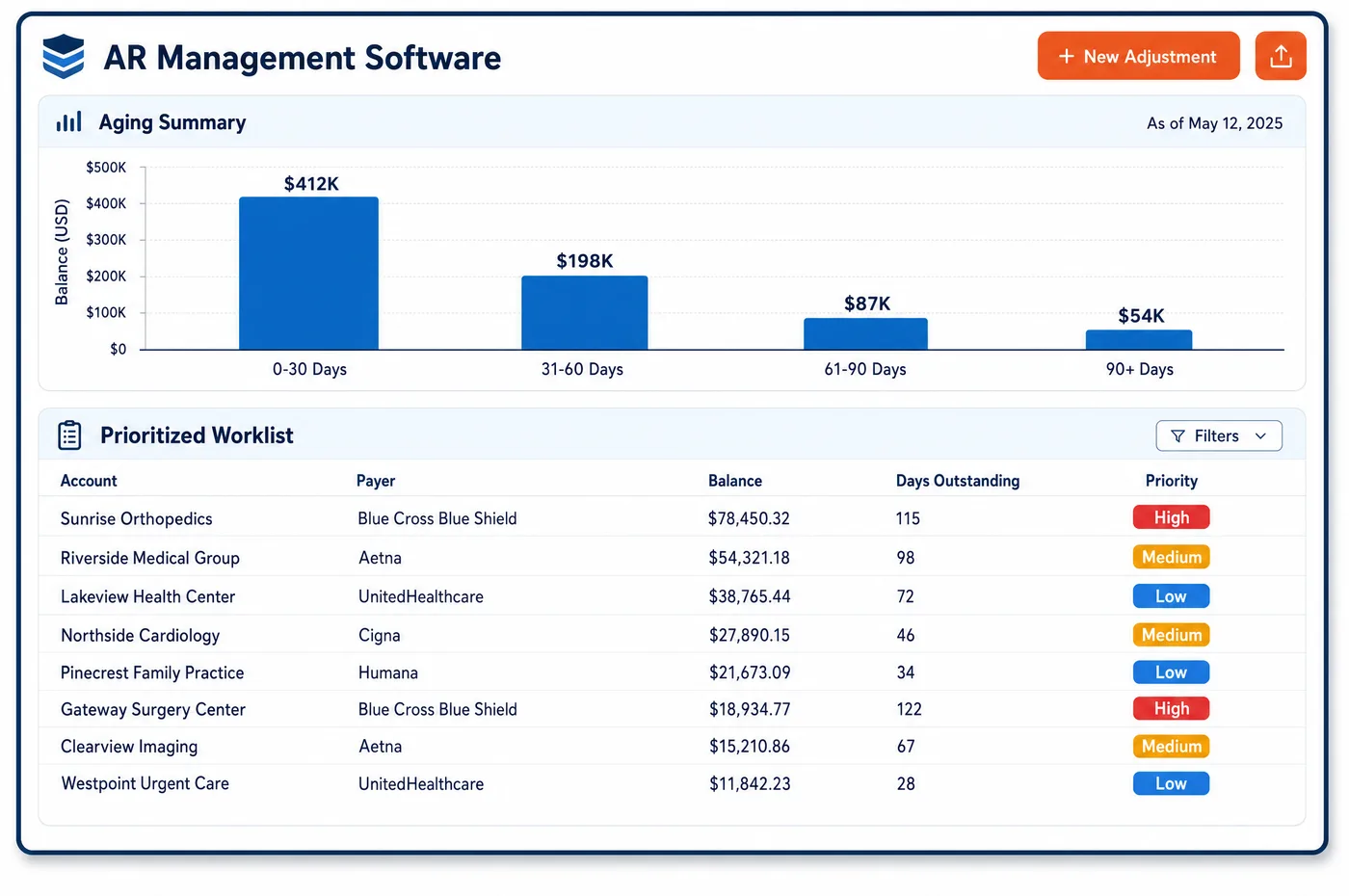
Denial Management in a Diabetes Care Practice
Denials in a diabetes practice come in small amounts and large numbers. One class billed past the yearly limit, one CGM review repeated in a month or one nutrition visit without a referral is a small loss. The same error across hundreds of patients is a real one. Denial management for diabetes care starts with the remittance. Each claim adjustment reason code and remark code on the 835 is read and placed in a cause group such as authorization, frequency, medical necessity, modifier or duplicate. Staff work each group from its own queue, with the claim, the order and the documentation on one screen. Fixable items are corrected and resubmitted, and the rest go to appeal with the record attached. Reports then show which causes repeat by payer and service, which tells the practice whether to change registration, scheduling, coding or clinician documentation upstream.
Why Is Denial Management Different in Diabetes Care?
Most diabetes denials are rule denials, not coding errors. The code was right, but the patient had used the hours, the month already held a CGM review, or the referral had lapsed. A team that only resubmits will see the same denials return, because nothing in the claim was wrong. Denial management in this specialty has to read the reason, then look at the patient's history to find what the rule was counting.
Several service lines have their own payers and rules, so a single denial rate hides the problem. Training and nutrition therapy follow Medicare education rules. CGM interpretation follows frequency limits. In-office tests follow lab policy. Suppliers bill for sensors and pumps, and their denials come back to the practice as requests for notes. Sorting by line and by payer shows which of these is leaking. Charge validation catches many of the same rules before the claim is sent, and what it misses shows up here.
Timing matters as well. Under Medicare, a claim has to be filed within one calendar year of the date of service, and other payers set shorter limits in their contracts. A denial worked late is often lost for that reason alone. Diabetes practices also see drug-related work, since GLP-1 and insulin coverage often depends on prior authorization, step therapy or quantity limits set by the plan. The staff time for those requests is part of the denial picture, so work from the front end and the back end is tracked in one place, as the AR follow-up queues do for open balances.
What Diabetes Care Denial Management Software Handles
- Authorization absent (CARC 197)
- Reason code 197 means precertification or authorization was missing. Staff route these to a queue where the order, the plan's rules and any retro request can be checked, and where a lapsed referral is renewed rather than just resubmitted. (X12 Claim Adjustment Reason Codes)
- Frequency not supported (CARC 151)
- Reason code 151 says the payer judged that the information does not support this many services. In diabetes care it often follows CGM interpretation, education units or A1c tests. The queue shows prior dates so staff can see which limit was hit. (X12 Claim Adjustment Reason Codes)
- Early A1c and medical necessity (CARC 50)
- Medicare's lab policy treats a test on a controlled patient more often than every three months as not reasonable unless the record shows a reason. Reason code 50 denials go to a clinician-assisted queue that checks for a documented change in regimen. (CMS National Coverage Determination 190.21: Glycated Hemoglobin/Glycated Protein)
- Modifier conflicts (CARC 4)
- Reason code 4 flags a code that conflicts with its modifier or lacks a needed one. Waived A1c lines need modifier QW, and G2211 is not paid beside an E/M with modifier 25 except with allowed preventive services. (CMS MLN Matters MM13455: New Waived Tests (CLIA certificate edits and modifier QW))
- Duplicate claims (CARC 18)
- Reason code 18 marks a duplicate claim or service. Staff compare the denied line with the earlier one, since a repeat of a class or CGM review may be a true duplicate or a distinct service needing a modifier. (X12 Claim Adjustment Reason Codes)
- Filing limit and Part D coverage work
- Medicare's filing rule in 42 CFR 424.44 sets the outer limit for claims. Part D coverage determinations for drugs follow plan rules, so staff track those requests and appeals as a separate queue. (eCFR: 42 CFR 424.44, Time limits for filing claims)
How Does Diabetes Care Denial Management Software Work?
1. Read each remittance
Reason and remark codes from the 835 are read as claims post. Each denied line is placed in a cause group, with the payer, service and patient history beside it.
2. Separate fixable from final
A soft denial can be corrected and sent again, while a hard denial needs an appeal. Staff mark each one so effort goes where payment is possible.
3. Work by queue and owner
Authorization items go to the front end, coding items to a coder, and documentation items to the clinician or educator. Each queue shows age and the filing deadline.
4. Appeal with the record
Appeals carry the order, notes, attendance sheets or lab dates that support the claim. Levels follow the payer's process, such as the Medicare appeal levels.
5. Fix the root cause
Reports show which causes repeat by payer and service. Changes go back to registration, scheduling or documentation, and the cause group is watched to see if it shrinks.
Diabetes Care Denial Management Software vs. Generic Software
| Area | Generic approach | Unlimited Systems |
|---|---|---|
| Denial sorting | One list ordered by date. | Cause groups by reason code, payer and service line. |
| Resubmission | Claims sent again unchanged. | Soft and hard denials separated before any work begins. |
| Frequency denials | Reviewed without the patient's dates. | Prior CGM, class and A1c dates shown beside the denied line. |
| Appeals | Records gathered from several places. | Order, notes and attendance sheets attached from the patient record. |
| Root cause | Seen only in monthly totals. | Repeat causes sent back to the step that created them. |
Who Uses It in a Diabetes Care Practice
- Denial specialist: Queues organized by cause, with the patient history, order and deadline on the claim so each item can be fixed or appealed in one pass.
- Diabetes educator: A short list of class denials that need attendance sheets or referral fixes, with the dates the payer used to count hours.
- Billing manager: Repeat causes by payer and service, which show where registration or scheduling needs to change to prevent the next denial.
Diabetes Care Denial Management Software FAQs
Common diabetes denials include missing or expired referrals for classes and nutrition therapy, education hours past the yearly limit, CGM interpretation billed more than once in a month, early A1c tests and modifier conflicts. Most are rule denials rather than coding mistakes, so the fix is usually upstream, not a resubmission.
A frequency denial on CGM interpretation is checked against the patient's earlier billing dates. If a second review fell in the same month, the line is usually written off or corrected. If a different service was billed, a modifier or documentation change may fix it. The cause is logged so scheduling and charge checks can stop repeats.
A denied A1c can be appealed when the record shows why the test was needed sooner than the payer's limit, such as a change in treatment. Medicare's lab policy allows more frequent testing when the documentation supports it. Staff send the clinician's note with the appeal, or collect a signed ABN before future tests when no reason applies.
Class denials return when the cause was never fixed. A used-up benefit, a missing referral or a same-day nutrition visit will deny again if the claim is sent unchanged. Denial management separates those from true errors, so staff correct the referral or write off the line instead of resubmitting a claim that will fail again.
Drug coverage denials fall under the patient's plan, not the medical claim. Staff track prior authorization, step therapy and quantity limit requests in their own queue and support coverage determinations and appeals with notes and lab results. The denial queue shows each request's status so the clinician and the patient know where it stands.
Reports track denials by cause, payer and service line over time. If referral denials fall after registration changes, or frequency denials fall after a scheduling change, the trend shows it. The practice can then compare those causes against its own history and decide which upstream step needs the next fix.
Related Diabetes Care Software
Billing & claims
In the revenue cycle
Denial Management for related specialties
Sources
- X12 Claim Adjustment Reason Codes
- X12 Remittance Advice Remark Codes
- CMS National Coverage Determination 190.21: Glycated Hemoglobin/Glycated Protein
- CMS MLN Matters MM13455: New Waived Tests (CLIA certificate edits and modifier QW)
- eCFR: 42 CFR 424.44, Time limits for filing claims
- CMS: Medicare Part D Coverage Determinations
GET STARTED
See Unlimited Systems in Action
Whether you're actively evaluating new technology or simply preparing for your next vendor renewal, Unlimited Systems can help you understand where your current workflows may be creating avoidable revenue risk.