

Payments & AR
Diabetes Care Payment Posting Software
Post DSMT hours, nutrition therapy units and monthly CGM interpretations from each 835, with benefit-limit denials and patient shares sorted line by line.
Diabetes Care Payment Posting Software applies each 835 remittance to the diabetes services it pays: CGM startup and interpretation, DSMT and nutrition therapy units, in-office A1c tests and the visits around them. It posts every line with its own adjustments, sends benefit-limit denials to an owner, and ties each payment to its deposit.



 6,500+ specialty providers

Payment Posting in a Diabetes Care Practice
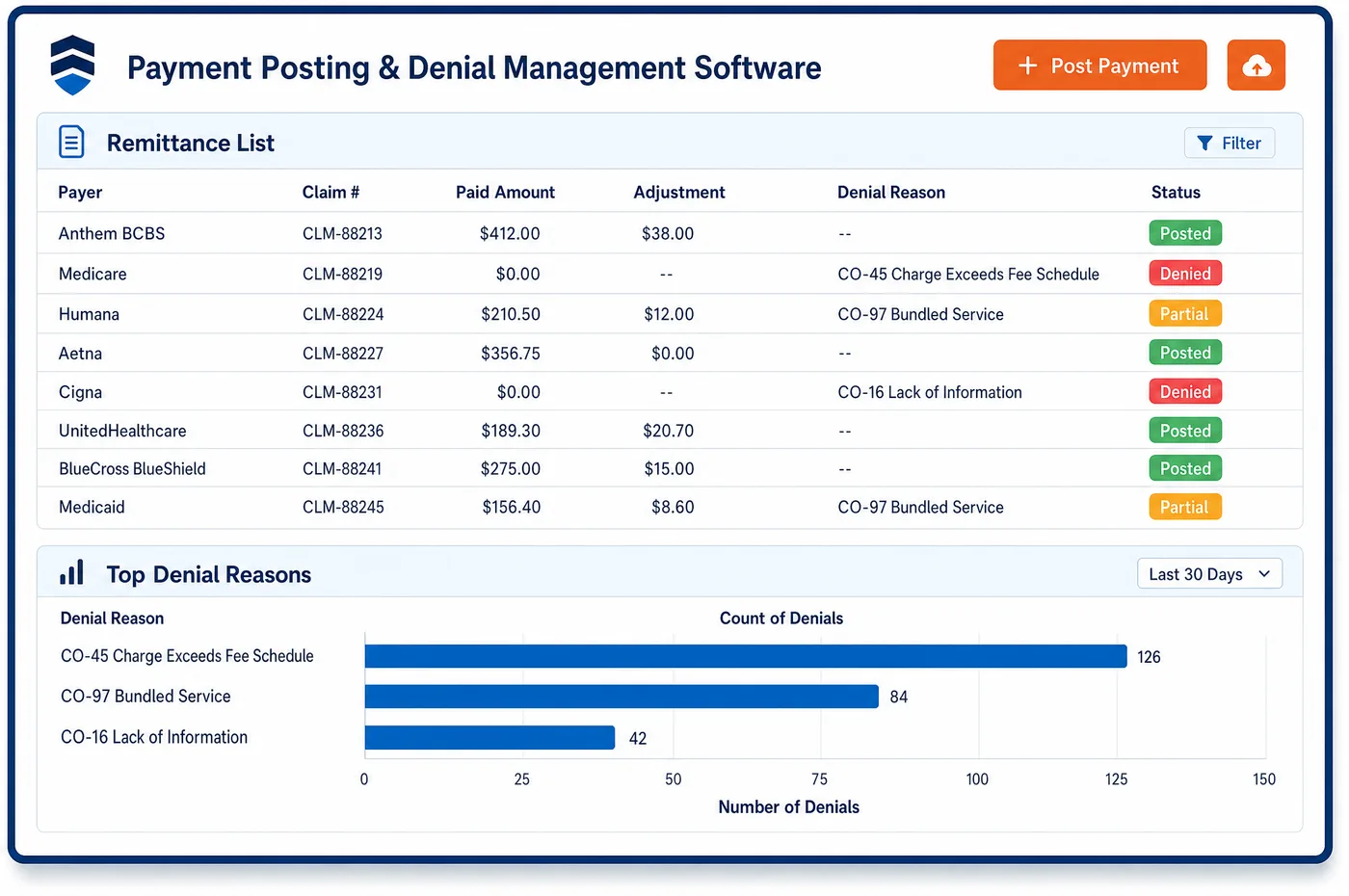
A diabetes claim often mixes services that pay under very different rules. One date might carry an office visit with modifier 25, a CGM interpretation billed as 95251, and an A1c test run on a waived analyzer. A training day carries several units of G0108 or G0109. Unlimited Systems imports the electronic remittance, matches it to the claim and posts each line with its own allowed amount and adjustment codes. The Part B deductible and coinsurance on a training line move to the next payer or to the patient. A nutrition therapy line that Medicare pays in full leaves no patient share at all. Units denied because the yearly training benefit ran out post at zero with their reason code shown, so staff can see whether hours were miscounted. Each day's posted cash is then matched to the bank deposit, so the ledger and the bank agree.
Why Is Payment Posting Different in Diabetes Care?
Diabetes education is billed in time units against a fixed yearly benefit. Medicare covers up to ten hours of initial self-management training, then two hours of follow-up each year after that, and nutrition therapy has its own separate hours. When a payer decides the hours are used up, the denial shows up at posting. A poster who sees only a zero-pay line may write it off. A poster who sees the reason code and the hours already billed can tell a real benefit limit from a counting mistake.
Monthly device work adds a second pattern. A clinician who reads a patient's CGM data and writes a report bills 95251, and that code may be reported once a month at most. A payer that sees two interpretations in one month will deny one, for example with a frequency reason code. Posting has to show which month the line belongs to and which clinician signed the report, so the fix is quick.
Patient shares also differ by service in ways that surprise staff. Under Medicare Part B, diabetes training carries the deductible and coinsurance, while covered nutrition therapy costs the patient nothing. Diagnostic lab tests such as an A1c usually carry no patient share either. Commercial and Medicare Advantage plans set their own rules. Payment posting in diabetes care has to read each line's group code and amount as the payer sent it, rather than apply one rule to the whole claim.
What Diabetes Care Payment Posting Software Handles
- DSMT units (G0108, G0109)
- Individual training posts as G0108 and group training as G0109, each billed per 30 minutes. Each unit posts on its own line, so a partial denial shows exactly which units the payer refused. (Noridian JF Part B: Diabetic, Diabetes Self-Management Training (DSMT) and Medical Nutrition Therapy (MNT) (updated 2025-07-11))
- Benefit limit reached (CARC 119)
- CARC 119 means the benefit maximum for the period has been reached. Training or nutrition units denied this way post at zero and go to follow-up on open claims with the hours billed so far shown beside them. (X12 Claim Adjustment Reason Codes)
- Frequency denials on 95251 (CARC 151)
- CARC 151 says the payer thinks the record does not support this many services. On a second 95251 in a month, the line posts at zero and is tagged with its service month and signing clinician. (X12 Claim Adjustment Reason Codes)
- Same or similar service already paid (RARC M86)
- RARC M86 marks a service denied because a similar one was already paid in a set time frame. It can appear on a repeat CGM startup code, since 95249 is reported only once while the patient owns the receiver. (X12 Remittance Advice Remark Codes)
- Nutrition therapy with no patient share (97802, 97803)
- Covered nutrition therapy under 97802 and 97803 leaves the patient owing nothing under Medicare. Those lines post with no coinsurance, so no statement is created by mistake. (Medicare.gov: Medical nutrition therapy services)
- In-office A1c (83036 with QW)
- An A1c run on a CLIA-waived analyzer is billed as 83036 with the QW modifier. Medicare-covered diagnostic lab tests usually carry no patient share, so the paid line should close with no balance left. (CMS MLN Matters MM13455: New Waived Tests (83036QW))
How Does Diabetes Care Payment Posting Software Work?
1. Import each remittance
Remittances from Medicare, Medicare Advantage plans and commercial payers are imported as they arrive. Each one is matched to its claim by claim number and service line.
2. Post each line on its own
Visit, CGM, training, nutrition and lab lines post with their own paid amount and adjustments. A claim that paid the visit but denied a training unit shows both, not a blended total.
3. Route the patient share
Deductible and coinsurance move to a supplemental payer when the remittance shows a crossover, or to the patient when it does not. Balances that stay with the patient flow on to diabetes patient statements.
4. Send zero-pay lines to an owner
Benefit-limit and frequency denials are routed by reason code. The line keeps its service month, unit count and signing clinician, so the next person does not have to rebuild the story.
5. Reconcile to the bank
Electronic payments are paired with their 835 by trace number. Cash, contractual adjustments and recoveries then post as double-entry lines for the general ledger.
Diabetes Care Payment Posting Software vs. Generic Software
| Area | Generic approach | Unlimited Systems |
|---|---|---|
| Training units | Units keyed in as one total per claim. | Each G0108 or G0109 unit posted on its own line. |
| Benefit-limit denials | Zero-pay training lines written off as small balances. | CARC 119 lines routed with hours billed shown. |
| Patient shares | One coinsurance rule applied to every line. | Each line's group code and amount posted as sent. |
| Monthly CGM reads | Second interpretations in a month found at month end. | Frequency denials tagged with month and clinician. |
| Deposits | Bank totals matched by hand in a spreadsheet. | Trace numbers pair each deposit with its 835. |
Who Uses It in a Diabetes Care Practice
- Payment poster: A brief list of lines that failed to post cleanly, each carrying a next step drawn from its CARC and RARC.
- Diabetes program manager: Training and nutrition denials by payer, so referral and hour-count problems get fixed before the next class is billed.
- Practice owner: Diabetes service cash that ties to the bank, with a clear view of what each payer pays for training, CGM work and lab tests. Trends feed diabetes care analytics.
Diabetes Care Payment Posting Software FAQs
Payment posting reads each training line on the 835. When a payer denies G0108 or G0109 units with CARC 119, the benefit maximum has been reached, so the line posts at zero and goes to follow-up. Staff see the hours already billed and can check whether the payer's count matches the practice's own before they appeal or adjust.
Code 95251 may be reported once a month at most. When a second interpretation lands in the same month, the payer usually denies it, for example with a frequency reason such as CARC 151. The posted line keeps its service month and signing clinician, so staff can confirm the duplicate and correct the charge rather than appeal it.
Under Medicare, a patient who qualifies for medical nutrition therapy pays nothing for the covered service. The 835 shows no deductible or coinsurance on those lines, and the posting follows it. Commercial and Medicare Advantage plans can set their own cost sharing, so each payer's remittance is posted as sent rather than by a fixed rule.
Diabetes self-management training carries the Part B deductible and coinsurance. The 835 shows those amounts with patient responsibility group codes. If the remittance says the claim crossed over to a supplemental plan, the amount waits for that payer. If it does not, the amount moves to the patient's balance and appears on the next statement.
Code 95249 covers startup and training on a patient's own CGM and is reported only once while the patient owns that receiver. A repeat claim can be denied with a remark such as M86. The line posts at zero, and staff check whether the patient truly has a new receiver or whether the code was added by mistake.
Each electronic funds transfer carries a trace number that also appears on its 835. The two are paired, so every deposit links to the remittance and the lines it paid. Cash, adjustments and recoveries post as double-entry lines, which means month-end close starts from a ledger that already agrees with the bank.
Related Diabetes Care Software
Payments & AR
In the revenue cycle
Payment Posting for related specialties
Sources
- Noridian JF Part B: Diabetic, Diabetes Self-Management Training (DSMT) and Medical Nutrition Therapy (MNT) (updated 2025-07-11)
- X12 Claim Adjustment Reason Codes
- X12 Remittance Advice Remark Codes
- AAFP: Coding for Remote Patient Monitoring and Continuous Glucose Monitoring
- Medicare.gov: Medical nutrition therapy services
- Medicare.gov: Diabetes self-management training
- CMS MLN Matters MM13455: New Waived Tests (83036QW)
GET STARTED
See Unlimited Systems in Action
Whether you're actively evaluating new technology or simply preparing for your next vendor renewal, Unlimited Systems can help you understand where your current workflows may be creating avoidable revenue risk.