

Payments & AR
Diabetes Care AR Management Software
Work open training, nutrition and CGM claims by payer, referral status and filing deadline, so small diabetes balances are paid before they expire.
Diabetes Care AR Management Software keeps every unpaid diabetes claim in front of the right person. Training, nutrition therapy, CGM and visit claims are sorted by value, age and filing deadline. Claim status checks run in bulk, and each open claim shows whether a referral, an hour limit or a modifier is holding it up.



 6,500+ specialty providers

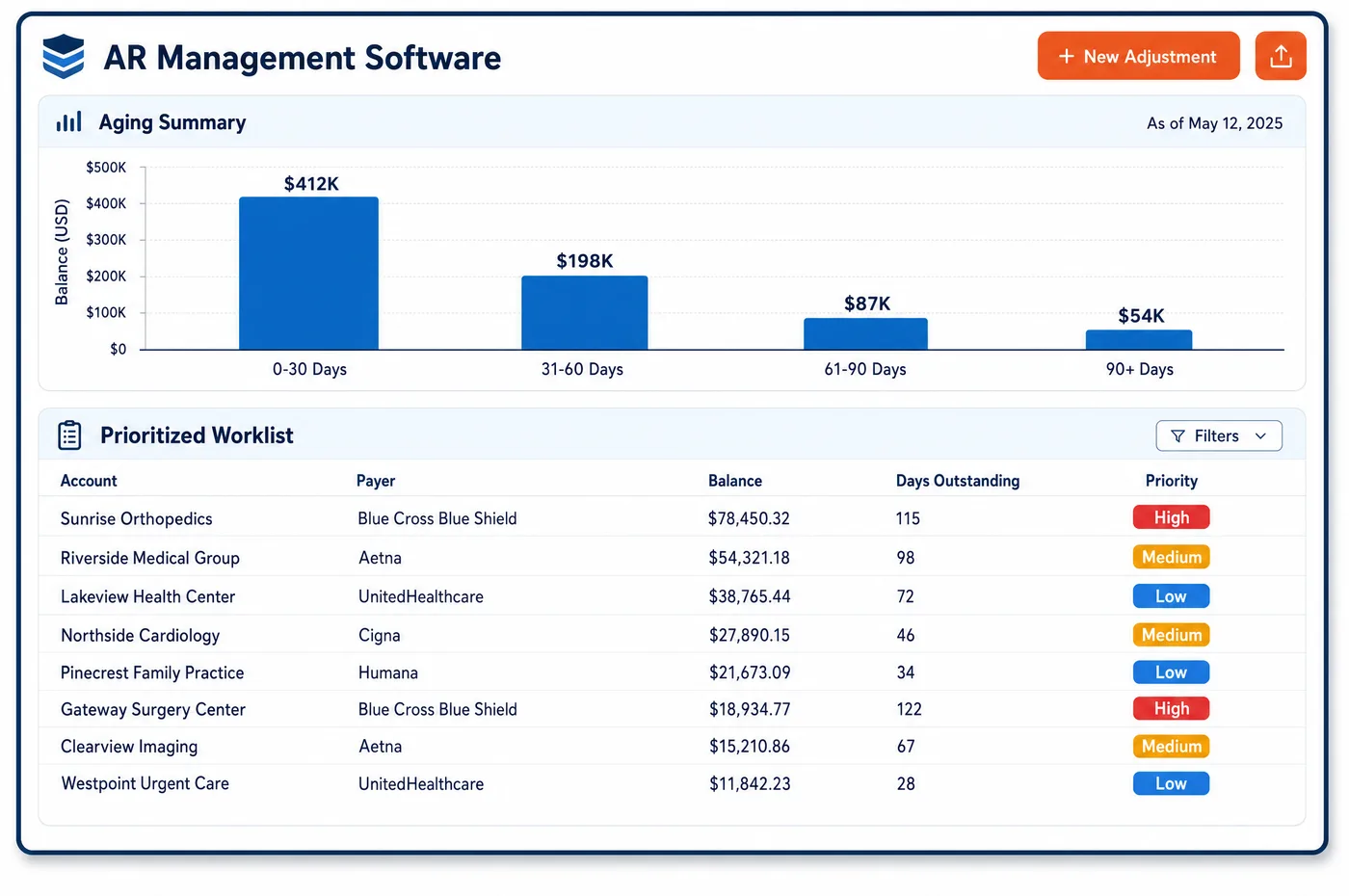
AR Management in a Diabetes Care Practice
Most diabetes claims are small, and there are a lot of them. A group class adds a few G0109 units for each patient. A monthly CGM read adds one 95251 line. A nutrition visit adds a handful of timed units. None of these looks urgent on its own, so they age quietly. AR management software for diabetes care sorts open claims by dollar value, payer and how close each one is to its filing limit. Bulk claim status requests show which claims are paid, pending or denied before anyone calls a payer. Claims stuck on a missing referral, a training year that ran out, or a visit that needed modifier 25 are grouped by cause. A billing team can then fix a whole batch at once. Secondary claims go out once the primary payment posts, so the supplemental share does not sit unbilled.
Why Is AR Management Different in Diabetes Care?
Diabetes services create a long tail of low-dollar claims. One patient in a training program may produce claims on several dates, each with a few units. A practice that works AR from a list sorted by balance will reach these last, and some will pass the Medicare filing limit before anyone looks. Ranking by deadline as well as value keeps small claims from expiring.
Many open diabetes claims are held up by paperwork rather than by payment rules. Training needs an order from the clinician treating the diabetes, and Medicare wants a new referral each calendar year for follow-up hours. Nutrition therapy past the yearly hours needs a second referral for a change in condition. When the referral is missing, the claim sits or denies. AR management in diabetes care works best when each open claim shows which document is missing, so the request goes to the right clinician.
A third group of open claims comes from how services were billed together. Medicare does not cover training and nutrition therapy for the same patient on the same day, so one of the two will deny. A visit billed on the same date as a CGM startup or read needs modifier 25, or the payer may treat it as part of the CGM service. These are fixable errors, and the sooner a collector sees the pattern, the fewer of them reach the next claim run.
What Diabetes Care AR Management Software Handles
- Medicare filing limit (42 CFR 424.44)
- Medicare requires a claim to be filed within one calendar year of the date of service. Open diabetes claims are sorted by days left before that limit, so a small training claim near the edge rises to the top. (eCFR: 42 CFR 424.44, Time limits for filing claims)
- Bulk claim status (X12 276/277)
- Status requests go out in bulk as X12 276 transactions, and the 277 replies show paid, pending or denied status. Collectors start with claims the payer has actually stalled on. (X12 Transaction Sets (270/271, 276/277, 835, 837))
- Follow-up training referrals
- Medicare requires a new referral each calendar year for follow-up training hours. Open follow-up claims with no current referral are flagged, and the request is routed to the treating clinician. (Noridian JF Part B: Diabetic, Diabetes Self-Management Training (DSMT) and Medical Nutrition Therapy (MNT) (updated 2025-07-11))
- Same-day training and nutrition therapy
- Medicare does not cover DSMT and nutrition therapy for the same patient on the same day. When one denies, the claim is grouped with others like it, and the schedule pattern behind it is passed to the denial team. (Noridian JF Part B: Diabetic, Diabetes Self-Management Training (DSMT) and Medical Nutrition Therapy (MNT) (updated 2025-07-11))
- Modifier 25 with CGM services
- An E/M visit billed on the same date as 95250 or 95251 needs modifier 25 when it is separate and medically necessary. Visit lines denied without it are grouped, so they can be corrected and refiled together. (AAFP: Coding for Remote Patient Monitoring and Continuous Glucose Monitoring)
- Crossover to a supplemental payer (RARC MA18)
- RARC MA18 says the claim was sent on to the supplemental insurer. Those balances are tracked as open with that payer, so they are not billed to the patient while the crossover is pending. (X12 Remittance Advice Remark Codes)
How Does Diabetes Care AR Management Software Work?
1. Rank the open claims
Each morning, open diabetes claims are sorted by value, payer and days left to file. Small claims near a deadline appear next to large ones.
2. Check status in bulk
Claim status requests run for every claim past a set age. Paid claims drop off the list once the payment posts through diabetes payment posting, and denied ones move to their own queue.
3. Group claims by cause
Open claims are grouped by what is holding them: a missing referral, a used-up benefit, a same-day conflict or a missing modifier. Staff fix a batch rather than one claim at a time.
4. Request missing documents
Claims waiting on a referral or order go to the clinician who treats the diabetes. The request and its date are logged on the claim through the diabetes workflow queues.
5. Bill the next payer
Once the primary payment posts, the remaining share is billed to the secondary payer or moved to the patient. Each step is dated so aging stays accurate.
Diabetes Care AR Management Software vs. Generic Software
| Area | Generic approach | Unlimited Systems |
|---|---|---|
| Small training claims | Worked last, after large balances, and often too late. | Sorted by filing deadline as well as value. |
| Claim status | Payer portals checked one claim at a time. | Bulk 276 requests with 277 replies on the claim. |
| Missing referrals | Found only after the claim denies. | Flagged on the open claim and routed to the clinician. |
| Repeat errors | Each denial worked alone, so the cause repeats. | Claims grouped by cause and fixed as a batch. |
| Secondary balances | Billed by hand when someone remembers. | Billed once the primary payment posts. |
Who Uses It in a Diabetes Care Practice
- AR collector: A sorted list of open diabetes claims, with the reason each one is stuck and the documents needed to free it.
- Billing manager: Aging by payer, service and cause, so referral gaps and modifier errors can be fixed upstream.
- Diabetes program manager: Open training and nutrition claims by class and educator, showing which referrals are still missing.
Diabetes Care AR Management Software FAQs
AR management software ranks open claims by filing deadline as well as dollar value. A training claim worth little rises to the top as it nears the Medicare filing limit of one calendar year from the date of service. Collectors see it beside the larger claims, so it is worked before it becomes a write-off.
Medicare requires a new referral each calendar year for follow-up training hours. When the referral on file is from a prior year, the claim can deny or sit unpaid. Open follow-up claims without a current referral are flagged, and the request goes to the clinician who treats the patient's diabetes so the claim can be refiled.
Medicare does not cover diabetes training and nutrition therapy for the same patient on the same day. One of the two claims will be denied. The open claim is grouped with others like it, and the pattern is shared with scheduling so the two services are booked on different days in future.
Claim status checks run in bulk using X12 276 requests, and the 277 replies are saved on each claim. Collectors see whether a payer has paid, pended or denied a claim before they call. Claims the payer has no record of stand out, so they can be resubmitted quickly.
When an office visit is billed on the same date as a CGM startup or interpretation, the visit needs modifier 25 if it was a separate, necessary service. Visit lines denied without it are grouped as one fixable error. Staff check the note, add the modifier where it is supported, and refile the batch.
Once the primary payment posts, the remaining share moves on. If the 835 shows a crossover to a supplemental plan, the balance stays open with that payer. If not, a secondary claim goes out or the amount moves to the patient. Each step is dated, so the aging report shows who owes what.
Related Diabetes Care Software
Payments & AR
In the revenue cycle
AR Management for related specialties
Sources
- eCFR: 42 CFR 424.44, Time limits for filing claims
- X12 Transaction Sets (270/271, 276/277, 835, 837)
- Noridian JF Part B: Diabetic, Diabetes Self-Management Training (DSMT) and Medical Nutrition Therapy (MNT) (updated 2025-07-11)
- AAFP: Coding for Remote Patient Monitoring and Continuous Glucose Monitoring
- X12 Remittance Advice Remark Codes
GET STARTED
See Unlimited Systems in Action
Whether you're actively evaluating new technology or simply preparing for your next vendor renewal, Unlimited Systems can help you understand where your current workflows may be creating avoidable revenue risk.