

Billing & claims
Diabetes Care Medical Billing Software
Build and send clean claims for diabetes visits, CGM services, in-office A1c, DSMT and nutrition therapy, then track each one to an answer.
Diabetes Care Medical Billing Software builds, checks and sends the claims a diabetes practice produces. It puts the referring physician on nutrition therapy claims, bills DSMT and nutrition time in the right units, adds the CLIA details to in-office A1c claims, applies modifier 25 where an E/M is billed with CGM work, and tracks each claim's status.



 6,500+ specialty providers

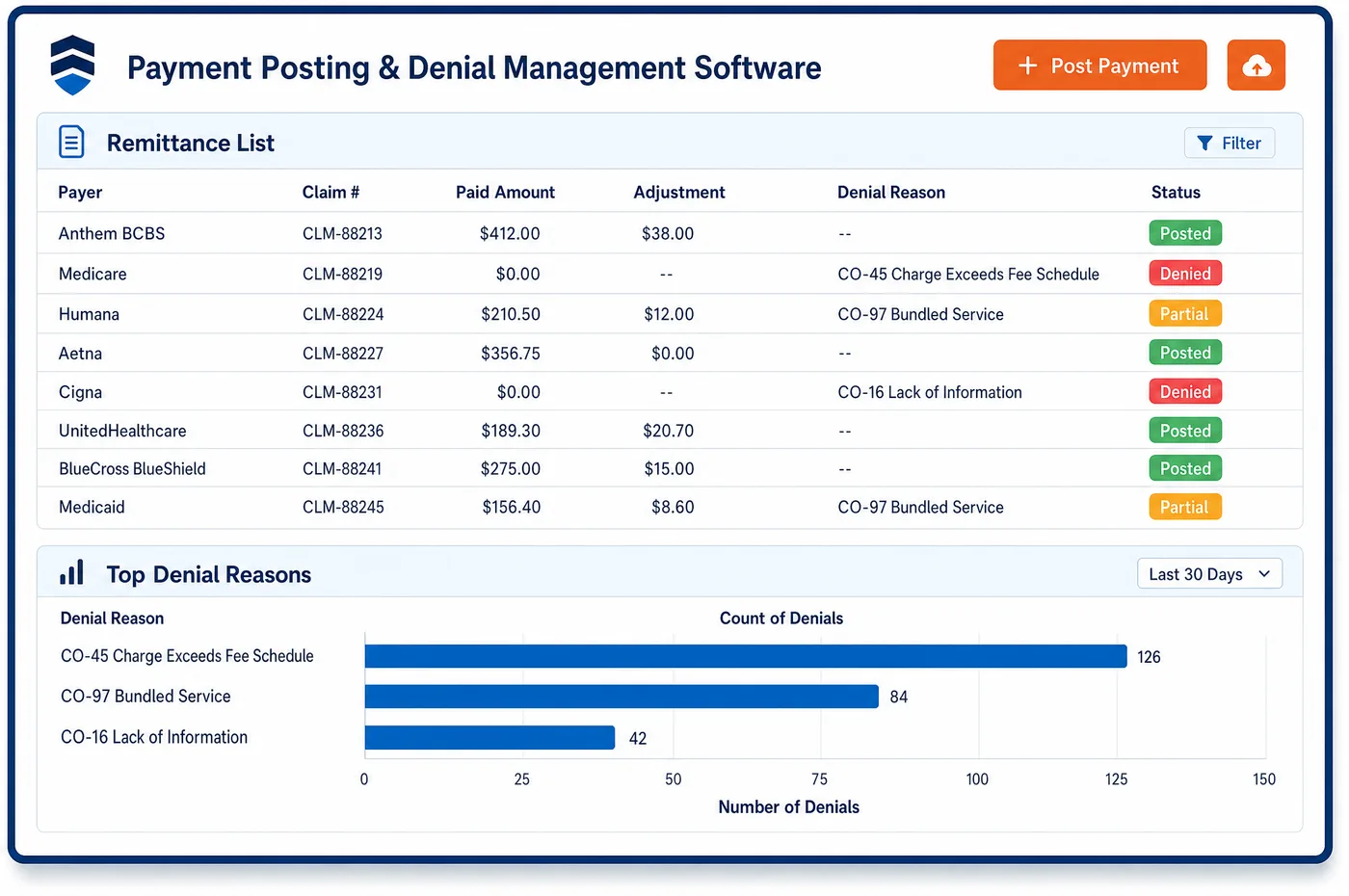
Medical Billing in a Diabetes Care Practice
Diabetes claims look simple until a detail is missing. A nutrition therapy claim from a dietitian must name the referring physician and NPI, or Medicare returns it. DSMT is billed in half-hour units under G0108 or G0109, and nutrition therapy in quarter-hour or half-hour units depending on the code. An in-office A1c from a waived analyzer goes out as 83036 with modifier QW under the site's CLIA certificate. An E/M visit on the same day as CGM interpretation needs modifier 25 when it is separately identifiable. Diabetes care medical billing software builds each claim from the coded charges, runs payer edits before it leaves, and sends it electronically through the clearinghouse. Acknowledgments and status come back to the same claim record. A rejection for a missing referring provider shows the remark code and the field to fix. Hospital-based DSMT programs bill on the institutional form under their own revenue code, so the claim form follows the setting.
Why Is Medical Billing Different in Diabetes Care?
Diabetes billing carries more names per claim than most office billing. The rendering provider may be a dietitian or a nurse educator working under an accredited program. The referring physician must appear for nutrition therapy. The supervising physician matters for a professional CGM placement. A claim builder that only knows the physician who saw the patient will send claims that are returned or denied for a name or NPI that was never filled in.
Units and same-day rules trip up claims next. Time-based education codes count in set increments, and Medicare's edits stop DSMT past its yearly hours. DSMT and nutrition therapy billed on the same date for one patient are blocked. An E/M with CGM interpretation needs modifier 25, and that modifier then blocks G2211 unless the other service is an allowed preventive one. These are claim-level checks, best made before the claim scrubber hands off to the payer.
Settings also change the claim form. A physician practice bills DSMT on the CMS-1500. A hospital outpatient program bills it on the institutional claim with revenue code 0942. Billing staff who handle more than one site need the claim to follow the setting without retyping. Medical billing is one stage of the diabetes revenue cycle, and clean claims here make every later stage easier.
What Diabetes Care Medical Billing Software Handles
- Referring physician on nutrition therapy claims (97802, 97803, 97804)
- The referring physician's NPI must be on the CMS-1500 claim a dietitian submits for MNT, and Medicare returns claims without it. The claim pulls the referring physician from the referral, not from the visit. (CMS Medicare Claims Processing Manual, Chapter 4, Section 300: Medical Nutrition Therapy Services)
- DSMT units (G0108, G0109)
- G0108 covers individual training and G0109 group training of two or more, each per 30 minutes. Session time on the roster is converted to units on the claim, and DSMT is billed to the regular A/B MAC, not a specialty contractor. (CMS Medicare Claims Processing Manual, Chapter 18, Section 120: Diabetes Self-Management Training Services)
- Institutional DSMT claims (revenue code 0942)
- Hospital outpatient DSMT is billed on the CMS-1450 with revenue code 942 and G0108 or G0109 in the HCPCS field. The claim form and revenue code follow the program's setting. (CMS Medicare Benefit Policy Manual, Chapter 15, Section 300: Diabetes Self-Management Training Services)
- In-office A1c (83036QW)
- Medicare pays lab tests only from a facility with a valid CLIA certificate, and waived tests need modifier QW. In-office A1c claims carry 83036QW and the site's certificate details. (CMS MLN Matters MM13455: New Waived Tests (CLIA certificate edits and modifier QW))
- E/M with CGM services (95250, 95251)
- An E/M visit can be billed with 95250 or 95251 only when it is medically necessary and separately identifiable, with modifier 25. The claim check asks for modifier 25 and then holds G2211 for review under Medicare. (American Academy of Family Physicians: Coding for Remote Patient Monitoring and Continuous Glucose Monitoring)
- Referring provider remark codes (N285, N286)
- RARC N285 means the referring provider name is missing or invalid, and N286 means the same for the referring provider's identifier. These remarks route back to the claim with the referral attached for a quick fix. (X12 Remittance Advice Remark Codes)
How Does Diabetes Care Medical Billing Software Work?
1. Build the claim from coded charges
Coded charges from the visit, class or nutrition session become a claim with the rendering, referring and billing providers filled in. The claim form follows the setting, professional or institutional.
2. Run edits before submission
Payer edits check units, modifiers, same-day conflicts and yearly limits. Claims with a missing referring NPI or CLIA detail are held for a fix.
3. Submit through the clearinghouse
Clean claims go out electronically through the clearinghouse. Acknowledgments return to the claim record, so staff see which claims the payer accepted.
4. Track status to payment
Claim status is checked until each claim is paid, denied or returned. Claims with no answer move to a follow-up queue.
5. Fix rejections at the source
A rejection shows the reason and remark code beside the field to correct. Repeated causes, such as missing referrals, are fixed in setup so they don't return.
Diabetes Care Medical Billing Software vs. Generic Software
| Area | Generic approach | Unlimited Systems |
|---|---|---|
| Referring provider | Left blank on nutrition therapy claims, which are then returned. | Pulled from the referral onto every MNT claim. |
| Education units | Minutes converted to units by hand. | Roster time converted to units for each code. |
| Lab claims | Missing modifier QW or CLIA details. | Site CLIA details and QW applied to waived tests. |
| Same-day services | E/M billed with CGM interpretation without modifier 25. | Modifier 25 checked, with G2211 held for review. |
| Claim form | Staff rekey claims for hospital-based programs. | Professional or institutional form chosen by setting. |
Who Uses It in a Diabetes Care Practice
- Billing specialist: Claims that arrive with providers, units and modifiers filled in, and rejections that point to the field to fix.
- Dietitian: Nutrition therapy claims that carry the referring physician every time, so their work is paid on the first pass.
- Billing manager: Status for every claim in one place, and fewer returned claims from missing referral details.
Diabetes Care Medical Billing Software FAQs
Medical billing for diabetes care involves more providers and more time-based codes than most office billing. Nutrition therapy claims need the referring physician, DSMT and nutrition codes bill in set time units, in-office A1c tests need CLIA details, and CGM work often sits beside an E/M visit. Each adds a field that must be right before the claim goes out.
Medicare returns nutrition therapy claims from dietitians that don't include the referring physician's NPI. Only a physician can refer for this benefit. Pulling the referring physician from the referral record onto each claim prevents the return, and a remark code such as N286 points staff to the missing identifier if one slips through.
G0108 and G0109 are each billed per 30 minutes, individual or group. The time on the class roster is converted to units for each patient who attended. Medicare's edits stop initial training past ten hours and follow-up past two hours a year, so the units billed should match the order and the hours left.
An in-office A1c from a waived analyzer is billed as 83036 with modifier QW. Medicare edits lab claims against the site's CLIA certificate, so the certificate must be valid and cover the test. The claim carries those details, and claims missing them are held before submission rather than denied later.
An E/M visit can be billed on the same day as CGM services when it is medically necessary and separately identifiable, with modifier 25 on the E/M. Under Medicare, modifier 25 makes G2211 unpayable unless the other service is an allowed preventive service, so the claim check reviews the add-on too.
A hospital outpatient DSMT program bills on the institutional claim form with revenue code 942 and G0108 or G0109 in the HCPCS field. A physician practice bills the same codes on the professional form. The claim form follows the setting, so a group with both types of program can bill each correctly.
Related Diabetes Care Software
Billing & claims
In the revenue cycle
Medical Billing for related specialties
Sources
- CMS Medicare Claims Processing Manual, Chapter 4, Section 300: Medical Nutrition Therapy Services
- CMS Medicare Claims Processing Manual, Chapter 18, Section 120: Diabetes Self-Management Training Services
- CMS Medicare Benefit Policy Manual, Chapter 15, Section 300: Diabetes Self-Management Training Services
- CMS MLN Matters MM13455: New Waived Tests (CLIA certificate edits and modifier QW)
- American Academy of Family Physicians: Coding for Remote Patient Monitoring and Continuous Glucose Monitoring
- X12 Remittance Advice Remark Codes
GET STARTED
See Unlimited Systems in Action
Whether you're actively evaluating new technology or simply preparing for your next vendor renewal, Unlimited Systems can help you understand where your current workflows may be creating avoidable revenue risk.