

Billing & claims
Diabetes Care Invoicing Software
Format and send each diabetes bill the way its payer expects, from institutional DSMT claims to self-pay class fees and facility contracts.
Diabetes Care Invoicing Software produces the bills a diabetes practice sends, in the form each recipient expects, and tracks them to payment. That covers professional and institutional claims for education and nutrition therapy, patient invoices after a signed ABN, self-pay class fees, and invoices to hospitals or other partners that contract for educator time.



 6,500+ specialty providers

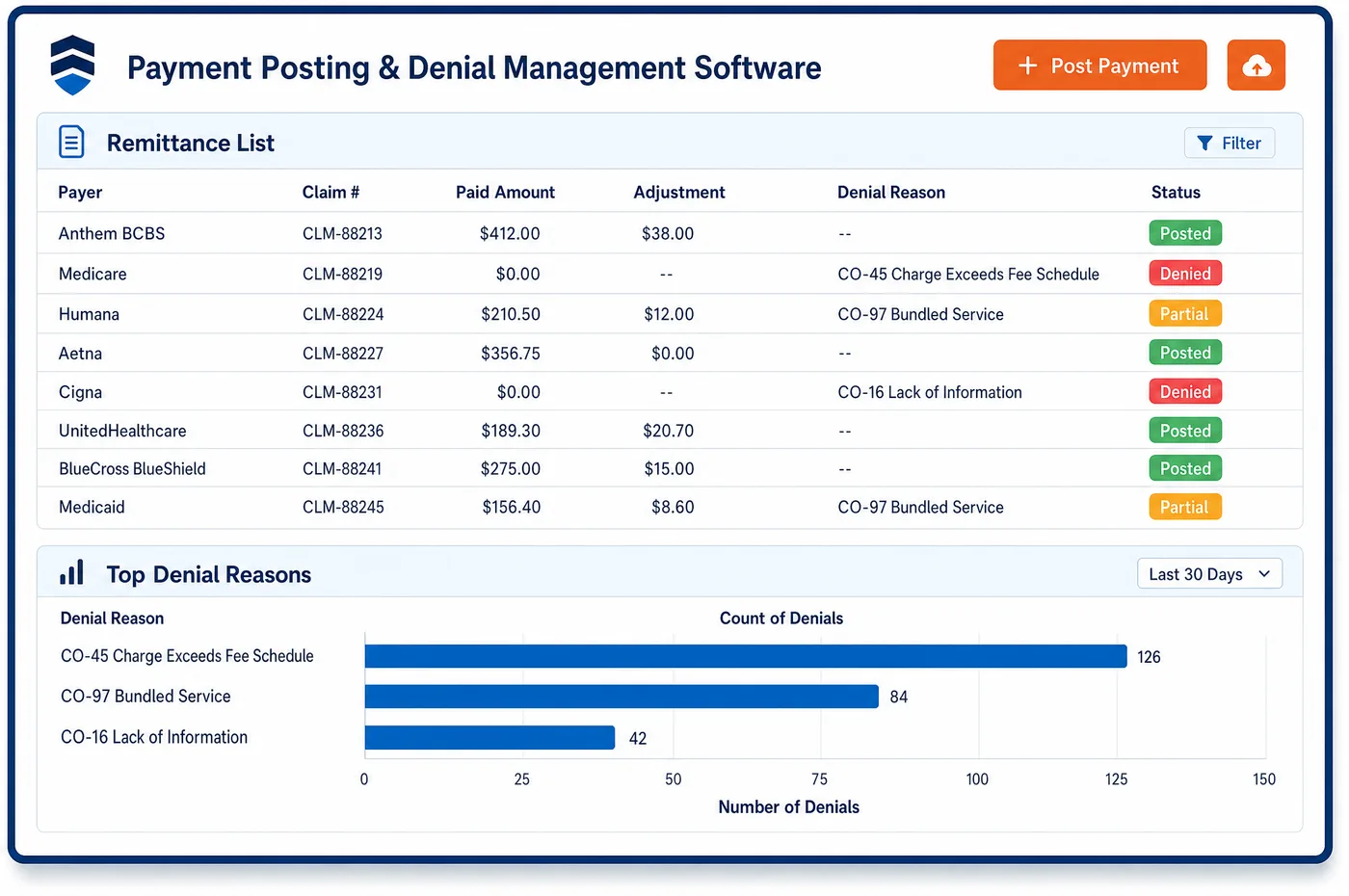
Invoicing in a Diabetes Care Practice
Not every diabetes bill is an ordinary office claim. A hospital outpatient DSMT program bills on the institutional form with its own revenue code. A dietitian who has reassigned benefits to a hospital is billed through the hospital, not under the dietitian's own number. A patient who signed an ABN before a class past their Medicare hours owes for that class. People with prediabetes, who don't qualify for Medicare DSMT, may take classes as self-pay. A hospital or employer may contract with the practice for educator time. Diabetes care invoicing software formats each of these to the recipient's rules. Claims go out electronically over a real-time clearinghouse connection, with formatting set per payer so staff don't edit each one. Each patient invoice is sent by email or text, with a link for paying online. Contract invoices list the sessions delivered. Each invoice is tracked until it is paid, so nothing waits in a drawer.
Why Is Invoicing Different in Diabetes Care?
Diabetes programs often sit across settings. One group may run a hospital-based education program, a physician-office clinic and nutrition visits by dietitians who work for either one. Who bills depends on the setting and on whether the dietitian reassigned benefits. Invoicing has to follow that map, or the same service is billed twice or not at all.
Some revenue never goes to an insurer. Classes for people with prediabetes, refresher courses beyond covered hours, and sessions for family members who aren't patients can all be self-pay. When a patient signs an advance beneficiary notice and Medicare then denies the extra hours, the balance becomes the patient's. These invoices need clear wording, so the patient sees what the class was and why they owe for it.
Contracts add a third kind of bill. A hospital may pay the practice for educator coverage, or an employer may buy a class series for its staff. These are invoices to an organization, priced by agreement, with no claim behind them. Tracking them in the same place as claims lets the practice see total program revenue, not just what insurers paid. Patient balances then move on to patient billing for statements.
What Diabetes Care Invoicing Software Handles
- Institutional DSMT claims (G0108, G0109)
- Hospital-based programs bill DSMT on the CMS-1450 or its electronic form, with revenue code 942 and G0108 or G0109 in the HCPCS field. Claim formatting for those sites is set up once. (CMS Medicare Benefit Policy Manual, Chapter 15, Section 300: Diabetes Self-Management Training Services)
- Hospital billing of dietitian services (97802, 97803, 97804)
- A hospital outpatient department can bill MNT to its A/B MAC (A) only when the dietitian has reassigned benefits to it. Otherwise the dietitian bills under their own number, so invoicing follows the reassignment on file. (CMS Medicare Claims Processing Manual, Chapter 4, Section 300: Medical Nutrition Therapy Services)
- Patient invoices after an ABN
- Under Medicare, the patient is liable for DSMT hours denied over the limit when a valid ABN was given, and the provider is liable without one. The signed ABN is linked to the patient invoice. (CMS Medicare Claims Processing Manual, Chapter 18, Section 120: Diabetes Self-Management Training Services)
- Cost sharing on DSMT
- The Part B deductible and coinsurance apply to DSMT. After Medicare pays, the patient's share of each G0108 or G0109 line moves to their invoice with the class date shown. (CMS MLN Fact Sheet MLN909381: Provider Information on Medicare Diabetes Self-Management Training)
- Self-pay classes for prediabetes
- Medicare DSMT covers beneficiaries diagnosed with diabetes, so classes for people with prediabetes fall outside that benefit. The practice can invoice these as self-pay or under other program terms. (CMS Medicare Benefit Policy Manual, Chapter 15, Section 300: Diabetes Self-Management Training Services)
- Dietitian assignment
- Registered dietitians who bill Medicare must accept assignment, so the limiting charge doesn't apply. Patient invoices for MNT reflect only the patient's share of the allowed amount. (CMS Medicare Claims Processing Manual, Chapter 4, Section 300: Medical Nutrition Therapy Services)
How Does Diabetes Care Invoicing Software Work?
1. Set formats by payer and setting
Each payer and site has its own claim format, set once. Professional and institutional claim forms are chosen by the setting.
2. File claims electronically
Claims go out over a real-time clearinghouse connection without staff reformatting them. Acceptance and rejection notices come back to the invoice record.
3. Invoice patients for their share
After the payer pays, the patient's share or an ABN-backed balance becomes an invoice. It goes out by email or text with a link to the patient payment options.
4. Invoice contracts and self-pay programs
Contract sessions and self-pay classes are invoiced to the organization or person who agreed to pay. Each invoice lists the dates and sessions delivered.
5. Track every invoice to payment
Open invoices are aged and followed up, whether a payer, a patient or a partner owes them. Paid invoices close against the account.
Diabetes Care Invoicing Software vs. Generic Software
| Area | Generic approach | Unlimited Systems |
|---|---|---|
| Claim formats | Staff adjust formats claim by claim. | Formatting set per payer, applied without staff edits. |
| Hospital programs | Services billed under the wrong entity. | Billing entity follows the setting and any reassignment on file. |
| ABN balances | Patients billed with no notice on file. | Invoices linked to the signed ABN. |
| Self-pay classes | Tracked in a spreadsheet. | Invoiced and tracked with other program revenue. |
| Contract billing | Word documents emailed to partners. | Invoices listing sessions delivered, aged with other receivables. |
Who Uses It in a Diabetes Care Practice
- Billing specialist: Payer formats that apply themselves, and one list of open invoices across payers, patients and partners.
- Program director: Total program revenue, including contracts and self-pay classes, beside insurer payments.
- Patient: A clear invoice for a class or visit, sent by text or email, with a way to pay online.
Diabetes Care Invoicing Software FAQs
Invoicing in a diabetes practice covers more than insurance claims. It includes professional and institutional claims, patient invoices for cost sharing or ABN-backed balances, self-pay classes such as prediabetes programs, and invoices to hospitals or employers that contract for educator time. Each is formatted for the recipient and tracked until paid.
A hospital outpatient program bills DSMT on the institutional claim, the CMS-1450 or its electronic form, with revenue code 942 and G0108 or G0109. A physician-office program sends G0108 and G0109 on the professional claim instead. Setting the format once per site keeps each program's claims in the right shape.
A patient can be invoiced for their deductible and coinsurance on covered DSMT, for a self-pay class, or for Medicare hours past the limit if they signed a valid ABN first. Without a valid ABN, the provider is liable for those extra hours. Linking the ABN to the invoice keeps the balance supportable.
If the dietitian has reassigned benefits to the hospital, the hospital bills Medicare for the nutrition therapy. If not, the dietitian bills under their own provider number, or the hospital bills the professional contractor. Invoicing follows the reassignment on file, so each visit is billed once by the right entity.
Contract services, such as educator time provided to a hospital or a class series bought by an employer, can be invoiced to that organization and tracked in the same place as claims. The invoice lists the sessions delivered under the agreement. Seeing both together shows the program's full revenue.
Medicare DSMT is for beneficiaries diagnosed with diabetes, so classes for people with prediabetes are outside that benefit. Practices that run them can invoice the participant directly, or bill under another program's own terms where one applies. Keeping these invoices with other program revenue shows what the classes bring in.
Related Diabetes Care Software
Billing & claims
Invoicing for related specialties
Sources
- CMS Medicare Benefit Policy Manual, Chapter 15, Section 300: Diabetes Self-Management Training Services
- CMS Medicare Claims Processing Manual, Chapter 4, Section 300: Medical Nutrition Therapy Services
- CMS Medicare Claims Processing Manual, Chapter 18, Section 120: Diabetes Self-Management Training Services
- CMS MLN Fact Sheet MLN909381: Provider Information on Medicare Diabetes Self-Management Training
GET STARTED
See Unlimited Systems in Action
Whether you're actively evaluating new technology or simply preparing for your next vendor renewal, Unlimited Systems can help you understand where your current workflows may be creating avoidable revenue risk.