

Billing & claims
Diabetes Care RCM Software
Run the diabetes revenue cycle from referral to payment across clinic visits, CGM services, in-office A1c, DSMT and nutrition therapy.
Diabetes Care RCM Software runs the revenue cycle for a diabetes practice from the first referral to the last payment. It covers eligibility and education hours up front, coding for visits, CGM services and in-office A1c, claims for DSMT and nutrition therapy, payment posting, denials and the measures that show where money is lost.



 6,500+ specialty providers

RCM in a Diabetes Care Practice
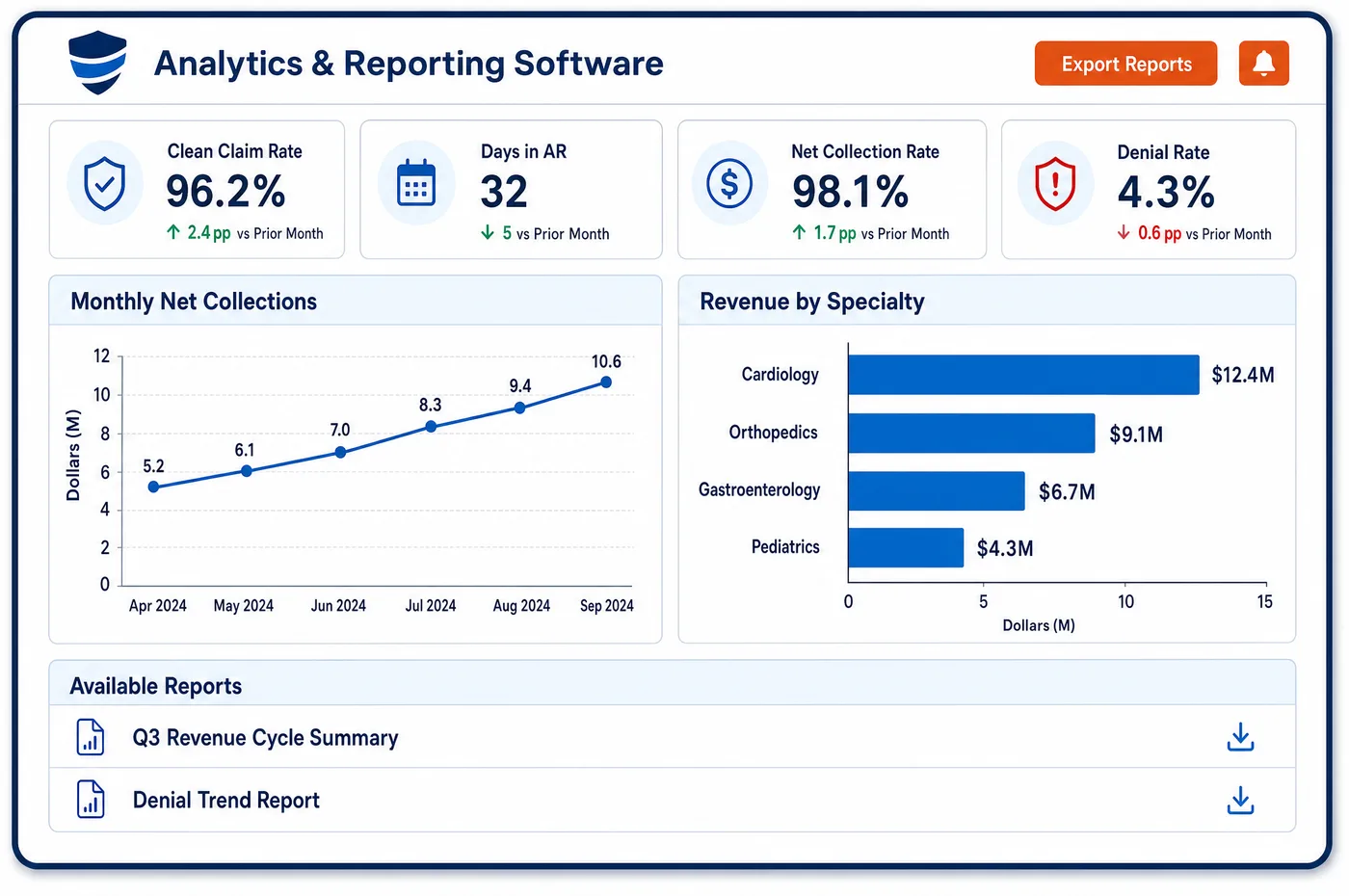
A diabetes practice earns from several small streams, not one large one. Clinic visits carry most of the revenue, often with the G2211 add-on for long-term care. CGM start-up and interpretation codes add a little per patient each month. An in-office A1c is billed under a CLIA certificate. DSMT is billed by the accredited program, and nutrition therapy by an enrolled dietitian. CGM sensors, pumps and diabetic shoes are billed by suppliers, yet the practice's notes decide whether those claims get paid. Diabetes care RCM software ties these streams to one patient account. Front-end checks count education hours and confirm referrals. Coding rules catch frequency limits and same-day conflicts. Claims go out through a clearinghouse, payments post from the 835, and denials are grouped by cause. Reports show revenue by service line, hours ordered against hours billed, and which denial causes repeat, so the practice can see whether each program pays for itself.
Why Is RCM Different in Diabetes Care?
The revenue in diabetes care is spread thin. Each CGM interpretation or class session pays a modest amount, and the volume is steady rather than large. A small leak, such as a missing referral NPI or a class billed past the yearly limit, repeats across hundreds of patients. RCM for diabetes care has to catch these at the front, because working them one by one at the back costs more than they are worth.
Program rules also sit outside the normal physician billing setup. DSMT must come from a program accredited by the ADA or ADCES, and payment is made only for sessions the patient attended and signed in for. Nutrition therapy is billed by a dietitian who is enrolled with Medicare and accepts assignment. An in-office A1c needs a CLIA certificate that covers the test. Each of these is a setup task as much as a claim task.
Many practices weigh running billing in-house against outsourcing it. The choice matters less than whether whoever bills knows the education hour edits, the referral rules and the device documentation that suppliers ask for. A revenue cycle that sees all of these in one place makes that work visible, whoever does it. Medical billing for diabetes care then handles the claim mechanics inside that cycle.
What Diabetes Care RCM Software Handles
- Accredited DSMT program (G0108, G0109)
- Medicare covers DSMT only from a program accredited by a CMS-approved organization, today the ADA or ADCES. The accreditation and billing entity are set up once, so every G0108 and G0109 claim goes out under the right program. (CMS MLN Fact Sheet MLN909381: Provider Information on Medicare Diabetes Self-Management Training)
- Attendance-based DSMT payment
- Medicare pays for DSMT only for sessions the patient actually attended, documented on attendance sheets. Class rosters are kept with the claim, so each billed half hour has a sign-in behind it. (CMS Medicare Benefit Policy Manual, Chapter 15, Section 300: Diabetes Self-Management Training Services)
- Dietitian enrollment for nutrition therapy (97802, 97803, 97804)
- A registered dietitian or nutrition professional must be enrolled in Medicare and accept assignment to bill 97802, 97803 or 97804. The dietitian is set up as a rendering provider, with the referring physician carried on each claim. (CMS Medicare Claims Processing Manual, Chapter 4, Section 300: Medical Nutrition Therapy Services)
- CLIA-waived A1c (83036QW)
- Medicare edits lab claims at the CLIA certificate level, and waived tests such as an in-office A1c analyzer are billed as 83036 with modifier QW. The certificate number and modifier are set up once for the site. (CMS MLN Matters MM13455: New Waived Tests (CLIA certificate edits and modifier QW))
- CGM professional services (95249, 95250, 95251)
- CGM start-up and interpretation are billed by the practice, while sensors and receivers are billed by suppliers. Codes 95250 and 95251 are not reported more than once a month, which sets the ceiling on this revenue line. (American Academy of Family Physicians: Coding for Remote Patient Monitoring and Continuous Glucose Monitoring)
- Visit complexity add-on (G2211)
- Medicare pays G2211 with office or outpatient E/M visits for ongoing care of a serious or complex condition. It isn't paid when the E/M carries modifier 25, except with allowed preventive services, so reports track how often it applies. (CMS MLN Matters MM13473: How to Use the Office and Outpatient E/M Visit Complexity Add-on Code G2211)
How Does Diabetes Care RCM Software Work?
1. Clear the patient up front
Eligibility, referral and education hours are checked when the visit or class is booked. Gaps in a CGM or pump chart are sent to the clinician before the order goes out.
2. Capture and code the service
Visits, CGM services, in-office tests, classes and nutrition sessions become coded charges. Same-day conflicts and frequency limits are checked before the claim is built.
3. Submit and track the claim
Claims go out through the clearinghouse with status tracked to payment. Rejections come back with the reason and are fixed the same way each time.
4. Post and reconcile payments
ERA payments post to the patient account, and patient balances move to statements. Payments that fall short of the expected amount are flagged.
5. Work denials and measure the cycle
Denials are grouped by cause and sent to the right queue for denial management. Reports track the revenue cycle KPIs by service line.
Diabetes Care RCM Software vs. Generic Software
| Area | Generic approach | Unlimited Systems |
|---|---|---|
| Revenue view | One total that blends visits, classes and tests. | Revenue shown by service line, including DSMT, nutrition therapy and CGM services. |
| Education billing | Hours billed without checking the order or the yearly limit. | Hours checked against the order and Medicare limits before billing. |
| Program setup | Accreditation, dietitian enrollment and CLIA details kept in a binder. | Setup stored once and applied to every claim for that service. |
| Supplier requests | Device documentation requests handled ad hoc. | Orders and notes on the patient record, ready when suppliers ask. |
| Billing model | In-house or outsourced, with no shared view of the cycle. | One view of the cycle for the practice and anyone billing for it. |
Who Uses It in a Diabetes Care Practice
- Physician owner: Revenue by program, so the practice can see whether DSMT, nutrition therapy and CGM services each cover their cost.
- Billing manager: One cycle across visits, classes and tests, with charge validation catching frequency limits before claims leave.
- Diabetes program director: Hours ordered against hours billed, and the denial causes that keep coming back.
Diabetes Care RCM Software FAQs
RCM in a diabetes practice spans clinic visits, CGM services, in-office A1c tests, DSMT classes and nutrition therapy. Each has its own rules for referrals, limits and who bills. A good revenue cycle checks those rules up front, codes each service correctly, tracks claims to payment and reports revenue by program, so leaks are found early.
In most cases a DME supplier or pharmacy bills for CGM sensors, receivers, pumps and their supplies, not the practice. The practice bills for its own services, such as CGM start-up and interpretation. The practice still matters to device revenue, because the supplier is paid only when the practice's orders and notes meet the payer's policy.
Useful RCM measures for diabetes programs include revenue by service line, education hours ordered against hours billed, denial rate by cause, and the share of classes and nutrition visits with a valid referral on file. Tracking CGM interpretation volume against the patient panel also shows whether eligible patients are being reviewed each month.
A physician practice can bill DSMT when it runs or represents a program accredited by a CMS-approved organization and already bills Medicare for other services. The program, not the individual educator, holds the accreditation. Payment is made only for sessions the patient attended, so attendance records support every claim.
Outsourcing can work if the billing team knows the education hour limits, referral rules and supplier documentation that diabetes care brings. Keeping it in-house can work for the same reason. Either way, the practice needs one view of the cycle, so it can see where hours, referrals or frequency limits are causing lost revenue.
An in-office A1c is billed as a lab test under the site's CLIA certificate. A waived analyzer is billed as 83036 with modifier QW. Medicare edits lab claims at the certificate level, and its lab policy sets a frequency limit for patients whose diabetes is controlled, so both the setup and the timing are checked.
Related Diabetes Care Software
Billing & claims
RCM for related specialties
Sources
- CMS MLN Fact Sheet MLN909381: Provider Information on Medicare Diabetes Self-Management Training
- CMS Medicare Benefit Policy Manual, Chapter 15, Section 300: Diabetes Self-Management Training Services
- CMS Medicare Claims Processing Manual, Chapter 4, Section 300: Medical Nutrition Therapy Services
- CMS MLN Matters MM13455: New Waived Tests (CLIA certificate edits and modifier QW)
- American Academy of Family Physicians: Coding for Remote Patient Monitoring and Continuous Glucose Monitoring
- CMS MLN Matters MM13473: How to Use the Office and Outpatient E/M Visit Complexity Add-on Code G2211
GET STARTED
See Unlimited Systems in Action
Whether you're actively evaluating new technology or simply preparing for your next vendor renewal, Unlimited Systems can help you understand where your current workflows may be creating avoidable revenue risk.