

Billing & claims
Diabetes Care Charge Validation Software
Check diabetes charges for same-day conflicts, yearly hour limits, CGM frequency, A1c timing, diagnosis rules and modifiers before they reach a claim.
Diabetes Care Charge Validation Software checks each charge line against coding edits, payer policy and the patient's history before the claim is built. It catches DSMT and nutrition therapy on one date, hours past Medicare's yearly limits, CGM codes billed too often, early A1c tests, missing diagnoses and modifier conflicts such as G2211 with modifier 25.



 6,500+ specialty providers

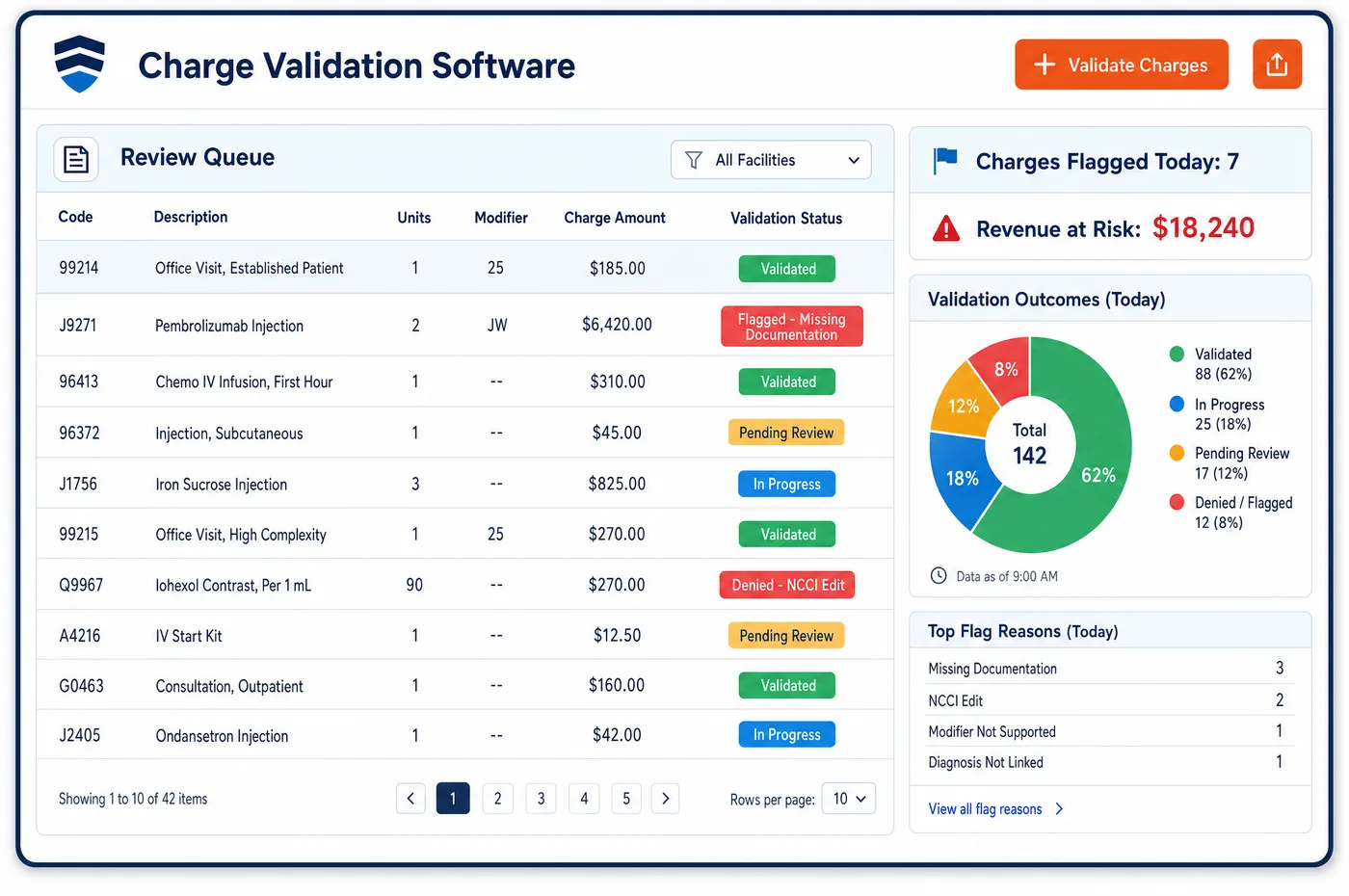
Charge Validation in a Diabetes Care Practice
Many diabetes denials come from rules that only show when today's charge is compared with the past. A CGM interpretation is fine unless one was already billed this month. A nutrition visit is fine unless DSMT was billed for the same patient on the same date. A class is fine until it pushes the patient past ten hours of initial training. Diabetes care charge validation software runs these checks on every line. It looks at the patient's billing history, the order on file and the codes on the encounter. It applies NCCI edits and payer rules, checks that waived lab tests carry modifier QW, and confirms the diagnosis supports the service. A nutrition therapy charge needs diabetes or renal disease on the claim. An A1c drawn sooner than the national policy allows for a controlled patient needs a documented reason or an ABN. Lines that fail are held with the reason shown, so staff fix them before the claim leaves.
Why Is Charge Validation Different in Diabetes Care?
The rules that matter most in diabetes billing are about counts and dates, not just code pairs. Standard code-pair edits catch a share of errors, but they don't know that this patient already had a CGM review this month, or that their education hours ran out in March. Charge validation in diabetes care needs the patient's own history in view, line by line.
Modifiers interact in ways that cost money. An E/M on the same day as CGM interpretation needs modifier 25 when it is separately identifiable. Under Medicare, that modifier stops G2211 from being paid unless the other service is an allowed preventive one. A waived A1c without modifier QW is denied even with a valid certificate. Checking these together, rather than one at a time, keeps a fix in one place from causing a denial in another.
Documentation is the last check. Individual DSMT beyond the single hour needs a reason in the referral, or Medicare can down-code it to group payment. Nutrition therapy needs a diagnosis of diabetes or renal disease on the claim. An A1c more often than the national policy allows needs a stated reason, such as a change in regimen. Medical necessity has to be visible in the record before the charge goes out, which is why lines arrive here from charge assembly with the order attached.
What Diabetes Care Charge Validation Software Handles
- DSMT and MNT on the same date
- Medicare doesn't allow DSMT and medical nutrition therapy for the same patient on the same day, and its edits block duplicates across institutional and professional claims. Validation holds the second line and shows the first. (CMS Medicare Claims Processing Manual, Chapter 4, Section 300: Medical Nutrition Therapy Services)
- Individual DSMT documentation (G0108)
- If individual training is billed but should have been group, Medicare down-codes it to group payment. Validation checks that the referral names an allowed reason for individual G0108 time beyond the single hour. (CMS Medicare Benefit Policy Manual, Chapter 15, Section 300: Diabetes Self-Management Training Services)
- CGM frequency (95249, 95250, 95251)
- Codes 95250 and 95251 are not reported more than once a month, and 95249 only once while the patient owns the receiver. Validation compares each line with the patient's billing history and holds repeats. (American Academy of Family Physicians: Coding for Remote Patient Monitoring and Continuous Glucose Monitoring)
- G2211 and modifier 25
- Medicare denies G2211 when the E/M carries modifier 25, except when the other service is an allowed Part B preventive service, immunization administration or annual wellness visit. Validation flags G2211 next to a modifier 25 E/M. (CMS MLN Matters MM13473: How to Use the Office and Outpatient E/M Visit Complexity Add-on Code G2211)
- A1c timing and diagnosis (83036)
- Medicare's lab NCD covers 83036 for listed diagnoses and treats testing a controlled patient more than every three months as not reasonable. Validation checks the last test date and the diagnosis, and asks for the reason when the test is early. (CMS National Coverage Determination 190.21: Glycated Hemoglobin/Glycated Protein)
- Waived test modifier (83036QW)
- Waived tests must carry modifier QW to be recognized, and Medicare edits lab claims at the CLIA certificate level. Validation adds or checks QW and the certificate for in-office A1c lines. (CMS MLN Matters MM13455: New Waived Tests (CLIA certificate edits and modifier QW))
How Does Diabetes Care Charge Validation Software Work?
1. Load the patient's history
Each line is checked with the patient's billing history, the order on file and the hours used. That is what makes count and date rules possible.
2. Run code and modifier edits
NCCI edits and payer rules check code pairs and modifiers. Modifier 25, QW and G2211 are checked together, not one at a time.
3. Check limits and timing
Education hours, CGM frequency and A1c timing are compared with the rules for the patient's plan. Lines past a limit are held unless an ABN is on file.
4. Confirm the diagnosis and documentation
The diagnosis must support the service, and individual DSMT needs its reason in the referral. Missing items go to the clinician or educator as a task.
5. Release clean lines
Lines that pass move on to the claim. Held lines show the rule that failed, and repeat causes are tracked for denial prevention.
Diabetes Care Charge Validation Software vs. Generic Software
| Area | Generic approach | Unlimited Systems |
|---|---|---|
| Frequency rules | Code-pair edits only, with no patient history. | Each line checked against the patient's own billing history. |
| Same-day conflicts | DSMT and nutrition therapy billed together, then denied. | Second line held with the first shown. |
| Modifier interactions | Modifier 25 added, and G2211 denied later. | Modifier 25, QW and G2211 checked as a set. |
| Lab timing | Early A1c tests billed without a reason. | Last test date and reason checked before the line moves on. |
| Documentation | Individual training billed without a stated reason. | Referral checked for an allowed reason before release. |
Who Uses It in a Diabetes Care Practice
- Coder: Held lines that show the rule, the history and the fix, instead of a bare edit message.
- Diabetes educator: A task when an individual session needs a reason in the referral, before the class is billed.
- Billing manager: A count of held lines by rule, which shows where setup or scheduling should change.
Diabetes Care Charge Validation Software FAQs
Charge validation for diabetes services checks code pairs, modifiers, diagnoses and the patient's history. It catches DSMT and nutrition therapy on the same date, education hours past the yearly limit, CGM codes billed too often, early A1c tests, nutrition therapy without a qualifying diagnosis, waived tests without modifier QW, and G2211 billed beside modifier 25.
Code 95251 is not reported more than once a month, and the same limit applies to 95250. Code 95249 is reported only once while the patient owns the receiver. Validation compares each new line with the patient's billing history and holds a repeat, so it can be corrected or removed before the claim leaves.
Under Medicare, G2211 isn't paid when the E/M is reported with modifier 25, unless the other service is an allowed preventive service, immunization administration or annual wellness visit. A diabetes visit with same-day CGM interpretation often needs modifier 25, so validation flags G2211 on those visits for review.
Medicare expects most initial DSMT to be group training, with one hour individual. If individual training is billed without an allowed reason, such as no class within two months or special needs noted by the referring practitioner, the payer can down-code it to group payment. Validation checks the referral for the reason first.
An early A1c isn't always denied. Medicare's lab policy treats testing a controlled patient more often than every three months as not reasonable, but more frequent tests can be covered after a regimen change or other events that affect control. Validation checks the last test date and asks for the documented reason, or an ABN, when a test is early.
Medicare covers medical nutrition therapy for patients with diabetes or renal disease, including those discharged after a kidney transplant in the past few years. A claim with no diagnosis is returned, and a claim without one of these diagnoses is denied. Validation checks the diagnosis on each nutrition therapy line before release.
Related Diabetes Care Software
Billing & claims
In the revenue cycle
Charge Validation for related specialties
Sources
- CMS Medicare Claims Processing Manual, Chapter 4, Section 300: Medical Nutrition Therapy Services
- CMS Medicare Benefit Policy Manual, Chapter 15, Section 300: Diabetes Self-Management Training Services
- American Academy of Family Physicians: Coding for Remote Patient Monitoring and Continuous Glucose Monitoring
- CMS MLN Matters MM13473: How to Use the Office and Outpatient E/M Visit Complexity Add-on Code G2211
- CMS National Coverage Determination 190.21: Glycated Hemoglobin/Glycated Protein
- CMS MLN Matters MM13455: New Waived Tests (CLIA certificate edits and modifier QW)
GET STARTED
See Unlimited Systems in Action
Whether you're actively evaluating new technology or simply preparing for your next vendor renewal, Unlimited Systems can help you understand where your current workflows may be creating avoidable revenue risk.