
Payments & AR
Diagnostic Imaging Payment Posting Software
Post global, technical and professional imaging payments line by line, and check every session and equipment reduction against the rule behind it.
Diagnostic Imaging Payment Posting Software applies payer and patient payments to each imaging study, whether it was billed globally or split into technical and professional parts. It reads the 835 remittance line by line, checks multiple-procedure and equipment-based reductions, and routes each denial to the staff who can fix it.



 6,500+ specialty providers

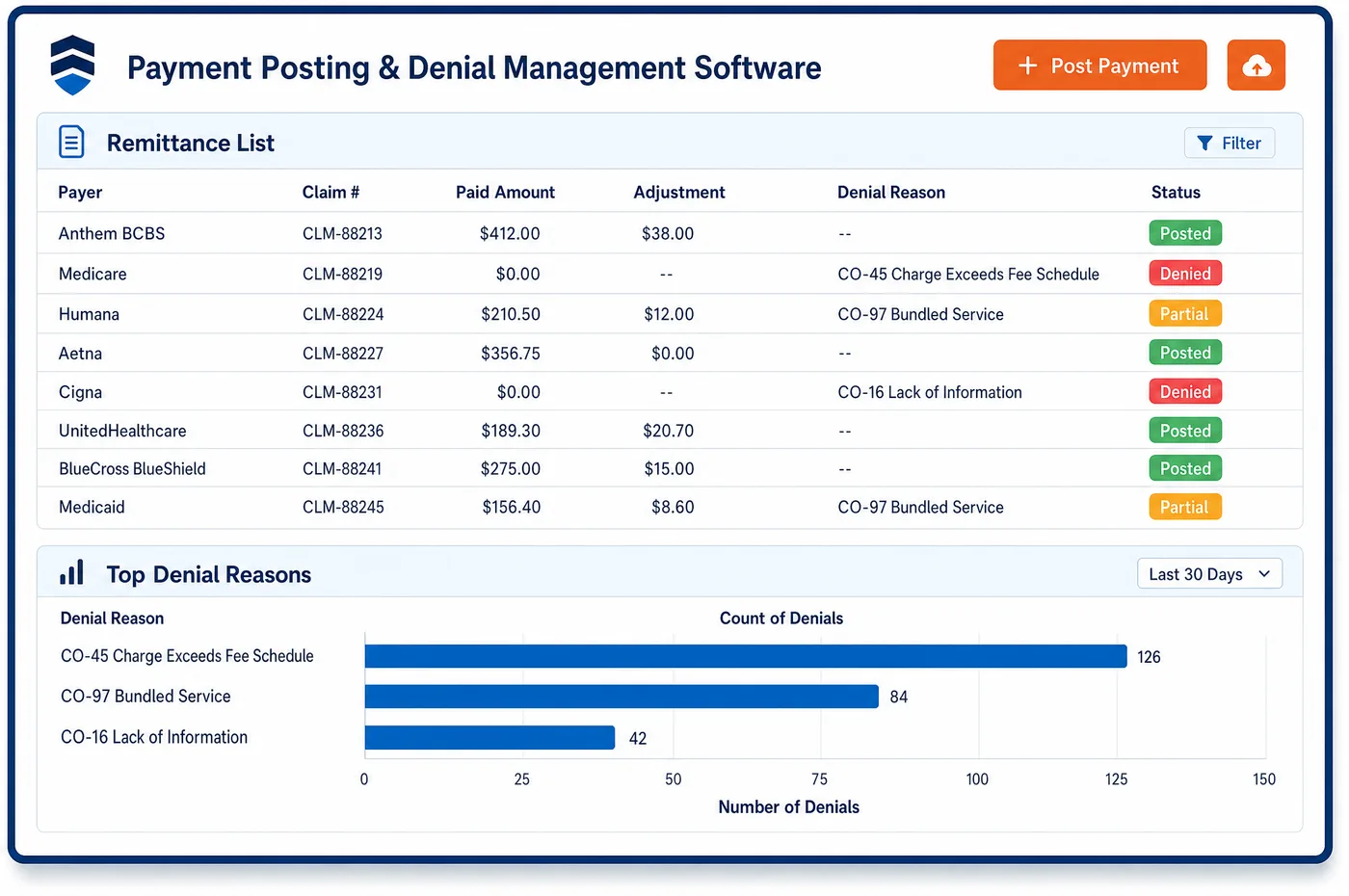
Payment Posting in a Diagnostic Imaging Practice
An imaging remittance rarely pays the way the charge was built. A freestanding center that owns the scanner and employs the radiologist bills the global code and gets one payment. A hospital outpatient department is paid for the technical part on its facility claim, while the reading group bills modifier 26 for the read. When two CT or MRI studies run in one session, Medicare cuts the technical payment on the later study and trims the professional payment too. Film and computed radiography X-rays carry their own cuts, flagged by modifiers FX and FY. Payment posting software for imaging reads each 835 line, matches it to the study and component that was billed, and compares the allowed amount with what the rule should produce. Clean lines post on their own. Lines that don't match go to a worklist with the CARC and RARC codes attached, so staff fix the cause instead of writing off the gap.
Why Is Payment Posting Different in Diagnostic Imaging?
Split billing is the first reason imaging posting is harder. One study can produce three kinds of payment: a global payment, a technical payment to the facility or center, and a professional payment to the radiologist. The same CPT code appears on all three, so a tool that matches only on code and date can apply a read payment to a scan line. Each 835 line has to be matched on the modifier as well. The technical and professional split also changes what a correct allowed amount looks like.
Payment rules also cut imaging payments in ways that look like short-pays but are not. Under Medicare, the technical part of a later study in the same session is reduced, the professional part is trimmed, and the office technical payment is capped at the hospital outpatient rate. A CT done on a scanner that does not meet the NEMA XR-29 dose standard is paid less when billed with modifier CT. Staff need to tell a correct reduction from a real underpayment. If they can't, they chase money that was never owed or miss money that was.
Imaging denials also point to a few clear owners. A missing authorization belongs to the team that cleared the study. An ordering provider who is not enrolled belongs to registration. A diagnosis that a coverage policy does not support goes back to coding. The remittance is where those signals first show up, so routing them well feeds denial management for imaging and keeps the same error from coming back next week.
What Diagnostic Imaging Payment Posting Software Handles
- Single-session imaging reductions
- Federal law reduces the Medicare technical payment for each later imaging study in one session and trims the professional payment as well. Posting compares each allowed amount with the reduction the rule sets, so a cut taken twice stands out. (42 U.S.C. 1395w-4 (Social Security Act section 1848): Medicare physician fee schedule, including the special rules for imaging services)
- CARC 59 on the remittance
- Payers report session cuts with CARC 59, processed under multiple or concurrent procedure rules. Lines with CARC 59 post as contractual adjustments when the math checks out, and go to a worklist when it does not. (X12: Claim Adjustment Reason Codes)
- Modifiers 26 and TC by setting
- Medicare pays the professional part of radiology in every setting, but it does not pay a supplier the technical part for a hospital patient. Payments are matched to the component billed, so a technical denial during an inpatient stay is read as a billing-site issue. (CMS Medicare Claims Processing Manual, Chapter 13: Radiology Services and Other Diagnostic Procedures)
- Film and computed radiography cuts (FX, FY)
- X-rays taken on film carry modifier FX and are paid less, and the remittance shows CARC 237 with RARC N775. Computed radiography carries modifier FY and its own cut. Both post as expected adjustments for the room that still uses that equipment. (CMS Medicare Claims Processing Manual, Chapter 13: Radiology Services and Other Diagnostic Procedures)
- CT dose standard reduction (modifier CT)
- CT studies done on equipment that does not meet NEMA XR-29-2013 are billed with modifier CT and paid less on the technical part. Each of these lines is flagged by scanner, so the practice sees what the older unit costs. (CMS Medicare Claims Processing Manual, Chapter 13: Radiology Services and Other Diagnostic Procedures)
- Ordering provider remark codes (N264, N265, N574)
- Lines denied for a missing ordering provider name (N264), a missing ordering NPI (N265) or a provider type that cannot order (N574) are routed to registration. The order details are fixed before the claim is sent again. (X12: Remittance Advice Remark Codes)
How Does Diagnostic Imaging Payment Posting Software Work?
1. Load the 835 and the deposit
Each ERA is loaded with its payment and matched to the bank deposit or EFT. A remittance that does not tie to a deposit is held, so cash and posting stay in step.
2. Match each line to study and component
Lines are matched on CPT code, modifier, date and claim line, not on code alone. A professional payment can only post to a professional line, even when the patient had three studies that day.
3. Check the allowed amount
The allowed amount is compared with the expected rate after any session reduction, OPPS cap or equipment cut. A gap the rules explain posts as an adjustment, and an unexplained gap goes to underpayment review.
4. Route denials by cause
Authorization denials go to the clearance team, ordering provider errors to registration, and coverage denials to coding. Each item carries the CARC, RARC and study details, so no one has to open the remittance again.
5. Close the day
Posted cash, adjustments and denials tie back to deposits before the day is closed. Open balances flow on to imaging AR follow-up and the totals post to the general ledger.
Diagnostic Imaging Payment Posting Software vs. Generic Software
| Area | Generic approach | Unlimited Systems |
|---|---|---|
| Split payments | Payments applied by CPT code alone, so components get mixed up. | Each payment matched to the global, technical or professional line it pays. |
| Session reductions | Assumed correct and posted without review. | Checked against the single-session rule before posting. |
| Equipment cuts | FX, FY and CT reductions lumped in with other adjustments. | Tracked by modifier and scanner as expected cuts. |
| Denials | Left in one general queue. | Routed to clearance, registration or coding by reason code. |
| Deposits | Reconciled at month end. | Tied to each ERA as it posts. |
Who Uses It in a Diagnostic Imaging Practice
- Payment poster: Remittances that post themselves when the reductions add up, and a short list of lines that need a look, each with its reason shown.
- Billing manager: A clear split between correct imaging reductions and real short-pays, so appeals go only where money is owed. Repeated gaps feed payer contract reviews.
- Imaging center owner: Posted revenue by modality and scanner, with the cost of older equipment visible in the FX, FY and CT adjustments.
Diagnostic Imaging Payment Posting Software FAQs
Payment posting matches each imaging payment to the line it pays: the global code, the technical line with modifier TC, or the professional line with modifier 26. Matching uses the modifier as well as the code and date. A professional payment cannot land on a technical line, even when the patient had several studies on the same day.
Under Medicare, when more than one imaging study is done for the same patient in one session, the technical part of each later study is reduced and the professional part is trimmed. The remittance reports the cut with CARC 59. The math is checked before the line posts, so a reduction taken on the wrong study is caught.
Modifier FX marks an X-ray taken on film, and modifier FY marks an X-ray taken with computed radiography. Medicare pays less on the technical part for both. The remittance for a film X-ray shows CARC 237 with remark code N775. These post as expected adjustments and are reported by room, so owners see the cost of older equipment.
Medicare pays less on the technical part of listed CT codes when the scanner does not meet the NEMA XR-29-2013 dose standard. Those claims carry modifier CT. Each reduced line is flagged by scanner, which gives owners a running count of what the older unit costs in lower payments and helps them plan a replacement.
Denials tied to the ordering provider, such as remark codes N264, N265 or N574, go to the registration team. Medicare requires the ordering physician's legal name and NPI on claims for ordered imaging, and the orderer must be enrolled or validly opted out. Registration corrects the order details, and the claim is sent again.
Each ERA is matched to the deposit or EFT that paid it before the day closes. A remittance with no matching deposit, or a deposit with no remittance, is held for review. Posted cash, adjustments and denials then tie out each day, and the totals flow to the general ledger for the finance team.
Related Diagnostic Imaging Software
Payments & AR
In the revenue cycle
Payment Posting for related specialties
Sources
- 42 U.S.C. 1395w-4 (Social Security Act section 1848): Medicare physician fee schedule, including the special rules for imaging services
- CMS Medicare Claims Processing Manual, Chapter 13: Radiology Services and Other Diagnostic Procedures
- X12: Claim Adjustment Reason Codes
- X12: Remittance Advice Remark Codes
- 42 CFR 424.507: Ordering covered imaging and clinical laboratory services
GET STARTED
See Unlimited Systems in Action
Whether you're actively evaluating new technology or simply preparing for your next vendor renewal, Unlimited Systems can help you understand where your current workflows may be creating avoidable revenue risk.