
Billing & claims
Diagnostic Imaging Denial Management Software
Sort imaging denials by cause, send missing approvals, ordering provider errors and necessity denials to the right owner, and fix the source.
Diagnostic Imaging Denial Management Software finds, sorts and works the claims payers refuse or reduce. It reads the reason codes, sends missing-approval, ordering provider, modifier and medical necessity denials to different owners, ranks the work by dollars at risk and filing deadline, and traces repeat causes back to registration, clearance or charge rules.



 6,500+ specialty providers

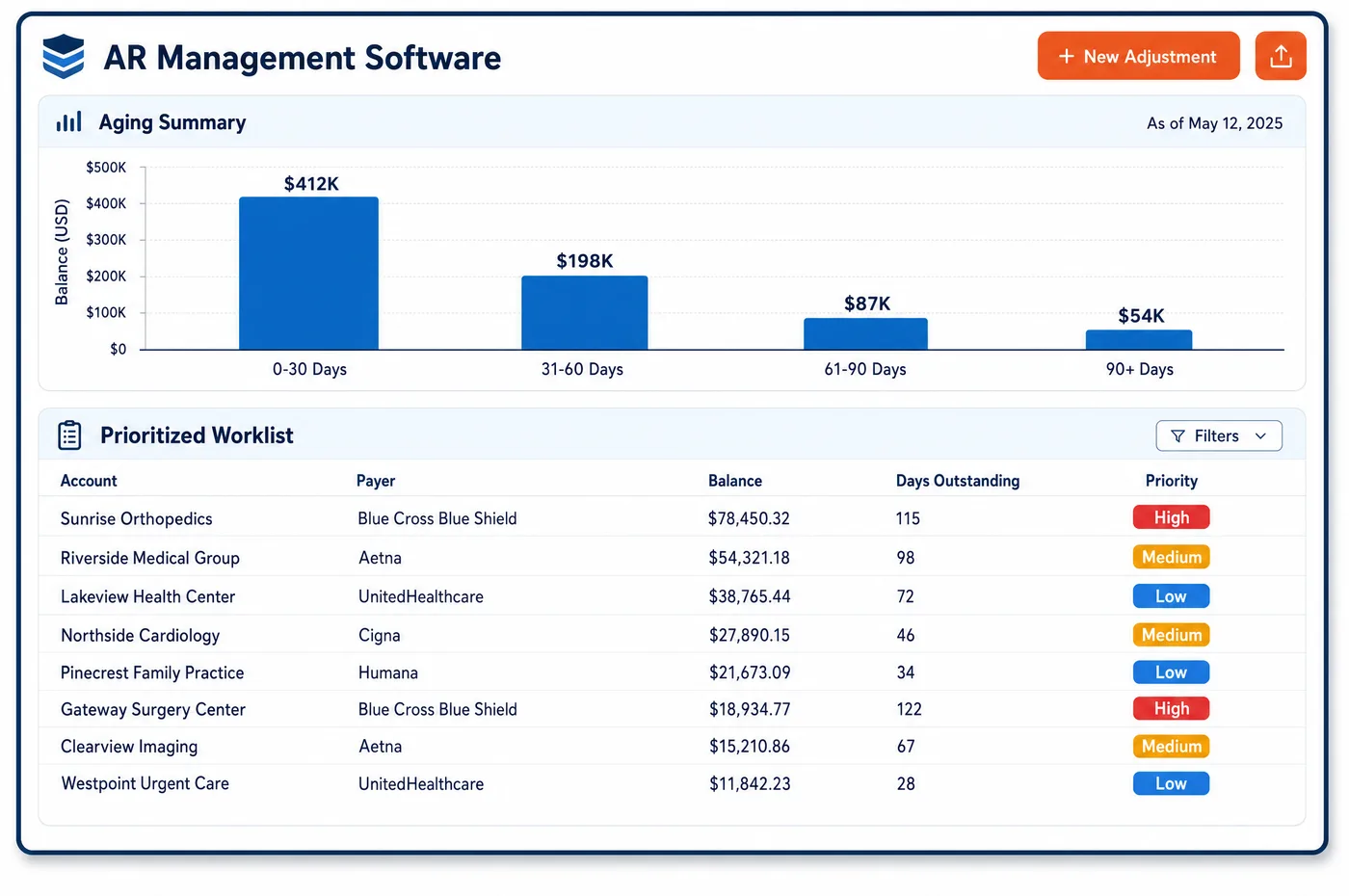
Denial Management in a Diagnostic Imaging Practice
Imaging denials fall into a few families, and each has a different fix. A missing or mismatched approval is usually reason code 197 and needs the authorization record and often a request for review. A modifier error, code 4, needs a corrected claim. An ordering provider error returns remark codes N264 or N265 and needs the right individual NPI and name. A medical necessity denial, code 50, needs the order, the clinical reason and sometimes a physician-to-physician call. Duplicates are code 18. Denial management software reads each code on the remittance and places the claim in the queue for its family. Staff see the claim, the study, the approval and the report together. The claims with the most money and the nearest deadline come first. After the work, the cause is counted, and the fix is made upstream in imaging financial clearance or charge validation.
Why Is Denial Management Different in Diagnostic Imaging?
Many imaging denials are decided before the exam is done. A study done without a required approval cannot be rescued by a better appeal. Under UnitedHealthcare's protocol, an administrative denial for a missing approval cannot be billed to the member, and an appeal by the rendering site is upheld when the ordering office is out of network and the site did not complete approval. The work is to prevent, not to argue.
Other denials can be won. A necessity denial may turn on the order and the clinical reason, which the referring office holds. A modifier or code-pair denial may only need a corrected claim with a record of two distinct studies. An ordering provider denial needs the right individual NPI and name. Telling these apart on the first read of the remittance saves the time that a general appeal queue wastes.
Not every reduction is a denial. Claim adjustment reason code 59 means the claim was processed under multiple or concurrent procedure rules, such as multiple imaging procedures, and the reduction is expected. If staff chase it as an underpayment, they waste effort. Denial management has to know which codes mean a payer error and which mean a payment rule at work.
What Diagnostic Imaging Denial Management Software Handles
- CARC 197 for missing authorization
- Reason code 197 means precertification, authorization, notification or pre-treatment was not obtained. These denials go to the authorization owner with the approval record, and the cause is counted by payer and exam type. (X12: Claim Adjustment Reason Codes (CARC 4, 18, 50, 59, 97, 197))
- CARC 50 for medical necessity
- Reason code 50 means the payer found the services not medically necessary. The queue pulls the order, the reason for the exam and the report, and the ordering clinician may be asked for more. (X12: Claim Adjustment Reason Codes (CARC 4, 18, 50, 59, 97, 197))
- CARC 4 and CARC 97
- Code 4 means the procedure code does not match the modifier billed. Code 97 means the payment is included in another service already adjudicated. Both go to coding for a corrected claim or a documented distinct study. (X12: Claim Adjustment Reason Codes (CARC 4, 18, 50, 59, 97, 197))
- CARC 59 for multiple imaging procedures
- Code 59 means the claim was processed under multiple or concurrent procedure rules, such as multiple imaging procedures. Medicare reduces the technical component of second and later studies on the same date, so the reduction is checked against the rule, not appealed on sight. (X12: Claim Adjustment Reason Codes (CARC 4, 18, 50, 59, 97, 197))
- Ordering provider denials (N264, N265)
- Remark codes N264 and N265 mean the ordering provider's name or primary identifier is missing, incomplete or invalid. The fix is the individual NPI and the name as enrolled, without nickname or credentials. (Noridian Medicare JE Part B: PECOS ordering and referring edits)
- UnitedHealthcare administrative denials and peer review
- When the radiology approval protocol was not followed, an administrative denial may result and the member cannot be billed. The ordering or rendering professional may request a physician-to-physician discussion with the reviewer. Staff tag these claims so they are not sent to the patient. (UnitedHealthcare: Outpatient radiology prior authorization FAQ, commercial and Individual Exchange plans)
- Medicare appeal levels
- Fee-for-service appeals run from redetermination by the MAC, to reconsideration by a qualified independent contractor, then an OMHA decision, Medicare Appeals Council review and federal court. Staff note the level on the claim. (CMS: Fee-for-Service (Original Medicare) Appeals)
How Does Diagnostic Imaging Denial Management Software Work?
1. Read the remittance and sort
Each denial reason is mapped to a family: approval, modifier, ordering provider, necessity, duplicate or payment rule. The claim goes to that family's queue with the study attached.
2. Rank by value and deadline
Claims are ordered by dollars at risk and the filing or appeal deadline. A large claim near its deadline is worked before a small one with time left.
3. Work the claim
The owner corrects the claim, sends the missing record or prepares the appeal. For a necessity denial the ordering office may be asked for the clinical reason, and a physician-to-physician call is arranged where the payer offers one.
4. Escalate and track the level
Appeals are logged with their level and due date. Medicare claims move up the five levels only when the lower one has been decided, so staff see where each claim is.
5. Trace the cause upstream
Repeat causes are counted by payer, exam type and site, and the fix is made at imaging patient registration, clearance or charge rules. This keeps the same denial from returning.
Diagnostic Imaging Denial Management Software vs. Generic Software
| Area | Generic approach | Unlimited Systems |
|---|---|---|
| Sorting | All denials in one queue for one team. | Denials grouped by reason family and sent to the right owner. |
| Priority | Oldest first. | Dollars at risk and deadline set the order. |
| Payment rules | Reductions chased as underpayments. | Multiple-procedure reductions checked against the rule first. |
| Approval denials | Appealed even when the payer will not overturn. | Tagged as administrative, with the member not billed. |
| Root cause | Fixed one claim at a time. | Counted by payer and exam type, then fixed upstream. |
Who Uses It in a Diagnostic Imaging Practice
- Denial specialist: A queue grouped by cause, with the study, the approval and the report attached, so each claim is worked from one screen.
- Authorization coordinator: A short list of missing-approval denials by payer, which shows where imaging patient scheduling rules need to hold a study.
- Radiology group administrator: Necessity denials that need a physician's input arrive with the order and reason in place, so the physician answers one clear question.
Diagnostic Imaging Denial Management Software FAQs
Imaging denial management is the work of finding, sorting and resolving claims that payers refuse or reduce. Software reads the reason codes, sends each denial to the right owner, ranks the work by value and deadline, and counts the causes. The aim is to fix the source, such as a missing approval, so the same denial does not return.
Code 197 means precertification, authorization, notification or pre-treatment was not obtained. Code 50 means the payer found the services not medically necessary. The first needs the approval record or a request for review, and the second needs the order, the clinical reason and the report. Each goes to a different owner.
A reduction coded as claim adjustment reason code 59 is usually the payer applying its multiple imaging rule. Medicare reduces the technical component of second and later studies on the same date. Staff check the amount against the rule first. An appeal makes sense only when the rule was misapplied.
That depends on the payer. Under UnitedHealthcare's outpatient radiology protocol, a claim administratively denied for not following the approval protocol cannot be billed to the member. Staff tag such denials so they are held from patient invoicing, and they check each payer's own rule.
Billing staff fix it, with help from the referring office. Remark codes N264 and N265 mean the ordering provider's name or identifier is missing, incomplete or invalid. The claim needs the individual NPI and the name as enrolled, with no nickname or credentials. If the order lacked the data, the referring office supplies it.
Medicare fee-for-service appeals have five levels: redetermination by the MAC, reconsideration by a qualified independent contractor, an OMHA decision, Medicare Appeals Council review and federal district court. Staff log the level and due date on the claim, so each one is worked at the right step.
Related Diagnostic Imaging Software
Billing & claims
In the revenue cycle
Denial Management for related specialties
Sources
GET STARTED
See Unlimited Systems in Action
Whether you're actively evaluating new technology or simply preparing for your next vendor renewal, Unlimited Systems can help you understand where your current workflows may be creating avoidable revenue risk.