
Front office
Diagnostic Imaging Financial Clearance Software
Eligibility, radiology benefit manager approvals and patient cost estimates settled for each CT, MRI, PET and screening study before the slot is kept.
Diagnostic Imaging Financial Clearance Software settles coverage for each study before the patient arrives. It checks eligibility, finds out whether the plan sends the exam to a radiology benefit manager, tracks the approval against the exact CPT code ordered, and prepares the patient's cost estimate so the exam is not held up at the door.



 6,500+ specialty providers

Financial Clearance in a Diagnostic Imaging Practice
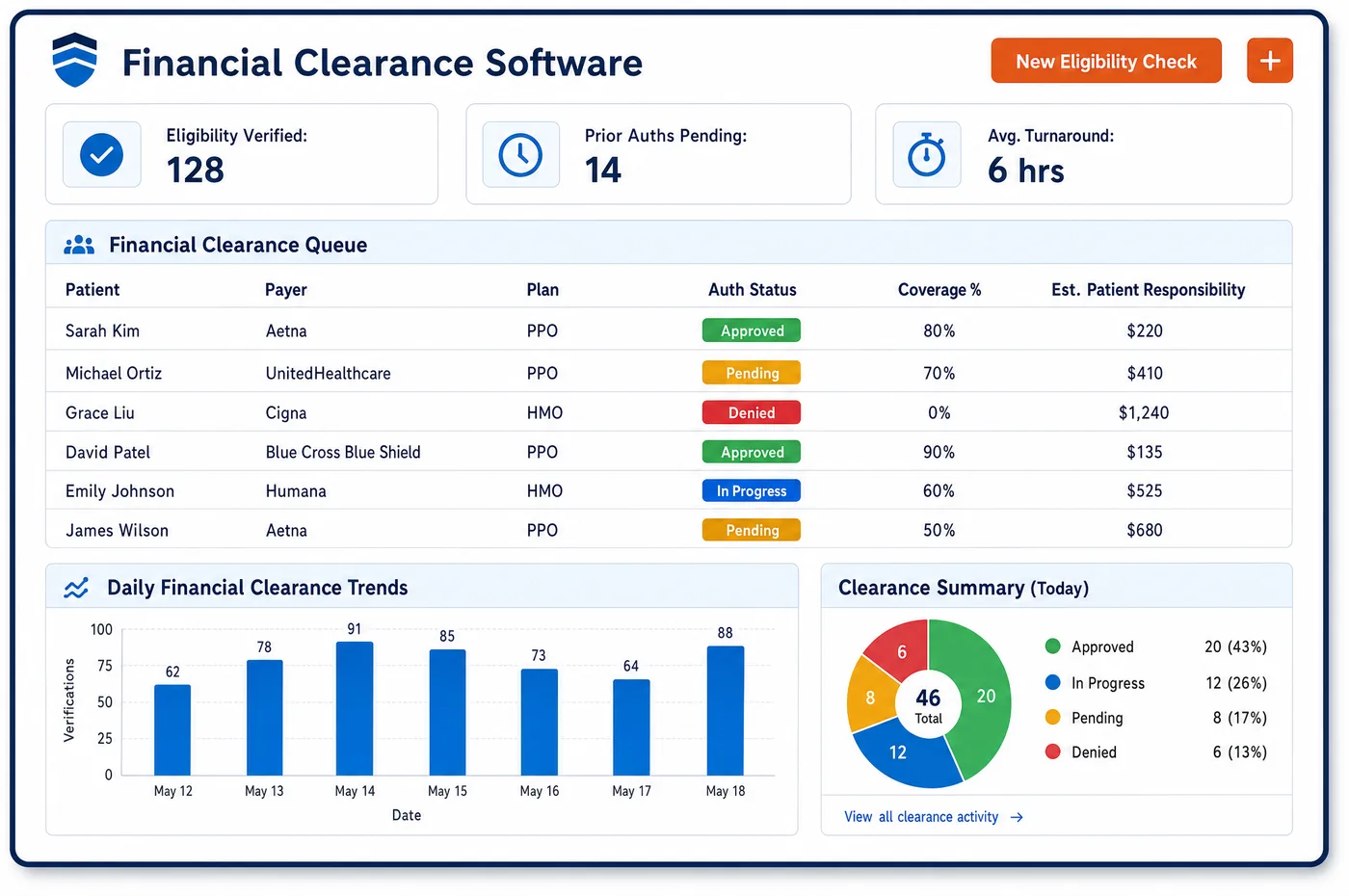
Imaging approvals are tied to one exam, not to a patient. A payer may ask for approval of a CT, MRI, MRA or PET scan. The approval names the CPT code, the ordering clinician and often the site. Financial clearance software runs a real-time eligibility check when the study is booked and reads the plan type from the result. Staff then see whether this plan needs approval for this study. If so, the request goes out. The approval number and approved code are stored on the study. A schedule lock can hold the exam until that approval is on file. If the order changes, staff compare the new code with the approved one before the slot is confirmed. The patient's cost estimate comes from the same record. Clearance starts from the study set up in imaging patient registration and hands a cleared exam to imaging patient scheduling.
Why Is Financial Clearance Different in Diagnostic Imaging?
Approval for imaging often depends on the plan product, not just the payer. One carrier may ask for approval on a commercial plan but skip it on a Medicare Advantage plan. It may also exempt emergency and urgent care visits. The same MRI can need approval for one patient and not for the next. Staff cannot work from memory. They need the plan, the study and the site of care in view together.
Medicare fee-for-service works differently. It has no front-end approval step for most imaging, so the check is about medical necessity. The treating clinician must order the test. Coverage rules decide which diagnoses support it. The federal appropriate use criteria program for advanced imaging is on hold. CMS says it has paused the program and rescinded its rules at 42 CFR 414.94. Clearance should not wait for a decision-support consultation. Staff still watch the CMS page for a restart.
Cost sharing also turns on the kind of exam. A Medicare screening mammogram carries no deductible or coinsurance when the provider accepts assignment, while a diagnostic mammogram carries coinsurance after the deductible. A patient told the first who then needs the second may be surprised. Self-pay patients are owed a written estimate before the visit. Clearance has to say which case applies before the exam, not after.
What Diagnostic Imaging Financial Clearance Software Handles
- Radiology benefit manager approval by CPT code
- Under the UnitedHealthcare protocol the approval is completed for each individual CPT code. The ordering office is generally responsible for requesting it, and the rendering site must confirm it exists before the exam. The study record keeps the approved code, so a later change in the order can be compared with it. (UnitedHealthcare: Outpatient radiology prior authorization FAQ, commercial and Individual Exchange plans)
- Plan lists and exemptions
- UnitedHealthcare names CT, MRI, MRA, PET and nuclear cardiology as advanced outpatient imaging that may need approval. It does not require approval for CT, MRI or MRA on Medicare Advantage and D-SNP plans, and it exempts services in an emergency room, observation unit, urgent care center or inpatient stay. Clearance reads the plan type before it asks for anything. (UnitedHealthcare: Radiology prior authorization)
- AUC program for advanced imaging
- CMS paused the appropriate use criteria program and rescinded the regulations at 42 CFR 414.94 in the CY 2024 physician fee schedule final rule. Medicare studies are not held for a clinical decision support consultation. Staff recheck the CMS page for any restart. (CMS: Appropriate Use Criteria Program (current status))
- Low-dose CT lung screening criteria (NCD 210.14)
- Medicare covers the screening for patients aged 50 to 77 who have no signs of lung cancer, at least 20 pack-years of smoking and are current smokers or quit within the last 15 years, with an order. Clearance checks each of these facts before the first study is booked. (CMS National Coverage Determination 210.14: Lung Cancer Screening with Low Dose Computed Tomography (LDCT))
- Screening and diagnostic mammography cost sharing
- For Medicare, an annual screening mammogram for women 40 and older carries no deductible or coinsurance when the provider accepts assignment. A diagnostic mammogram carries Part B coinsurance after the deductible. The estimate shown to the patient follows the exam type on the order. (Medicare.gov: Mammograms)
- Good faith estimate for self-pay patients
- A patient who is uninsured or not using insurance should get a good faith estimate of expected charges before the exam. Clearance starts that estimate from the study on the order and keeps the copy in the patient's file. (CMS: What is a good faith estimate?)
How Does Diagnostic Imaging Financial Clearance Software Work?
1. Run eligibility at booking
When the study is placed on the schedule, a real-time 270/271 check returns active coverage, plan type and patient cost-share details. Staff see at once whether the plan is a commercial product, Medicare Advantage or Medicare fee-for-service.
2. Decide whether approval applies
The plan type and the CPT code decide whether a radiology benefit manager must approve the study. Staff use payer rules the practice sets up, so prior authorization is requested only when it applies.
3. Request and store the approval
The request carries the ordering provider, the CPT code, the diagnosis and the site. The approval number, the approved code and the approved dates are stored on the study, and a hold on the slot stays until they arrive.
4. Compare approval with the order
If the radiologist or ordering office changes the exam, staff check whether the new code matches the approved one. A mismatch goes back to the ordering office before the exam, not after, and is tracked with imaging charge validation rules later.
5. Give the patient an estimate
The patient sees the expected share for that study, based on benefits and the exam type. A self-pay patient gets a good faith estimate, and a Medicare patient with a study that may not be covered is flagged for an advance beneficiary notice.
Diagnostic Imaging Financial Clearance Software vs. Generic Software
| Area | Generic approach | Unlimited Systems |
|---|---|---|
| Approval scope | One approval number per patient, whatever the exam. | Approval stored per study, with the approved CPT code beside the ordered one. |
| Plan rules | Staff recall which plans need approval for which scans. | Plan type read from the eligibility response and checked against payer rules the practice sets. |
| Booking control | Exams are booked first and approvals chased later. | A schedule lock holds a study that still needs approval. |
| Medicare imaging | Old AUC steps kept in the workflow. | Medicare studies checked for order and necessity, with AUC on hold. |
| Patient costs | Cost shared at the front desk after the scan. | An estimate prepared from the exam type before the visit. |
Who Uses It in a Diagnostic Imaging Practice
- Authorization coordinator: One worklist of studies that still need approval, each with the plan, the CPT code and the date of the exam, so nothing is booked blind.
- Front desk: A clear status on each booked study, and a script for what the patient will owe when screening turns diagnostic. It ties to imaging patient intake at check-in.
- Billing manager: Fewer claims returned for missing approval, and a record of what was requested and approved when an appeal begins.
Diagnostic Imaging Financial Clearance Software FAQs
Advanced outpatient studies are the usual targets. UnitedHealthcare, for one, may require approval for CT, MRI, MRA, PET and nuclear cardiology. Plain x-ray, ultrasound and screening mammography are generally not on those lists. Each payer keeps its own list of CPT codes, so financial clearance checks the code against the plan on the day the study is booked.
Under UnitedHealthcare's protocol, the ordering office is generally responsible for requesting approval, and the rendering site must confirm before the exam that approval is complete. Other payers set their own roles. A center that skips this confirmation can be denied, and under that protocol the member cannot be billed for the exam.
The CMS appropriate use criteria program for advanced diagnostic imaging is paused, and its regulations at 42 CFR 414.94 were rescinded in the CY 2024 physician fee schedule final rule. Centers are not required to collect a consultation for Medicare studies now. Staff should check the CMS program page for any restart.
A patient who pays without insurance is entitled to a good faith estimate of the expected charges. Clearance builds that estimate from the study on the order and keeps a copy on the patient's record. It also notes whether the exam is a screening or a diagnostic study, since the price and the follow-up may differ.
Medicare fee-for-service does not run a front-end approval step for most MRI and CT. The check is medical necessity: the treating clinician orders the test, and coverage rules decide which diagnoses support it. If a study may not be covered, the patient can be given an advance beneficiary notice before the exam, not after.
The approved CPT code and the performed code are compared before the exam. Some payers publish a table of related codes that need no new request, and for others the ordering office must update the approval. Staff do this while the patient is still scheduled, so the claim does not meet a denial for missing authorization.
Related Diagnostic Imaging Software
Front office
In the revenue cycle
Financial Clearance for related specialties
Sources
- UnitedHealthcare: Radiology prior authorization
- UnitedHealthcare: Outpatient radiology prior authorization FAQ, commercial and Individual Exchange plans
- CMS: Appropriate Use Criteria Program (current status)
- CMS National Coverage Determination 210.14: Lung Cancer Screening with Low Dose Computed Tomography (LDCT)
- Medicare.gov: Mammograms
- CMS: What is a good faith estimate?
GET STARTED
See Unlimited Systems in Action
Whether you're actively evaluating new technology or simply preparing for your next vendor renewal, Unlimited Systems can help you understand where your current workflows may be creating avoidable revenue risk.