
Payments & AR
Multi-Specialty Patient Billing Software
Show each patient one clear balance for visits across departments, after every payer has finished.
Multi-Specialty Patient Billing Software turns what a patient owes after insurance into clear statements, even when care came from several departments. It waits for payer decisions, separates deductible, coinsurance and copay amounts, and shows which visit each charge came from. Patients see one account they can understand and pay.



 6,500+ specialty providers

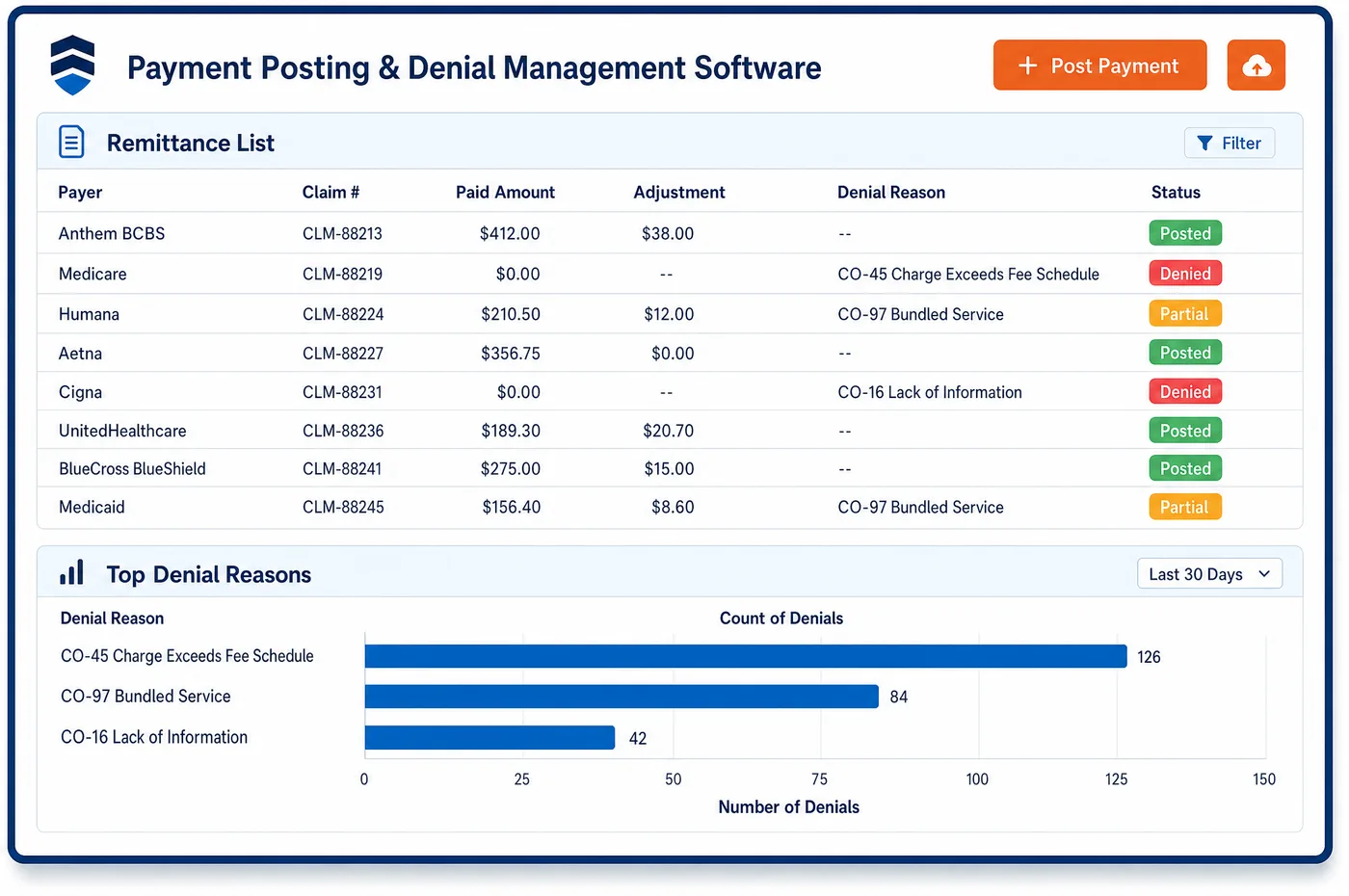
Patient Billing in a Multi-Specialty Practice
A patient in a multi-specialty group may see a primary care physician, a cardiologist and a therapist in the same season. Each visit adjudicates on its own schedule. Patient billing software holds the balance until the payer's remittance says what the patient owes. It then reads the patient-responsibility lines and builds the statement from them. Each line keeps its date of service, department and provider, so a patient can tell one visit from another. The practice sets how balances are grouped and when statements go out. Statements can be sent by text or email with a secure payment link, and payments land on the same account. Staff can see the same balance the patient sees, which makes a phone call shorter. Insurance balances stay out of the patient total until they are settled. Questions about a line go back to the department that provided the care.
Why Is Patient Billing Different in Multi-Specialty?
The hard part of patient billing in a multi-specialty group is that the patient does not think in departments. They think of one practice and one bill. Behind that bill sit separate visits, separate claims and often separate copays. Plans commonly set a different copay for a primary care visit and a specialist visit, so two visits on one day can carry two different amounts.
Timing is the second problem. Claims from different departments reach payers at different times and come back with different answers. A statement sent after the first remittance may leave out a visit still in process. If the practice then sends a second statement a week later, the patient sees a balance that keeps changing and starts to doubt every line.
Coverage rules add a third layer. When a patient has Medicare and another plan, coordination of benefits decides who owes what. Billing the patient before the primary and secondary payers have both processed the claim creates a balance that may not exist. In a group that sees many older patients across departments, that mistake repeats unless staff hold balances until the remittances are in.
What Multi-Specialty Patient Billing Software Handles
- Deductible, coinsurance and copay lines
- Remittances report patient responsibility with CARC 1 for deductible, CARC 2 for coinsurance and CARC 3 for copay, under the PR group code. The statement is built from these amounts, so the patient sees the reason for each charge and not just a total. A balance with no PR amount is never sent. (X12: Claim Adjustment Reason Codes)
- Patient responsibility groups
- Only amounts under the PR group belong on a patient statement. Contractual write-offs under the CO group do not. Staff review any statement where a CO amount appears on the patient side, since that is a posting error and not a patient debt. (X12: Claim Adjustment Group Codes)
- Medicare as primary or secondary
- When Medicare is one of two payers, the Medicare Secondary Payer rules set the order. Staff confirm that every payer has processed the claim before a patient balance is created, and statement holds are used for AR management follow-up when a secondary claim is still open. (CMS: Medicare Secondary Payer)
- Part B cost sharing
- Under Medicare Part B, the patient generally owes the annual deductible and then coinsurance on the approved amount. A supplemental plan may pay some or all of it. Staff check the secondary plan first, so a patient with supplemental coverage is not billed for amounts it will pay. (Medicare.gov: What Medicare costs)
- Good faith estimates for self-pay patients
- For patients who have no insurance or who choose not to use it, providers must give a good faith estimate when care is scheduled in advance or when the patient asks for one. The estimate is kept on the account so the final statement can be compared with it. (CMS: Good faith estimates for people who do not have or do not use insurance)
How Does Multi-Specialty Patient Billing Software Work?
1. Hold until the payer decides
A balance is not created at the time of service beyond the copay collected. It waits for the remittance, so the statement shows what the plan has finalized.
2. Read the patient-responsibility lines
Staff or rules take PR amounts from each posted remittance and attach them to the right visit. Contractual amounts are written off and never reach the patient.
3. Group by account and department
Balances from several departments sit on one patient account. Each line keeps its department and date of service, so the patient and staff both know what a charge is.
4. Send the statement
The practice sets the statement cycle and the channel. A text or email with a secure link lets the patient open the itemized balance and pay through integrated patient payments.
5. Answer questions by owner
Billing staff answer questions about amounts. A question about the care itself goes to the department. Notes stay on the account so the next person does not start over.
6. Follow up on what remains
Open balances move through reminders and the practice's own policy steps. Payments are posted to the account as they arrive, and the balance updates for patient and staff alike.
Multi-Specialty Patient Billing Software vs. Generic Software
| Area | Generic approach | Unlimited Systems |
|---|---|---|
| Statement timing | A statement goes out after the first remittance, and a corrected one follows. | The balance waits for every payer's decision, then goes out once. |
| Visit detail | A total with no department or date shown. | Each line shows its visit, department and provider. |
| Payer versus patient amounts | Contractual and patient amounts are mixed on the statement. | Only patient-responsibility amounts reach the patient. |
| Delivery | Paper statements in the mail. | Text or email with a secure payment link. |
| Staff view | Staff see a different number than the patient. | Staff and patient look at the same account. |
Who Uses It in a Multi-Specialty Practice
- Patient financial representative: One account with each visit's department and amount listed, so questions can be answered without searching three systems.
- Front desk: A current balance at check-in that already reflects finished claims, so staff collect only what is truly due.
- Billing director: Control over statement cycles, holds and follow-up steps for the whole group, with the same rules in every department. See healthcare accounting for how collected cash reaches the books.
Multi-Specialty Patient Billing Software FAQs
Patient billing software places each department's patient-responsibility amount on one account, with the visit, provider and date shown on every line. The statement is sent after payers have decided, so it is not revised later. Questions about an amount go to billing staff, and questions about care go to the department.
The remittance states what the plan finalized as deductible, coinsurance and copay. Billing before that risks a balance the payer later reduces or pays, which means refunds and distrust. Waiting keeps statements accurate, and a patient who sees an accurate first statement is more likely to pay it.
Yes. Payments from text, email links and the front desk are recorded on the account staff work from, so both sides see the same figure. This shortens calls, since staff do not have to reconcile a patient's number with a different internal one before they can help.
Staff should confirm which payer is primary under the Medicare Secondary Payer rules, then wait until both payers have processed the claim. Any amount the supplemental plan will pay is not billed to the patient. This avoids sending balances that later have to be reversed.
A patient without insurance, or one who chooses not to use it, should receive a good faith estimate when care is scheduled in advance or when they ask. The group keeps the estimate with the account, so the final statement can be checked against it and any difference explained.
Patient billing covers what the patient owes after insurance, and it is built from the patient-responsibility lines on a remittance. Billing a payer is done with claims, and its status is tracked as insurance receivables. Keeping the two apart stops a payer-owed amount from appearing on a patient statement.
Related Multi-Specialty Software
Payments & AR
In the revenue cycle
Patient Billing for related specialties
Sources
GET STARTED
See Unlimited Systems in Action
Whether you're actively evaluating new technology or simply preparing for your next vendor renewal, Unlimited Systems can help you understand where your current workflows may be creating avoidable revenue risk.