
Payments & AR
Multi-Specialty Accounting Software
Keep revenue, adjustments and cash tied to the department, provider and Tax ID that earned them.
Multi-Specialty Accounting Software ties every payment, adjustment and write-off to the department, provider and Tax ID that earned it, then carries those figures to the general ledger. Leaders get a profit and loss view by specialty, and the group's physicians can trust that pay and bonus reports start from the same books.



 6,500+ specialty providers

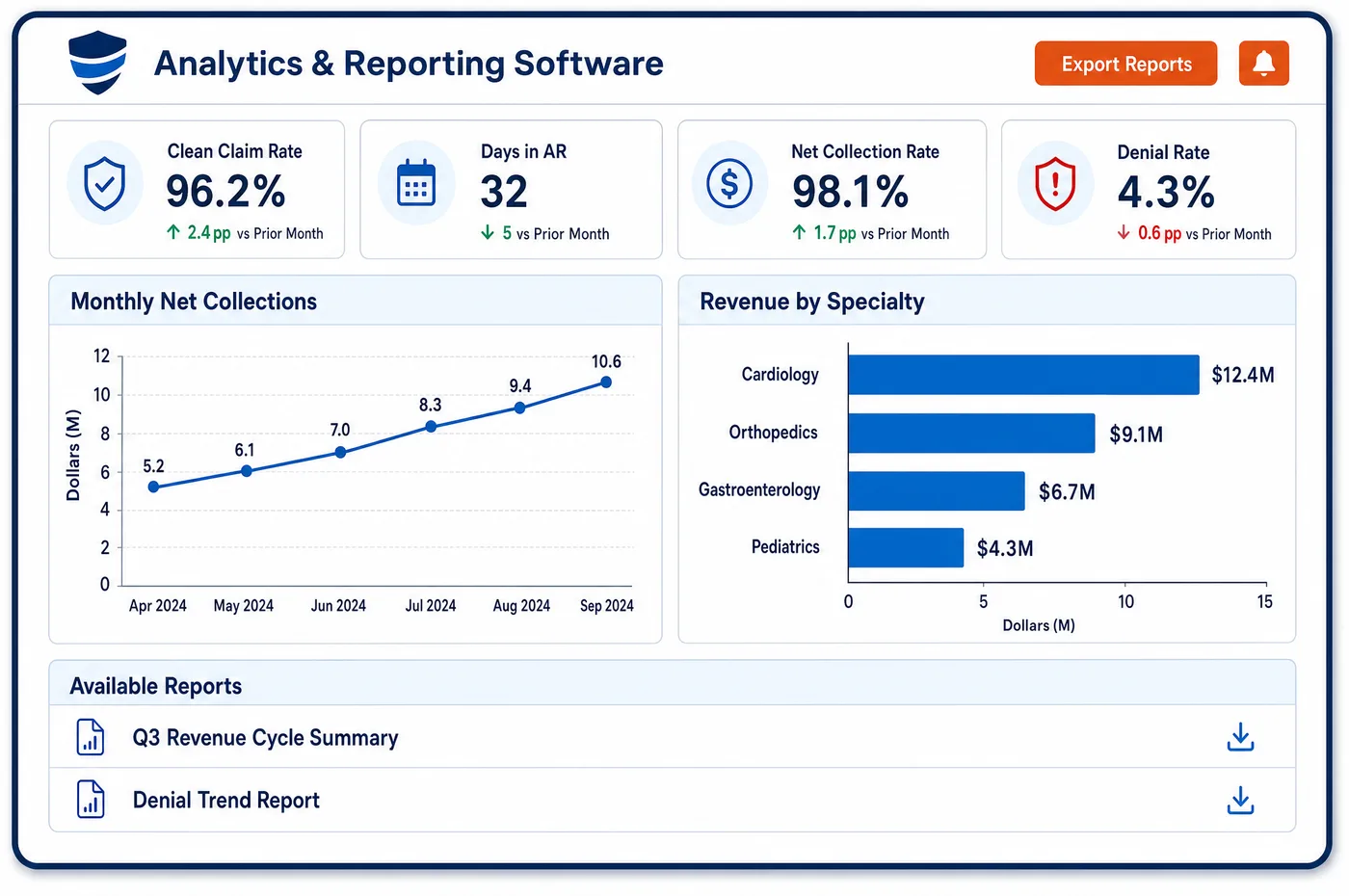
Accounting in a Multi-Specialty Practice
Accounting in a multi-specialty group starts with one rule: revenue belongs somewhere. Each charge has a department and a rendering provider. Each payment or adjustment follows the claim back to them. Payment posting writes the cash and the contractual adjustment as separate entries. These entries are summarized as ledger postings for the general ledger. Shared costs such as the front office, billing staff and the building are allocated by rules that finance sets and keeps. When the group holds more than one Tax ID, the company hierarchy keeps each entity's figures apart while leadership still sees the whole. The result is a department margin the chair can read. It is also a production figure the compensation committee can audit, and a ledger that agrees with the bank. The software does not decide how costs are shared. It makes sure the numbers behind them are right.
Why Is Accounting Different in Multi-Specialty?
A single-specialty practice keeps one pool of revenue and one pool of cost. A multi-specialty group needs to know which department makes money after its own costs, because the answer drives hiring, space and equipment. Without accounting that follows the department, the group sees a total that looks fine while one specialty carries another.
Physician pay makes it harder. Many groups pay on personal work measured in relative value units. Some add a share of group profit. Federal self-referral law limits how pay may tie to referrals. The books must show productivity and profit in a form that can be verified.
Ancillary services add one more layer. Many groups run their own lab, imaging and therapy. These carry their own rules. If the ledger cannot show ancillary revenue next to the physicians who ordered it, the group cannot prove the in-office ancillary exception is met, and it cannot tell whether the service line pays for itself.
What Multi-Specialty Accounting Software Handles
- Group practice definition
- Under 42 CFR 411.352, a physician group practice must be a unified business with centralized decision-making and consolidated billing, accounting and financial reporting. The ledger design supports this by keeping one chart of accounts and one reporting structure that every department posts to. (eCFR: 42 CFR 411.352, Group practice)
- Profit shares and productivity bonuses
- The same rule permits a share of overall profits divided in a reasonable and verifiable way, and a productivity bonus based on personally performed work, such as total patient encounters or relative value units. The records behind the calculation must be available on request. So the export keeps the inputs, not just the result. (eCFR: 42 CFR 411.352, Group practice)
- In-office ancillary services
- Under 42 CFR 411.355(b), designated health services furnished in the group's own space can fit an exception if the service is supervised, located and billed as the rule requires. Finance tracks ancillary revenue by service line and billing number, which gives the compliance lead one place to check. (eCFR: 42 CFR 411.355, General exceptions to the referral prohibition (in-office ancillary services))
- Relative value units
- The Medicare physician fee schedule publishes work, practice expense and malpractice RVUs for each code. A group's work-RVU report adds up the work component for services each physician performed. See wRVU reporting for how those reports are built and shared. (CMS: Physician Fee Schedule relative value files)
- Overpayments and credits
- The Medicare overpayment rule at 42 CFR 401.305 requires an identified overpayment to be reported and returned. A credit that sits on a department's account is also a liability on the books. Finance reviews credits by entity, so refunds come from the entity that was paid. (eCFR: 42 CFR 401.305, Requirements for reporting and returning of overpayments)
How Does Multi-Specialty Accounting Software Work?
1. Define the structure
Finance sets the divisions, departments, locations and Tax IDs once. Each claim and payment carries these attributes from the day it is created.
2. Post cash and adjustments
Payment posting records the payment and the contractual adjustment as separate entries for each department. Patient payments post to the same structure.
3. Send totals to the ledger
Posted totals are summarized as ledger entries by entity and department. The finance team imports them into the general ledger it already keeps.
4. Allocate shared cost
Finance applies its own allocation rules for shared staff, space and supplies. The rules and their dates are kept, so a later review can see why a department carried a given share.
5. Prepare physician reports
Production and collections by provider are drawn from the same ledger. The compensation committee works from figures that match the books.
6. Review credits and variances
Credits, unapplied cash and unusual write-offs are listed by department. A controller clears them before they distort a department's margin.
Multi-Specialty Accounting Software vs. Generic Software
| Area | Generic approach | Unlimited Systems |
|---|---|---|
| Department view | One revenue total for the whole group. | Revenue, adjustments and cash by department and provider. |
| Multiple Tax IDs | A separate system and spreadsheet for each entity. | Several Tax IDs sit in one database under a company hierarchy. |
| Ledger hand-off | Re-keyed summaries at month end. | Posted totals summarized as ledger entries for the general ledger. |
| Physician pay support | Production pulled from a separate report that does not match the books. | Production drawn from the same ledger as collections. |
| Ancillary revenue | Lab and imaging lumped into general revenue. | Ancillary revenue tracked by service line and billing number. |
Who Uses It in a Multi-Specialty Practice
- Group controller: Posted cash, adjustments and credits by entity and department, with ledger entries ready for the general ledger and clear reasons for variances.
- Chief financial officer: A department margin built on the same figures as collections, so decisions about staff, space and equipment rest on one set of books. Pair it with analytics for trends.
- Compensation committee: Provider production and collections that tie to the ledger, with inputs kept so a calculation can be shown to an auditor.
Multi-Specialty Accounting Software FAQs
Healthcare accounting software ties payments, adjustments and write-offs to the department, provider and Tax ID that earned them, then summarizes them for the general ledger. Leaders see profit and loss by specialty, and physicians see production figures drawn from the same books. This keeps finance, billing and compensation working from one set of numbers.
Yes. The tiered company hierarchy supports multiple Tax IDs and divisions in one database, with reporting, workflow and security following that hierarchy. Each entity's figures stay apart while leadership can still view the whole group. How a group's own books are closed remains the finance team's process.
No. The group's finance team decides how front office, billing staff, space and equipment are shared among departments. The software supplies reliable revenue and cost inputs and keeps the allocation rules and dates on file, so a later review can see why a department carried a given share.
Pay based on personally performed work, such as relative value units or total encounters, needs inputs that can be traced. Production and collections drawn from one ledger can be reproduced on request. The self-referral rules call for a reasonable and verifiable method.
Lab, imaging and therapy have their own supervision, location and billing conditions under the in-office ancillary services exception. Tracking them by service line and billing number shows whether each pays for itself and gives compliance one place to check that billing follows the rule.
A credit on a department's account is both a patient or payer overpayment and a liability. Listing credits by entity lets the controller refund from the entity that was paid and report an identified Medicare overpayment on time. Leaving them parked in a general account hides the liability.
Related Multi-Specialty Software
Payments & AR
Accounting for related specialties
Sources
GET STARTED
See Unlimited Systems in Action
Whether you're actively evaluating new technology or simply preparing for your next vendor renewal, Unlimited Systems can help you understand where your current workflows may be creating avoidable revenue risk.