
Payments & AR
Multi-Specialty AR Management Software
Work open claims and balances by department, payer and filing deadline, with one central team and clear ownership.
Multi-Specialty AR Management Software tracks every unpaid claim and patient balance across all departments. It ranks follow-up by dollar value and filing deadline, and it keeps each account tied to the specialty that owns it. A central billing team can then work the whole group's receivables without losing track of who is accountable.



 6,500+ specialty providers

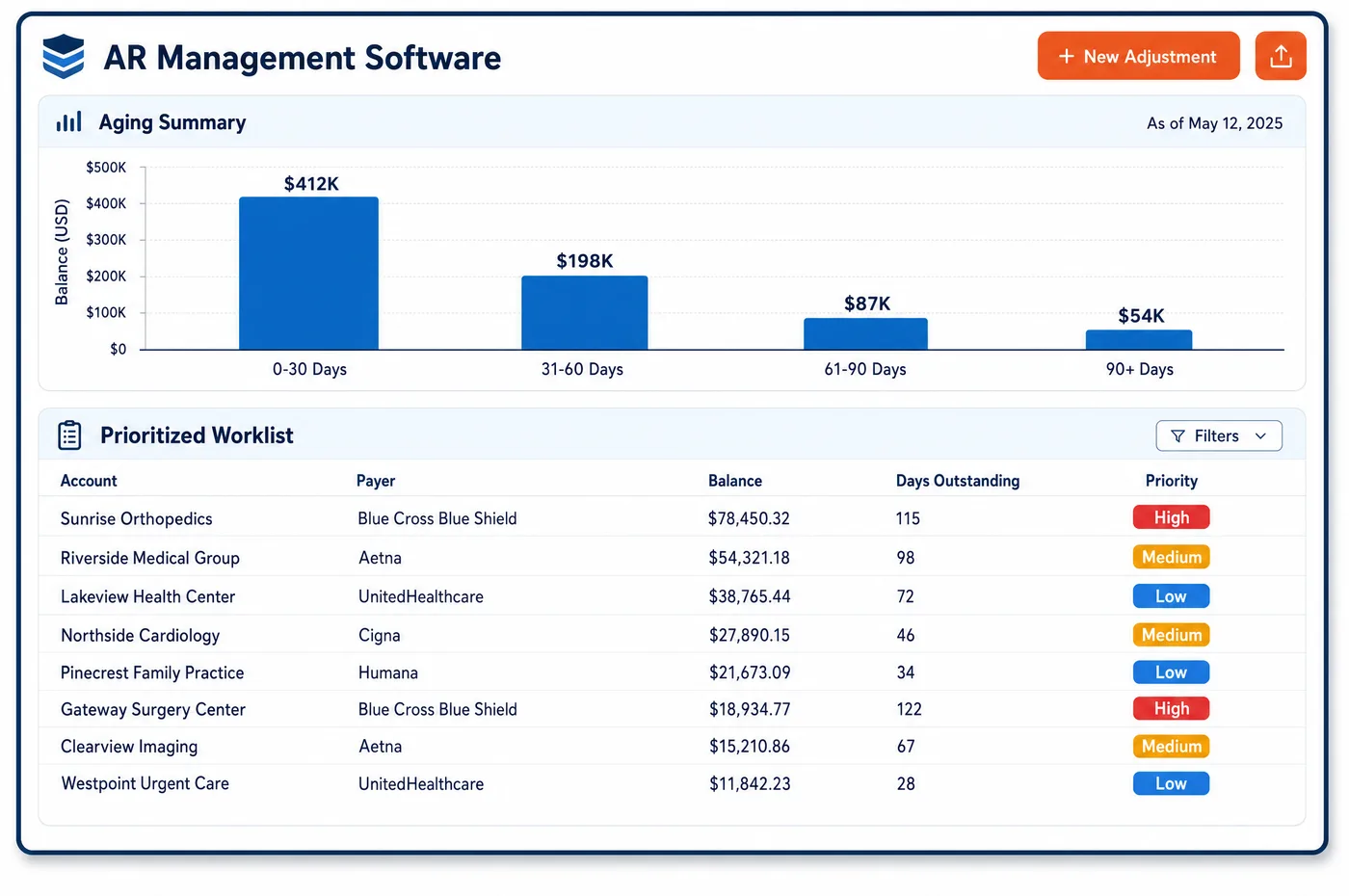
AR Management in a Multi-Specialty Practice
Open receivables in a multi-specialty group come from many places at once. Cardiology holds claims waiting on prior authorization, orthopedics holds surgical claims inside a global period, and primary care holds a long tail of small patient balances. AR management software gathers them into one worklist and sorts it by value, payer and deadline. Staff in the central billing office can pick up the next account without asking which department it belongs to. The account still carries its department, rendering provider and location. A collector who needs a clinical answer knows who to ask. Claim status requests can run in bulk, so staff start from the payer's answer rather than a phone call. Secondary and patient balances follow once the primary payer has paid. Aging is then reported by department and payer as well as for the group, so a slow specialty is visible early instead of hiding inside a healthy total.
Why Is AR Management Different in Multi-Specialty?
Receivables in a single-specialty practice share a rhythm. The same payers, the same codes and the same denial reasons repeat. A multi-specialty group has none of that. An imaging claim, a surgical claim and a therapy claim stall for different reasons, and each needs a different fix. A worklist that sorts only by age treats them alike and sends collectors to the wrong accounts first.
Ownership is the second problem. When a claim ages, someone must decide whether it is a billing error, a clinical documentation gap or a payer delay. In a large group those people sit in different departments. If the account does not name the department and provider, collectors guess, and the claim bounces between desks. Each bounce uses up filing time that the payer will not give back.
The third problem is the shared patient. One person can owe a balance to three departments, while their insurer owes the group money on all three. Collectors need to see the insurance side and the patient side together, or they will bill a patient for something the payer has not yet decided. They also need the department view, so managers can see which specialty is driving the aging.
What Multi-Specialty AR Management Software Handles
- Medicare Part B filing limit
- Under 42 CFR 424.44, a Part B claim must be filed no later than one calendar year after the date of service, with narrow exceptions. Other payers set their own limits by contract, so the worklist carries each claim's deadline and ranks accounts near it ahead of older but safer ones. See timely filing for how limits are counted. (eCFR: 42 CFR 424.44, Time limits for filing claims)
- Claim status inquiry (276/277)
- Claim status travels as the HIPAA-adopted 276 request and 277 response. Staff run these in bulk for unpaid claims and work the accounts where the response shows a pended, denied or missing claim. A department lead is pulled in only when the answer is clinical. (CMS: HIPAA adopted standards and operating rules (claim status, 276/277))
- Patient responsibility versus contractual groups
- Remittances split each adjustment by group code, so PR marks what the patient owes and CO marks what the contract requires the group to write off. Collectors move only PR amounts to the patient side, which keeps a payer-owed balance from ever reaching a statement. (X12: Claim Adjustment Group Codes)
- Secondary and crossover balances
- When a patient has Medicare and another plan, the order of payment follows the Medicare Secondary Payer rules. Staff confirm who pays first before a balance is called a patient balance. A crossover claim that never arrives is followed up as a payer account, not a patient one. (CMS: Medicare Secondary Payer)
- Credit balances and overpayments
- A credit on one department's account can be a duplicate payment or a payer error. The Medicare overpayment rule at 42 CFR 401.305 requires an identified overpayment to be reported and returned. Staff list credits beside open debits so they can be resolved as part of the same review. (eCFR: 42 CFR 401.305, Requirements for reporting and returning of overpayments)
How Does Multi-Specialty AR Management Software Work?
1. Load the open balances
Unpaid claims and patient balances from every department enter one list. Each row keeps its department, provider, location and payer, so nothing has to be looked up to know who owns it.
2. Rank by value and deadline
The worklist is ordered by dollar value, payer and filing deadline, with the group's own priority rules applied. High-value claims near their limit rise to the top of the central team's AR management queue.
3. Check claim status in bulk
Status requests go out for claims that have no answer yet. Staff work the returned results, which separates payer delays from claims that never arrived.
4. Route by cause
A coding or documentation question goes to the owning department's contact. A payer delay stays with the central team. A denial goes to its own queue.
5. Move balances to the next payer or the patient
Once a payer has paid, any remaining amount moves to the secondary payer or to the patient side. Only patient-responsibility amounts reach patient billing.
6. Report aging by department
Aging is shown by department, payer and location, along with the group total. Managers see which specialty or payer is slowing cash and can act on it.
Multi-Specialty AR Management Software vs. Generic Software
| Area | Generic approach | Unlimited Systems |
|---|---|---|
| Worklist order | Accounts are sorted by age alone, so old low-value claims crowd out new high-value ones. | Accounts are ordered by value, payer and filing deadline, with age as one input. |
| Ownership | Collectors email departments to find out who handles a claim. | Each account shows its department and provider, so the right person is clear at once. |
| Claim status | Staff call payers or open portals one claim at a time. | Status requests run in bulk and staff work the answers. |
| Shared patients | Each department chases its own balance from the same patient. | Insurance and patient balances are seen together, with the department on each. |
| Aging reports | One group total hides a slow department. | Aging splits by department, payer and location. |
Who Uses It in a Multi-Specialty Practice
- Central collector: One prioritized worklist covering every department, with each account showing who owns it and when its filing limit arrives.
- Department manager: Aging, denials and open balances for the manager's own specialty, so slow accounts can be explained or assigned before they expire.
- Billing director: AR aging by department and payer for the whole group, along with the view needed to move collectors where the backlog is. See reporting for how these views are shared.
Multi-Specialty AR Management Software FAQs
AR management software gathers unpaid claims and balances from all departments into one worklist and sorts it by value, payer and filing deadline. Each account keeps its department and provider, so a central team can work it and still send clinical questions to the right specialty. Aging reports then split by department as well as for the group.
Yes. A central office can work a single prioritized list that covers all departments, since each account carries its department, provider and location. Where policy requires, staff access can be limited by location. Clinical questions go back to the owning department, while payer follow-up stays with the central team.
The department that rendered the service owns the clinical answer, and the central billing team owns the payer follow-up. The account shows both, along with the cause of the delay. This stops a claim from moving between desks without anyone deciding whether it is a documentation, coding or payer problem.
Remittance group codes tell staff what the patient owes and what the contract writes off. Only patient-responsibility amounts move to the patient side, and only after the primary and any secondary payer have paid. Amounts a payer still owes remain in the insurance queue, so patients are not billed early.
For Medicare Part B, a claim generally must be filed within one calendar year of the date of service under 42 CFR 424.44, with narrow exceptions. Commercial payers set their own limits by contract. The worklist should carry each claim's own deadline, so staff can act on the nearest ones first.
Useful reports show aging by department, payer and location alongside the group total, plus denial reasons and credit balances. This lets a manager see whether a slow total comes from one specialty, one payer or one site. Reports should use the same definitions in every department so comparisons are fair.
Related Multi-Specialty Software
Payments & AR
In the revenue cycle
AR Management for related specialties
Sources
GET STARTED
See Unlimited Systems in Action
Whether you're actively evaluating new technology or simply preparing for your next vendor renewal, Unlimited Systems can help you understand where your current workflows may be creating avoidable revenue risk.