
Billing & claims
Multi-Specialty Denial Management Software
Sort denials by department, payer and cause, send each to its owner, and fix the front-end gap that created it.
Multi-Specialty Denial Management Software holds claims likely to deny before submission, sorts the denials that still happen by department, payer, provider and reason code, and sends each to the person who owns the fix. Queues are ordered by value and filing deadline, with the cause and the next step attached.



 6,500+ specialty providers

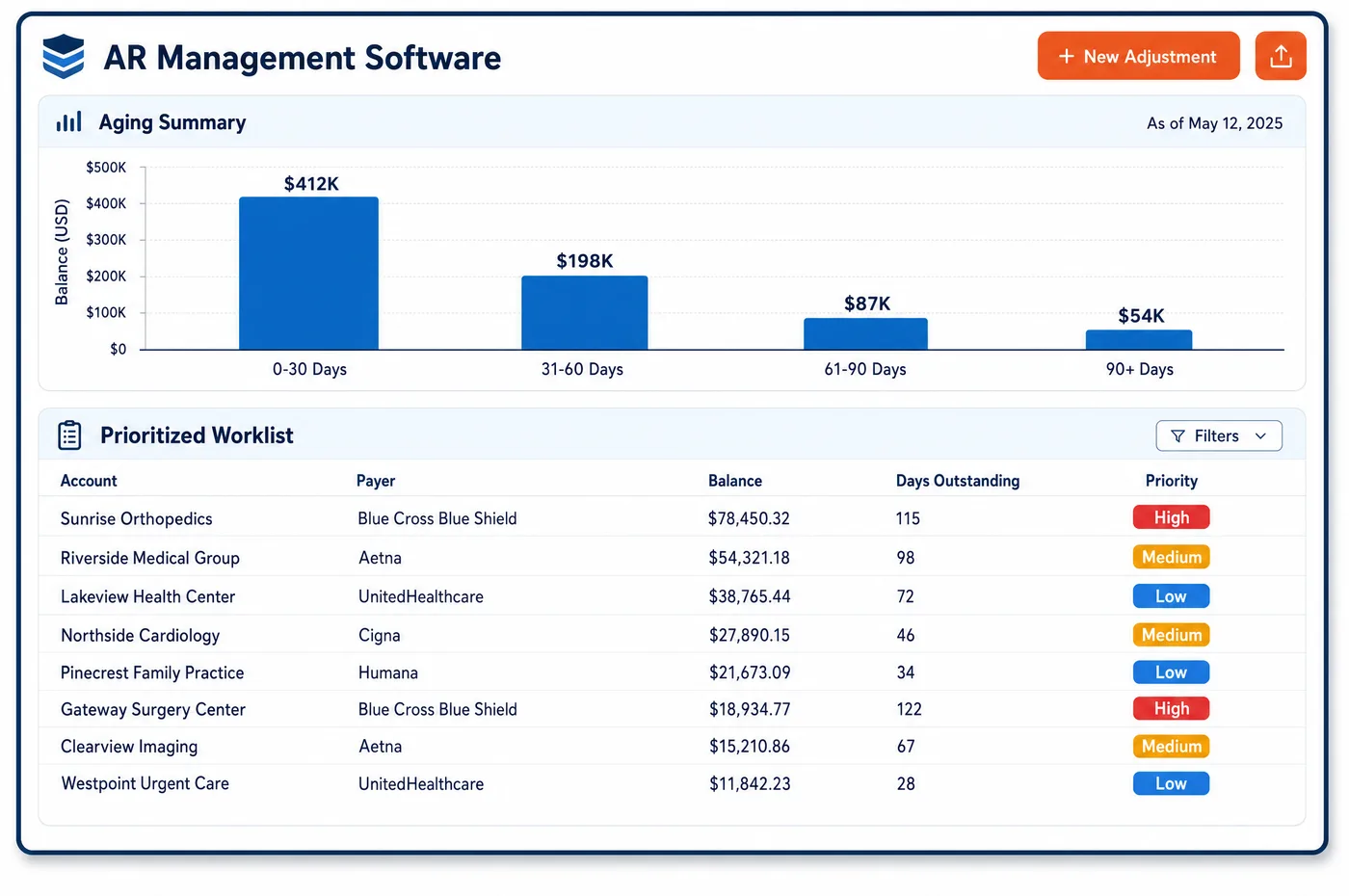
Denial Management in a Multi-Specialty Practice
Denials in a group come from many places. A referral missing in one department, a modifier left off in another and an enrollment gap at a new site all show up as denials in the same billing office. Multi-specialty denial management software scores claims against payer policy, coding edits and past remittances before they go out, and holds the ones likely to deny. Denials that still arrive are grouped by payer, code, provider and reason, so a pattern in one department is visible. Each denial lands in a queue ordered by value and deadline. Staff see the likely cause and the documents needed. Appeals are prepared from how similar claims were settled. Root causes are sent back to the department or the front desk that can stop them. This work relies on clean claims from medical billing and shared metrics from RCM.
Why Is Denial Management Different in Multi-Specialty?
The same reason code means different things in different departments. A bundling denial in a surgical department points to a modifier or global period problem. In primary care it may point to a preventive visit paired with a problem visit. A group-wide denial count hides this. Only a view by department shows who needs to change what.
Many denials in a group start before the claim exists. Missing authorizations, absent referrals, wrong coverage order and unenrolled clinicians all come from front-end steps and enrollment. Billing staff can resubmit or appeal, but they cannot fix an enrollment gap or a referral process. Denial management has to feed causes back to the people who own them, or the same denials keep returning.
Same-day visits create denials that are unique to groups. Two departments can bill the patient on one date, and the payer may deny the second as a duplicate or bundle it with the first. Medicare treats same-specialty physicians in one group as a single physician for evaluation and management, so a second visit in that specialty needs unrelated problems documented. Denial staff need to know which case they face before they appeal.
What Multi-Specialty Denial Management Software Handles
- Authorization and referral denials
- Payers use CARC 197 for absent precertification, authorization or notification, CARC 288 for an absent referral, and CARCs 242 and 243 for services not provided or not authorized by network or primary care providers. These trace back to the front end; see authorization denial. (X12: Claim Adjustment Reason Codes (CARC 4, 16, 18, 22, 31, 50, 97, 109, 197, 242, 243 and 288))
- Duplicate and bundled services
- CARC 18 is Exact duplicate claim/service and is used with group code OA in most cases. CARC 97 means the benefit is included in the payment for another service, which is common when two departments bill close together; see duplicate claim denial. (X12: Claim Adjustment Reason Codes (CARC 4, 16, 18, 22, 31, 50, 97, 109, 197, 242, 243 and 288))
- Coverage and eligibility denials
- CARC 31 means the patient cannot be identified as the payer's insured, CARC 22 means care may be covered by another payer under coordination of benefits, and CARC 109 means the claim is not covered by this payer and must be sent to the correct one. (X12: Claim Adjustment Reason Codes (CARC 4, 16, 18, 22, 31, 50, 97, 109, 197, 242, 243 and 288))
- Coding and medical necessity denials
- CARC 4 means the procedure code is inconsistent with the modifier used, CARC 16 means the claim lacks information or has errors, and CARC 50 means the service is not deemed medically necessary by the payer. Each calls for a different fix. (X12: Claim Adjustment Reason Codes (CARC 4, 16, 18, 22, 31, 50, 97, 109, 197, 242, 243 and 288))
- Medicare appeal levels
- Medicare fee-for-service appeals run through five levels: redetermination, reconsideration by a qualified independent contractor, an administrative law judge hearing, Appeals Council review and judicial review. Staff note the level and the deadline on each appeal; see appeal levels. (CMS Medicare Claims Processing Manual, Chapter 29: Appeals of Claims Decisions)
How Does Multi-Specialty Denial Management Software Work?
1. Hold likely denials before submission
Claims scored as likely to deny are held for a fix. The reason, such as a missing referral or modifier, is attached.
2. Categorize each denial
Denials are grouped by payer, reason code, provider and department. Group code CO, PR or OA shows who owes the amount.
3. Work by value and deadline
Each denial lands in a queue sorted by dollar value and filing deadline. Staff see the cause and the next step.
4. Appeal with the right documents
Appeals are prepared from the documents that resolved similar claims. Staff follow the payer's appeal path, and for Medicare the five appeal levels.
5. Fix the root cause
Patterns are reviewed by department each period. Gaps found at registration, clearance or enrollment go back to those teams, linked to financial clearance.
Multi-Specialty Denial Management Software vs. Generic Software
| Area | Generic approach | Unlimited Systems |
|---|---|---|
| Denial view | One group-wide count. | Counts by department, payer, provider and reason. |
| Prevention | Denials found after payment. | Likely denials held before submission. |
| Work order | First in, first out. | Sorted by value and filing deadline. |
| Appeals | Documents gathered from scratch each time. | Documents suggested from similar claims. |
| Root cause | Biller fixes each claim alone. | Causes sent back to the owning team. |
Who Uses It in a Multi-Specialty Practice
- Denial specialist: A sorted queue with the cause and next step on each denial, so the first minute goes to action, not research. Appeals start with the likely documents in hand.
- Department manager: A monthly view of the department's top denial reasons, with the claims behind them. The manager can change a template or a front-desk step and see whether the pattern stops.
- Practice administrator: A group view that shows whether a denial trend comes from one payer, one site or one department, which guides contract talks and enrollment work.
Multi-Specialty Denial Management Software FAQs
Each denial is tied to its payer, reason code, provider and department, and grouped with similar ones. A cluster of referral denials in one department points to a front-end gap, while a cluster of modifier denials points to coding. Staff then fix the source instead of appealing one claim at a time.
Common ones include CARC 18 for duplicate claims, CARC 97 for services bundled into another, CARC 197 and 288 for missing authorization or referral, CARC 31 for member mismatch, and CARC 22 for coordination of benefits. Which of these a department sees depends on its specialty and payers.
A payer may treat the second claim as a duplicate or bundle it with the first. Under Medicare, physicians of different specialties in one group are paid separately, while same-specialty physicians are treated as one. Staff check specialty, diagnosis and documentation before they appeal.
Work denials by dollar value and by filing deadline, since some have short appeal windows. Queues sorted that way put the claims most at risk at the top. Staff also look at denials that share a cause, because one fix can clear many claims.
Original Medicare has five levels: redetermination by the contractor, reconsideration by a qualified independent contractor, a hearing before an administrative law judge, Appeals Council review and federal court review. Each has its own deadline, so staff record the level and due date on the appeal.
Many can. Checking eligibility, referrals and authorizations before the visit, validating charges before the claim and scoring claims against payer policy before submission all stop denials at the source. Claims likely to deny are held for a fix, so staff correct them before they reach the payer.
Related Multi-Specialty Software
Billing & claims
In the revenue cycle
Denial Management for related specialties
Sources
- X12: Claim Adjustment Reason Codes (CARC 4, 16, 18, 22, 31, 50, 97, 109, 197, 242, 243 and 288)
- X12: Claim Adjustment Group Codes
- CMS Medicare Claims Processing Manual, Chapter 29: Appeals of Claims Decisions
- CMS Medicare Claims Processing Manual, Chapter 12 (section 30.6.5, Physicians in Group Practice)
GET STARTED
See Unlimited Systems in Action
Whether you're actively evaluating new technology or simply preparing for your next vendor renewal, Unlimited Systems can help you understand where your current workflows may be creating avoidable revenue risk.