
Billing & claims
Multi-Specialty Medical Billing Software
Turn each department's visits into clean claims with the right billing group, rendering provider, location and payer order.
Multi-Specialty Medical Billing Software turns visits from every department into claims that name the right billing group, rendering provider, service location and payer order. Claims are checked before submission, sent electronically, tracked through acknowledgment and status, and worked back by department when a payer rejects or denies them.



 6,500+ specialty providers

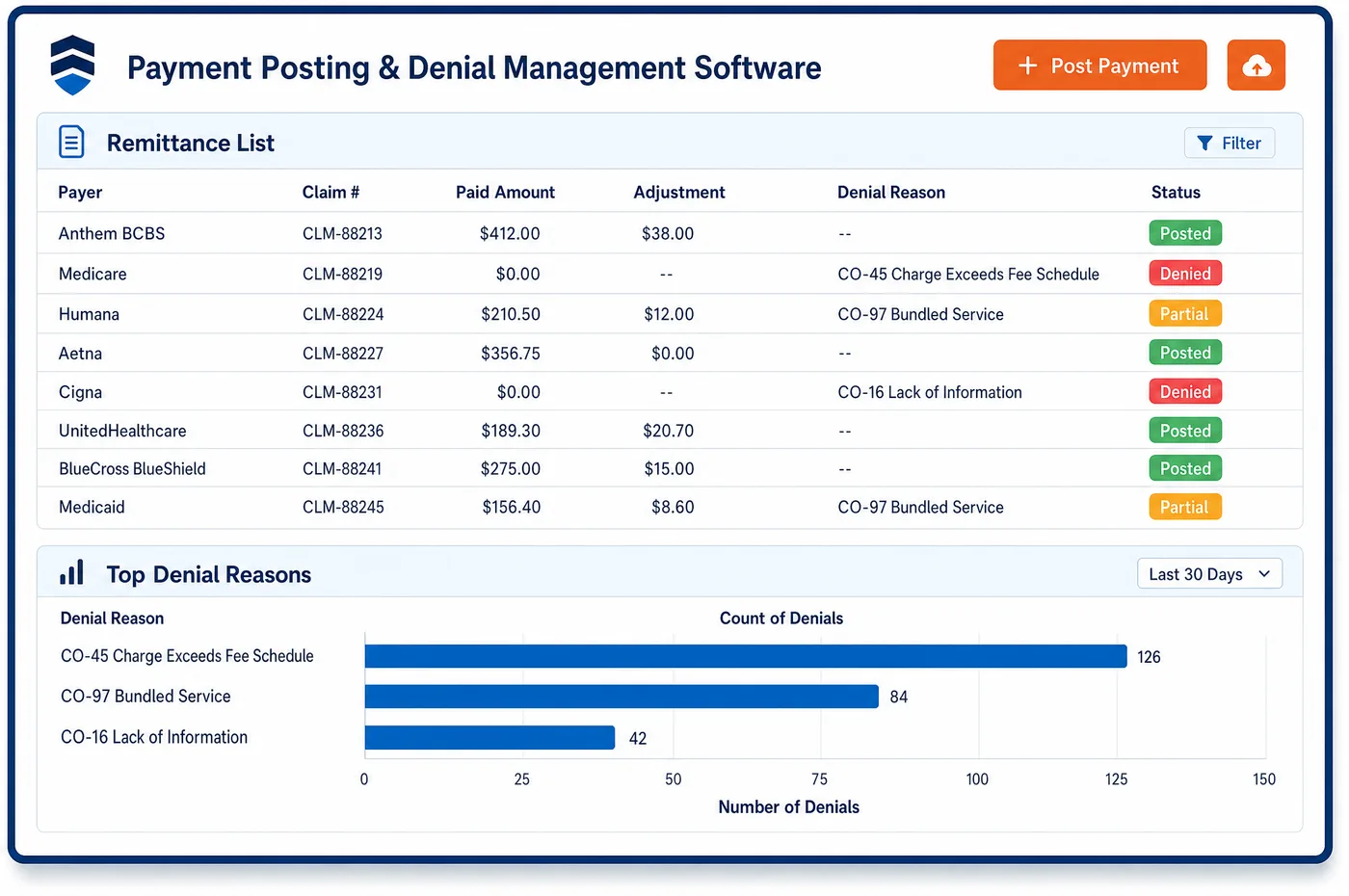
Medical Billing in a Multi-Specialty Practice
A claim carries more identity detail than most staff expect. The billing group and its NPI, the clinician who did the work, the address where it happened and the plan that pays first all have to be right. In a group with many departments and sites, those fields change from visit to visit. Multi-specialty medical billing software reads them from the encounter and the shared record, so staff do not choose them by hand. A scrubber checks codes, modifiers and payer limits before the claim leaves. Claims go out electronically as 837 files, and acknowledgments and rejections come back to the same queue. Primary, secondary and tertiary claims follow the payer order on the record. A rejection returns with its reason to the person who owns the department. Billing sits inside the wider RCM process, and it takes validated charges from charge validation.
Why Is Medical Billing Different in Multi-Specialty?
Identity errors are the quiet cause of rejections in a group. A claim that lists the wrong rendering clinician, a site that does not match enrollment or the wrong billing entity can be rejected before it is ever read for coding. These errors multiply when many clinicians rotate across sites and departments each week.
Rules differ by department on the same form. Medicare allows incident-to billing only under set conditions, with the supervising physician as the biller. A procedure department adds global period and modifier rules. Behavioral health adds time-based codes. Primary care adds preventive services with their own diagnosis rules. A billing process that treats every claim alike will pass some errors through and flag others that are fine.
Payer order is the third challenge. Patients with more than one plan are common in a large practice, and the plan that pays first can change with the reason for the visit. Secondary claims depend on the primary payment, so they have to follow the remittance. In a group, a missed secondary claim in one department can go unnoticed for a long time.
What Multi-Specialty Medical Billing Software Handles
- Billing provider and rendering provider on the CMS-1500
- Item 33a holds the NPI of the billing provider or group, and item 24J holds the rendering provider's NPI. The claim names the group as biller and the clinician as renderer, so each department's clinicians need correct NPIs on file. (CMS Medicare Claims Processing Manual, Chapter 26: Completing and Processing Form CMS-1500 (Items 24J, 32, 33))
- Service location per claim
- Item 32 holds the name, address and ZIP code of the place where services were furnished, and only one location may appear per claim form. Visits at different sites need separate claims. (CMS Medicare Claims Processing Manual, Chapter 26: Completing and Processing Form CMS-1500 (Items 24J, 32, 33))
- Incident-to billing
- Medicare permits incident-to services only when they are furnished under direct supervision by the physician or a practitioner with an incident-to benefit, and only the supervising physician or practitioner may bill. Staff confirm those conditions before a claim goes out under the physician's NPI; see incident-to billing. (eCFR: 42 CFR 410.26, Services and supplies incident to a physician's professional services)
- Same specialty, same group, same day
- Medicare treats physicians of the same specialty in the same group as one physician, so only one E/M service is reported on a day unless the problems are unrelated. Different specialties in the group bill separately. (CMS Medicare Claims Processing Manual, Chapter 12 (section 30.6.5, Physicians in Group Practice))
- Claim-level rejection codes
- Payers use CARC 16 when a claim lacks information or has billing errors, and CARC 4 when the procedure code does not match the modifier. A scrubber that checks those fields before submission prevents many of them. (X12: Claim Adjustment Reason Codes (CARC 4 and 16))
How Does Multi-Specialty Medical Billing Software Work?
1. Build the claim from the encounter
The encounter supplies the billing group, rendering clinician, location and diagnoses. The coverage list on the record sets the payer order.
2. Scrub against payer rules
Codes, modifiers, units and payer coverage limits are checked before the claim leaves. Failures return to a queue with the reason attached.
3. Submit electronically
Claims go to payers as 837 files through the clearinghouse connection. Acknowledgments and status come back and are shown on the claim.
4. Resolve rejections the same day
Rejected claims return to a named owner by department. Staff fix the field and resend, rather than waiting for a month-end review.
5. Send secondary claims
When the primary payer remits, the secondary claim is built from that payment, so deductibles and coinsurance are not lost. The result flows to invoicing for patient balances.
Multi-Specialty Medical Billing Software vs. Generic Software
| Area | Generic approach | Unlimited Systems |
|---|---|---|
| Claim identity | Staff pick the billing entity and location by hand. | Billing group, clinician and location read from the encounter. |
| Scrubbing | Errors found after the payer rejects. | Codes and modifiers checked before the claim leaves. |
| Submission | Batches sent late in the day or week. | Claims sent electronically with status tracked. |
| Secondary claims | Built by hand after the primary pays. | Built from the primary remittance. |
| Rejections | Sit in a shared inbox. | Return to a queue with an owner and the reason. |
Who Uses It in a Multi-Specialty Practice
- Biller: A queue of rejected or held claims with reasons, sorted by department and payer. The biller fixes the cause once and resubmits.
- Billing manager: A view of claim status across departments, including claims not yet acknowledged. The manager sees where claims stall without opening each one.
- Department coder: A short list of claims returned for coding questions, tied to the work done in charge assembly, so questions arrive with the encounter in view.
Multi-Specialty Medical Billing Software FAQs
The billing group and its NPI come from the entity set on the encounter, and the rendering clinician comes from the visit. Staff do not retype them. When a group has more than one entity or several sites, each claim carries the one that matches the visit, which avoids rejections for identity mismatches.
The CMS-1500 allows only one service location on a claim. When a group sees patients at an office and at a hospital outpatient department, each site's visits go on their own claims. Billing software splits them by location so staff do not have to sort them by hand.
Under Medicare, incident-to billing is allowed when the service is furnished under direct supervision and the other conditions are met, and only the supervising physician or practitioner bills. Otherwise the practitioner bills under their own NPI. Staff in the group check the conditions for each case before the claim is built.
Secondary claims are built from the primary payer's remittance, using the payer order saved on the record. That includes the amounts the primary paid and adjusted. Staff see which claims await a secondary and can work the ones that are late.
A rejection returns to a work queue with the payer's reason, and the owner for that department fixes the field and resends it. Rejections are not denials, since the payer never processed the claim. Fixing them quickly keeps the claim inside the payer's filing window.
Claims go to payers through a clearinghouse connection, and the practice can connect to the one it uses or use Unlimited Clearinghouse. The billing software builds the claim and tracks status, while the clearinghouse routes the file to each payer.
Related Multi-Specialty Software
Billing & claims
In the revenue cycle
Medical Billing for related specialties
Sources
- CMS Medicare Claims Processing Manual, Chapter 26: Completing and Processing Form CMS-1500 (Items 24J, 32, 33)
- eCFR: 42 CFR 410.26, Services and supplies incident to a physician's professional services
- CMS Medicare Claims Processing Manual, Chapter 12 (section 30.6.5, Physicians in Group Practice)
- X12: Claim Adjustment Reason Codes (CARC 4 and 16)
GET STARTED
See Unlimited Systems in Action
Whether you're actively evaluating new technology or simply preparing for your next vendor renewal, Unlimited Systems can help you understand where your current workflows may be creating avoidable revenue risk.