
Billing & claims
Multi-Specialty Charge Validation Software
Run each department's coding rules on its own charges, plus the group-wide payer edits, before a claim is created.
Multi-Specialty Charge Validation Software checks every charge against the rules for its own department and the payer before a claim is built. Surgery charges get global period and modifier checks, primary care charges get preventive and visit checks, and group-wide edits such as NCCI pairs and unit limits apply to all of them.



 6,500+ specialty providers

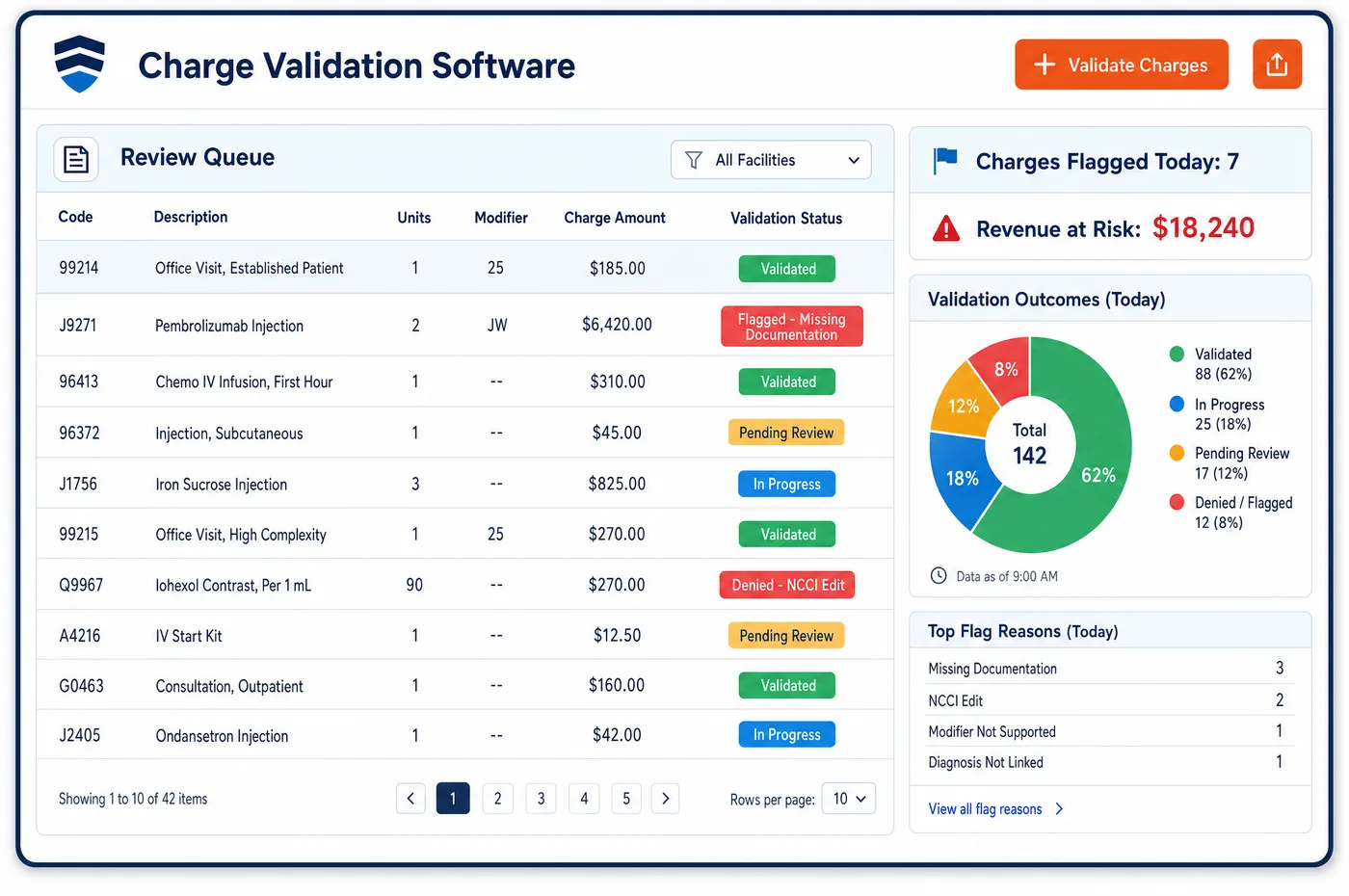
Charge Validation in a Multi-Specialty Practice
Validation in a group runs on layers. The first layer is the code set: valid codes, diagnosis pointers, units and modifiers. The second is the department. A procedure area needs global period logic, and a behavioral health clinic needs time checks. The third is the payer, whose rules differ by plan. Multi-specialty charge validation software runs the layers in order, so a rule built for one specialty never fires on another. Same-day charges from several departments are compared with each other, since two visits can raise a payer rule. Edits can also compare a charge with medical necessity policy when the practice sets that up. Failed charges return to the owner with the edit and the reason. Validated charges flow on to medical billing, after being gathered by charge assembly.
Why Is Charge Validation Different in Multi-Specialty?
A rule that is right for one specialty is wrong for another. Surgical codes have a global period, so related visits after the procedure are not paid separately. A primary care visit on the same day as a minor procedure may need a modifier. A behavioral health session depends on time. If one rule set is applied to all of them, correct charges are held and incorrect ones pass.
Group-wide rules still apply. NCCI pair edits and unit limits rest on services by the same provider for the same patient on one date. They mostly act inside one clinician.s claims. Clinicians in different departments rarely trip them against each other. A clinician who works in two departments can. Validation has to know which provider each charge belongs to.
Some checks are about the patient's day, not one line. Medicare pays one E/M service per day for same-specialty physicians in one group, unless the problems are unrelated. A second visit can fit that rule or break it, depending on specialty. The group needs a validation step that sees the whole day across departments, because no single department can.
What Multi-Specialty Charge Validation Software Handles
- Global surgical period and modifier 24
- Medicare pays an E/M visit during a postoperative period only when the same physician who did the procedure bills it with modifier 24 and documentation that it is unrelated. Validation holds post-op visits without the modifier; see modifier 24. (CMS Medicare Claims Processing Manual, Chapter 12 (sections 30.6.5 and 30.6.6))
- Modifier 25 on same-day E/M
- Medicare requires modifier 25 only on E/M claims for a service by the same physician or practitioner on the same day as another procedure, and different diagnoses are not required. Validation checks that the modifier is on the E/M line and not the procedure. (CMS Medicare Claims Processing Manual, Chapter 12 (sections 30.6.5 and 30.6.6))
- NCCI procedure-to-procedure edits
- NCCI edits and medically unlikely edits are based on services by the same provider to the same beneficiary on the same date. Validation applies them per provider, using the rendering NPI on each line; see NCCI edits. (CMS NCCI Policy Manual for Medicare Services, Chapter I: General Correct Coding Policies)
- Distinct service modifiers
- Modifier 59 and the X modifiers XE, XS, XP and XU are NCCI-associated modifiers used only when no other modifier better describes the relationship between codes. Staff review these lines against documentation; see modifier 59. (CMS NCCI Policy Manual for Medicare Services, Chapter I: General Correct Coding Policies)
- Same-specialty same-day rule
- Only one E/M service may be reported on a day by the same physician or by physicians in the same specialty in the same group, unless the problems are unrelated. Validation flags a second same-specialty E/M for review. (CMS Medicare Claims Processing Manual, Chapter 12 (sections 30.6.5 and 30.6.6))
How Does Multi-Specialty Charge Validation Software Work?
1. Identify the department and provider
Each charge arrives with its department, rendering clinician, specialty and place of service. Those fields decide which rules apply.
2. Run code-set and department rules
Codes, units, diagnoses and modifiers are checked first, then the department's own rules such as global period logic. Failures stay with the department.
3. Apply payer and policy edits
Payer coverage limits and medical necessity policies set up by the practice are checked next. NCCI pairs are checked per provider.
4. Compare the whole day
Charges from all departments on the same date are checked against each other for same-day rules. A visit that conflicts goes to review before billing.
5. Return or release
Clean charges go on to billing. Failed charges go back with the edit and the fix, using queues that the practice assigns by revenue cycle role.
Multi-Specialty Charge Validation Software vs. Generic Software
| Area | Generic approach | Unlimited Systems |
|---|---|---|
| Rule sets | One list of rules for every department. | Rules grouped by department and payer. |
| Timing | Errors found after the claim is rejected or denied. | Charges checked before a claim is created. |
| Same-day visits | Each department is checked alone. | All departments' charges for the day compared. |
| Modifiers | Added from memory at billing. | Checked against codes and documentation before release. |
| Feedback | Billers fix the same error repeatedly. | Errors return to the department with the edit named. |
Who Uses It in a Multi-Specialty Practice
- Certified coder: A short list of failed charges with the exact edit and the rule behind it. The coder spends time on judgment calls, not on rechecking clean charges.
- Department physician: Clear feedback on why a charge was held, such as a missing modifier or a post-op visit, so the next note and charge are right the first time.
- Compliance officer: A record of edits that fired and how each was resolved, which supports internal audits of modifiers 24, 25 and 59 and same-day visits.
Multi-Specialty Charge Validation Software FAQs
Validation chooses its rules from the department and provider on each charge. A global period check fires on surgical codes and never on a primary care visit. Group-wide edits, such as code validity and payer limits, apply to everything. The layers run in order so a department rule stays local.
NCCI procedure-to-procedure edits and medically unlikely edits are built on services provided by the same provider to the same beneficiary on the same date of service. Different clinicians seldom trigger them against each other, but a clinician who works in two departments can. Validation uses each line's rendering provider to apply them.
Under Medicare, physicians of the same specialty in the same group are paid as one physician, and only one E/M service is reported on a day unless the problems are unrelated. Visits from different specialties are paid separately. Validation flags a same-specialty second visit so staff can check the documentation first.
Modifier 24 marks an E/M service in the postoperative period that is unrelated to the surgery, and it is used by the same physician who did the procedure. Medicare pays such a visit only with documentation supporting the unrelated problem. Validation holds post-op visits without that modifier so staff can review them.
Validation can compare a charge with coverage policies, such as Medicare national and local coverage determinations, when the practice sets them up. A service whose diagnosis does not support it is held for review. Staff then add the right diagnosis or move toward an advance notice, depending on the payer's rules.
The failed charge returns to the department or coder that owns it, with the edit and the reason attached. Once the cause is fixed, the charge is released to billing. Repeated failures for the same edit can point to a note or template that needs a change.
Related Multi-Specialty Software
Billing & claims
In the revenue cycle
Charge Validation for related specialties
Sources
GET STARTED
See Unlimited Systems in Action
Whether you're actively evaluating new technology or simply preparing for your next vendor renewal, Unlimited Systems can help you understand where your current workflows may be creating avoidable revenue risk.