

Payments & AR
Orthopedics Payment Posting Software
Post each orthopedic remit against what the payer should have paid, from surgery lines to work injury checks.
Orthopedics Payment Posting Software applies 835 remits and patient payments to orthopedic claims line by line. It reads surgical reductions, global-period denials and drug payments for injections. It posts workers' compensation and auto payments to the right case. Then it matches each deposit to the bank, so the ledger and the cash agree.



 6,500+ specialty providers

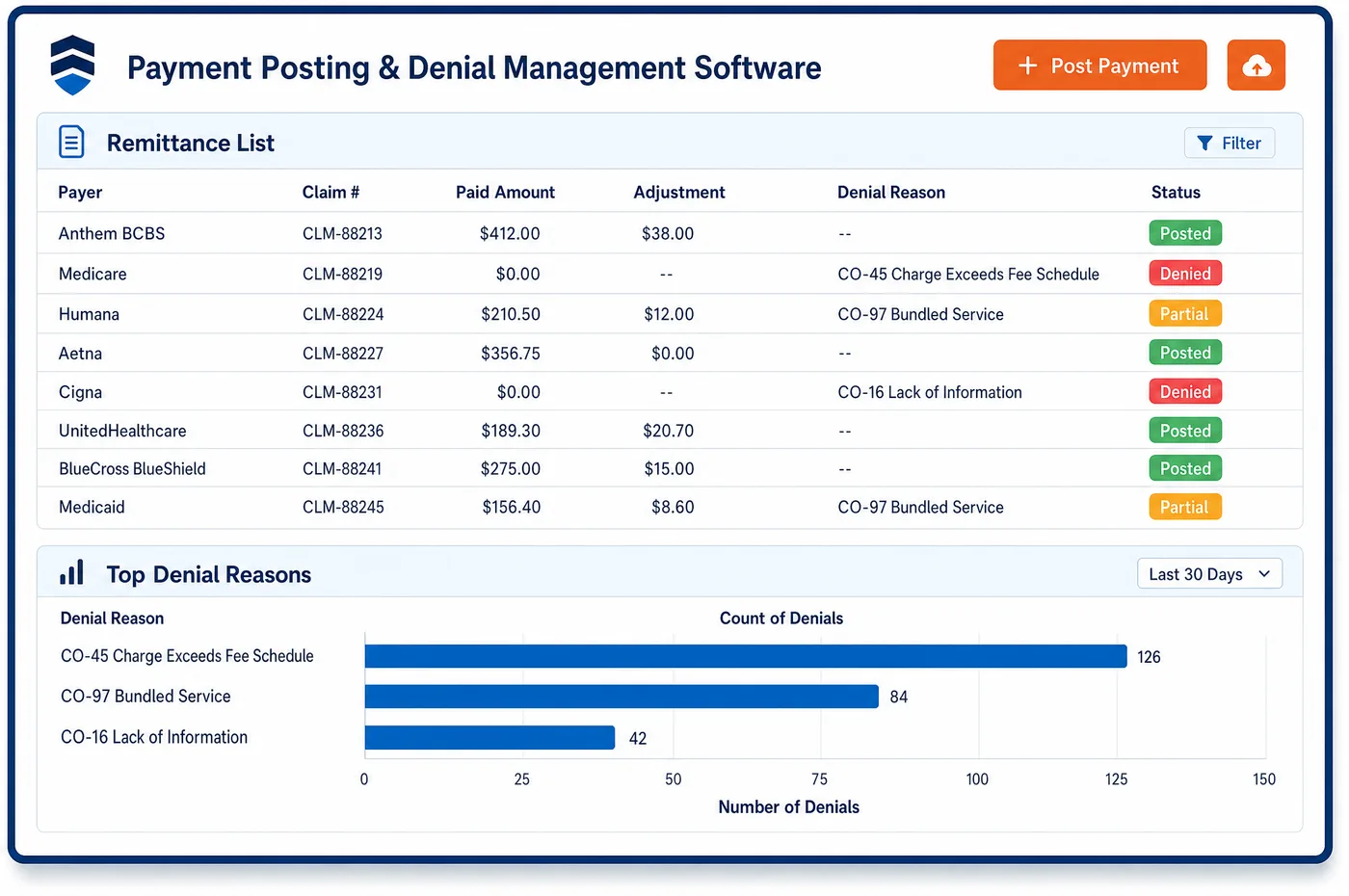
Payment Posting in a Orthopedics Practice
In an orthopedic group, one 835 file can hold a knee arthroscopy paid under multiple-procedure rules, a post-op visit denied as part of the global package, and a hyaluronic acid injection paid per unit. Payment posting starts when the system imports that file from the clearinghouse and matches each service line to the charge it pays. A CARC 59 reduction on a secondary procedure is checked against the amount the practice expected. A CARC 97 denial on a visit inside the global window is flagged, so staff can see whether modifier 24 or 79 was missing or the denial is correct. Contractual adjustments, deductibles and takebacks post as separate lines. Workers' compensation and no-fault carriers often pay by check or under their own payer ID, so those payments post against the injury case and claim number. When a line pays short of the expected rate, it goes to an underpayment queue instead of being written off.
Why Is Payment Posting Different in Orthopedics?
Orthopedic remits carry a lot of adjustment logic. Surgery is paid under multiple-procedure rules, so the highest-valued procedure is paid in full and each added procedure is reduced. Bilateral cases may be paid under modifier 50 or as RT and LT lines, and payers do not agree on which. A poster who keys only the check total cannot tell whether a reduction landed on the right line. Each line has to be compared with what the fee schedule and the global surgical package allow.
The payer mix adds a second layer. Health plans send 835 files, but many workers' compensation carriers and auto insurers still pay by check with a paper explanation of review. They pay from state fee schedules, not the Medicare rate. One injury can involve both a carrier and a health plan. Posting a carrier check to the wrong guarantor leaves balances that AR management staff later chase on the wrong account.
Drugs and supplies complete the picture. In-office injections are paid by HCPCS unit, braces and walking boots are paid under DMEPOS rules, and some commercial ASC contracts pay implants at invoice cost. Each pays on a different basis, so one expected-payment check does not fit them all. Denials found while posting also need to move straight to denial management rather than sit in the ledger as zero-pay lines.
What Orthopedics Payment Posting Software Handles
- CARC 59 multiple-procedure reduction
- Each reduced line is compared with the expected amount for its rank in the case, so a reduction applied to the primary procedure instead of the secondary one is flagged. (X12 Claim Adjustment Reason Codes)
- CARC 97 on global-period visits
- Visits denied as included in the surgical package are matched to the surgery date and its global days, and the poster sees whether the claim carried modifier 24, 78 or 79. (CMS MLN Global Surgery Booklet)
- Modifier 51 and 50 payment rules
- Bilateral and multiple-procedure lines are checked against the Medicare payment indicators for each CPT code, so a bilateral knee procedure paid as one side is caught at posting. (Medicare Claims Processing Manual, Chapter 12: Physicians/Nonphysician Practitioners)
- Workers' compensation fee schedules
- Carrier payments post against the claim number and are compared with the state fee schedule, such as the California Official Medical Fee Schedule, rather than a health plan rate. (California Division of Workers' Compensation, Official Medical Fee Schedule)
- 835 PLB provider-level adjustments
- Takebacks and offsets reported in the PLB segment post as their own lines and link to the original claim, so a recoupment on one patient is not hidden inside another patient's payment. (X12 transaction sets, including the 835 Health Care Claim Payment/Advice)
- Hyaluronic acid units (J7321 to J7329)
- Injection payments are checked per HCPCS unit. Some of these codes are billed per dose and others per milligram, so a short payment on a per-milligram product is easy to see. (UnitedHealthcare medical benefit drug policy: Sodium Hyaluronate)
How Does Orthopedics Payment Posting Software Work?
1. Import the 835
The system pulls each ERA from the clearinghouse and balances it to the payment total. Files that do not balance stop before anything posts.
2. Match lines to charges
Each service line is matched to the CPT code, modifiers and units billed. Surgical lines keep their order, so the reduction can be compared with the expected rank.
3. Check the expected payment
Allowed amounts are compared with the contract or fee schedule for that payer and site of service. Lines that pay short go to an underpayment queue with the reason code attached.
4. Post carrier and attorney checks
Workers' compensation, auto and attorney checks are posted against the injury case and claim number. The explanation of review is stored with the payment for later appeals.
5. Reconcile the deposit
Posted totals are matched to bank deposits and lockbox files using the EFT trace number. Gaps between cash received and cash posted show up on the day they occur.
6. Route the exceptions
Zero-pay lines with codes such as CARC 97, 16 or 50 move to the right work queue. The poster does not have to decide who owns each one.
Orthopedics Payment Posting Software vs. Generic Software
| Area | Generic approach | Unlimited Systems |
|---|---|---|
| Surgical reductions | Accepted as paid because the check total looked close. | Each line compared with the expected amount for its place in the case. |
| Global-period denials | Written off as bundled without checking the modifier. | Matched to the surgery date so a missing 24 or 79 modifier is visible. |
| Workers' compensation checks | Posted to the patient's health plan account by mistake. | Posted to the injury case and checked against the state schedule. |
| Takebacks | Netted silently against new payments. | Posted as separate PLB lines linked to the original claim. |
| Deposit match | Reconciled at month end from bank statements. | Matched to deposits and lockbox files as payments post. |
Who Uses It in a Orthopedics Practice
- Payment poster: A queue of only the exceptions, such as unbalanced files, short pays and paper carrier payments, with the remittance detail on one screen.
- Billing manager: Underpayment and denial counts by payer and CPT code, so a payer that keeps reducing the wrong line can be raised with its provider representative.
- Practice administrator or CFO: Cash that agrees with the bank, with contractual adjustments and takebacks posted to the general ledger instead of buried in totals.
Orthopedics Payment Posting Software FAQs
Orthopedic payment posting checks each surgical line against the amount the payer should allow for its place in the case. Medicare pays the top-valued procedure in full. It cuts the others when modifier 51 rules apply. If the payer cut the primary procedure instead, or cut a line that is exempt from the rule, the line is flagged as an underpayment. Its CARC code is shown next to it.
A post-op visit denied as global is matched to the surgery and the global days for that CPT code. If the visit treated an unrelated problem and modifier 24 was missing, the line is sent back for a corrected claim. If the visit was routine post-operative care, the denial is correct and the line is closed so it does not linger in AR.
Workers' compensation, auto and no-fault payments post in the same ledger as health plan payments, but against the injury case rather than the patient's health plan. Each payment is tied to the carrier's claim number and checked against the state fee schedule that applies. Paper explanations of review are scanned and kept with the payment so staff can find them for an appeal.
Hyaluronic acid and steroid injection payments are checked by HCPCS unit. Some hyaluronic acid codes are billed per dose and others per milligram, so the expected payment depends on the code and the units billed. When a payer pays fewer units than were billed, or pays the drug but denies the injection procedure, the line goes to review.
Takebacks reported in the 835 PLB segment post as separate adjustments linked to the original claim and patient. That keeps a recoupment on one account from lowering the payment shown on an unrelated account. Staff can see why the payer took the money back and decide whether to accept it or appeal it.
Posted remittances are matched to bank deposits and lockbox files using the EFT trace number in the 835. Payments that arrive without a matching ERA, and ERAs without a matching deposit, appear on a reconciliation list. Finance sees the same cash total the bank reports, and posted payments flow on to the general ledger.
Related Orthopedics Software
Payments & AR
In the revenue cycle
Payment Posting for related specialties
Sources
- X12 Claim Adjustment Reason Codes
- X12 transaction sets, including the 835 Health Care Claim Payment/Advice
- CMS MLN Global Surgery Booklet
- Medicare Claims Processing Manual, Chapter 12: Physicians/Nonphysician Practitioners
- California Division of Workers' Compensation, Official Medical Fee Schedule
- UnitedHealthcare medical benefit drug policy: Sodium Hyaluronate
GET STARTED
See Unlimited Systems in Action
Whether you're actively evaluating new technology or simply preparing for your next vendor renewal, Unlimited Systems can help you understand where your current workflows may be creating avoidable revenue risk.