

Payments & AR
Chiropractic Payment Posting Software
Post Medicare AT lines, GA and GY denials, accident carrier checks and daily copays to one chiropractic ledger.
Chiropractic Payment Posting Software applies payer remittances and patient payments to each manipulation, exam and therapy line. It reads why Medicare paid an AT line and denied a GA or GY line. It keeps auto, workers' compensation and health plan money apart, and ties each day's copays and checks to the bank deposit.



 6,500+ specialty providers

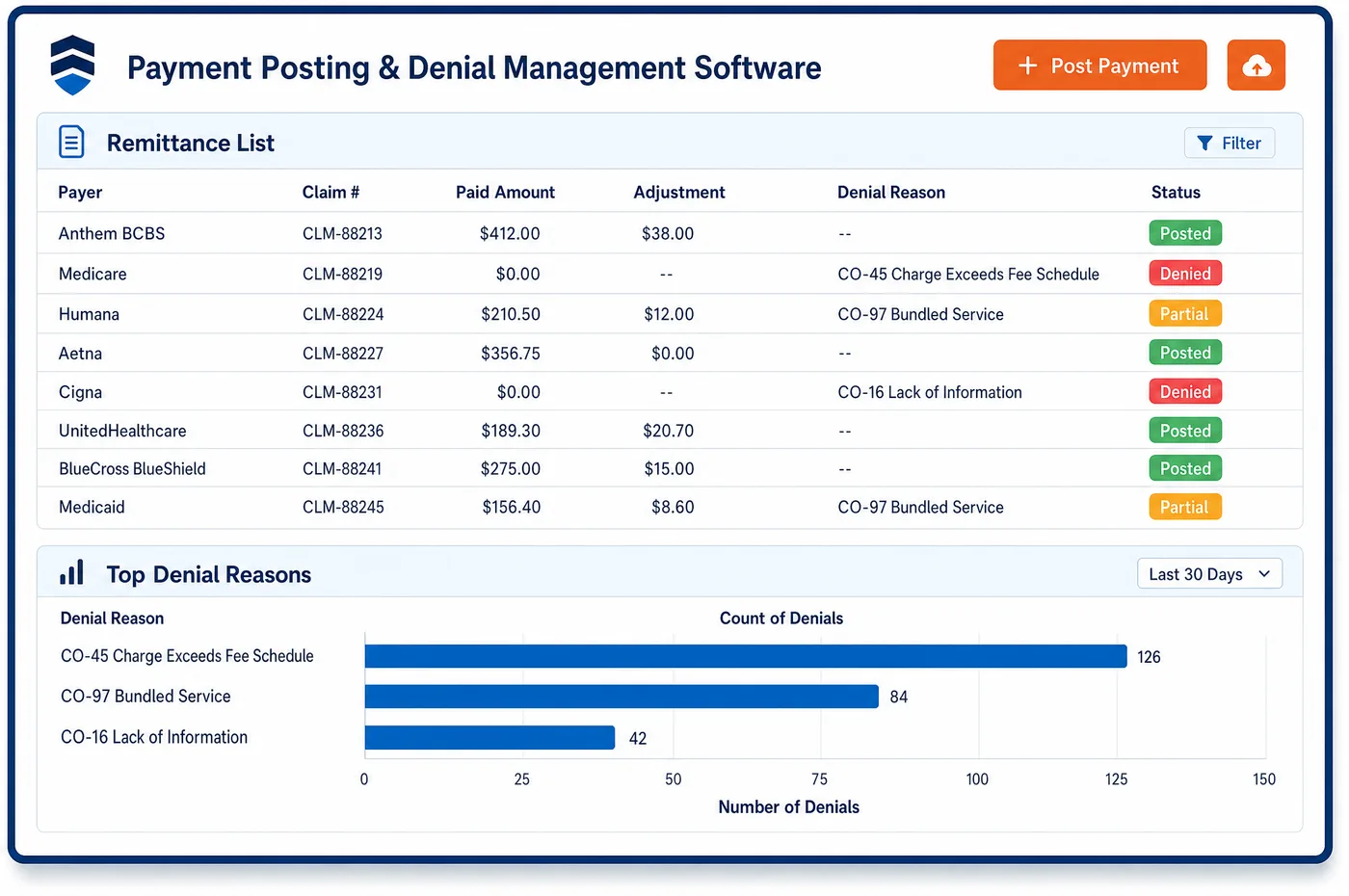
Payment Posting in a Chiropractic Practice
A chiropractic office posts a lot of small payments. A patient on an active care plan may come in several times a week, and each visit brings a copay and a claim. Unlimited Systems imports each 835 remittance and matches it to the claim line by line. For Medicare, the manipulation line billed with the AT modifier posts as paid. A maintenance visit billed with GA posts as a denial the patient owes, since an ABN was signed. Exams, x-rays and therapy that a chiropractor bills with GY also move to the patient, because Medicare does not cover them from a chiropractor. A missing initial treatment date comes back as a fixable error, not a write-off. Auto and workers' compensation carriers often pay by paper check, and staff post those checks against the case's claim number. Copays taken at the front desk land on the same ledger, and each day's totals are matched to deposits.
Why Is Payment Posting Different in Chiropractic?
Volume is the first difference. Chiropractic care runs on frequent, short visits under a treatment plan. That means many claims with small paid amounts, and a copay on almost every visit. A payment posting process built for fewer, larger claims gets buried here. Each copay must reach the right date of service, or the patient's balance stops matching what the front desk collected.
Medicare adds its own logic. It pays a chiropractor only for manual manipulation of the spine to correct a subluxation, billed as 98940, 98941 or 98942 with the AT modifier. A visit without AT is treated as maintenance and denied. Other services a chiropractor bills, such as exams and x-rays, are not covered at all. So one Medicare remittance can carry a paid line, a GA denial the patient owes, and excluded lines that also go to the patient. Each one needs a different posting action.
Then come accident and injury cases. Auto no-fault, liability and workers' compensation carriers pay first when an injury is theirs, and health plans deny with codes that say so. Many of these carriers still mail paper checks and EOBs. Posting has to keep each case's money with the case, so open accident balances can be worked and the health plan is not billed by mistake.
What Chiropractic Payment Posting Software Handles
- AT modifier on 98940, 98941 and 98942
- Medicare pays these manipulation codes only for active or corrective care billed with AT. Paid AT lines post as usual, and an AT line denied after medical review goes to follow-up with its reason code. (CMS Medicare Benefit Policy Manual, Chapter 15, Section 240 (Chiropractic Services))
- GA and GZ maintenance lines
- A GA line means an ABN was signed, so a maintenance denial posts as patient responsibility. A GZ line means no ABN was signed, so the denial stays with the practice and is held for review before any write-off. (Noridian JE Part B: Chiropractic Claim Submission Requirements (AT, GA, GZ, GY))
- GY on excluded services
- Exams, x-rays and therapy that a chiropractor bills to Medicare carry GY and are denied as excluded. The poster moves those lines to the patient under the practice's financial policy. (Noridian JE Part B: Chiropractic Claim Submission Requirements (AT, GA, GZ, GY))
- CARC 16 with RARC MA122
- Medicare uses this pair when the initial treatment or exacerbation date is missing. The line goes to a correction queue so the date can be added and the claim sent again. (CMS Medicare Claims Processing Manual, Chapter 12, Section 220 (Chiropractic Services))
- CARC 119 visit-limit denials
- This code says the benefit maximum was reached. Staff check the visit count against the plan before billing the patient or appealing a limit applied too early. (X12 Claim Adjustment Reason Codes)
- CARC 19, 20 and 21
- These codes say a workers' compensation, liability or no-fault carrier is liable. The denied line stays open and is moved to that carrier instead of being written off. (X12 Claim Adjustment Reason Codes)
- 97140 bundled with manipulation
- Under NCCI, manual therapy in the same spinal region as manipulation is not paid on its own. A bundling denial is flagged so staff can check whether the note shows a different region before resubmitting with 59 or XS. (CMS NCCI Policy Manual for Medicare Services, Chapter XI, Section S (Chiropractic Manipulative Treatment))
How Does Chiropractic Payment Posting Software Work?
1. Import remittances
835 files from Medicare and health plans are imported as they arrive. Each file is matched to its original claim and claim line.
2. Post each line
Each CPT line gets its own paid amount, contractual adjustment and patient share. A paid manipulation line and a denied exam line from the same visit are posted on their own.
3. Route the exceptions
Denials are sorted by reason code into queues. Missing-date errors go to correction, visit-limit denials go to review, and wrong-payer codes go to the staff who handle accident claims.
4. Post paper checks by case
Auto and workers' compensation checks are posted against the case and its carrier claim number. Accident money stays with the accident case, not the patient's health plan account.
5. Apply copays and plan payments
Copays, self-pay visits and care-plan installments post to the same ledger. Whatever is left moves on to patient statements.
6. Reconcile to the bank
Each day's posted totals are matched to bank deposits, EFTs and lockbox files. Cash, adjustments and recoveries then flow to the general ledger as balanced entries.
Chiropractic Payment Posting Software vs. Generic Software
| Area | Generic approach | Unlimited Systems |
|---|---|---|
| Medicare modifiers | AT, GA and GY lines posted the same way, so patient balances drift. | Each line posted by its modifier and reason code. |
| Copay volume | Front desk copays batched and posted at the end of the week. | Copays post to the visit they were taken for. |
| Accident carriers | Paper checks kept in a folder until someone has time. | Checks posted to the case and its claim number. |
| Visit-limit denials | Written off or billed to the patient without a check. | Reviewed against the plan's visit count first. |
| Bank deposits | Reconciled by hand in a spreadsheet once a month. | Each day's posted totals tied to the deposit. |
Who Uses It in a Chiropractic Practice
- Payment poster: A queue of only the lines that did not post cleanly, with GA, GY, CARC 16 and CARC 119 lines already sorted by next step.
- Billing manager: Denials by payer and reason, so a run of missing initial treatment dates or visit-limit problems gets fixed before the next claim goes out.
- Clinic owner: Cash that ties to the bank, and a ledger that shows health plan, Medicare, accident and self-pay money apart.
Chiropractic Payment Posting Software FAQs
Payment posting reads the modifier and reason code on each Medicare line. A GA line was billed with a signed ABN, so a maintenance denial posts as patient responsibility. A GY line covers a service Medicare excludes when a chiropractor provides it, such as an exam or x-ray, and it also moves to the patient. GZ denials stay with the practice, because no ABN was signed.
Medicare returns CARC 16 with remark MA122 when the initial treatment or exacerbation date is missing from the claim. That is a billing error, not a coverage decision. The line goes to a correction queue instead of being written off. Staff add the date from the treatment plan and resend the claim, and the first denial stays in the account history.
Auto, liability and workers' compensation payments are posted against the injury case and the carrier's claim number. The case keeps its own balance, separate from the patient's health plan visits. That matters because these carriers pay first for the injury, and a payment posted to the wrong account can lead to a duplicate bill or a missed balance on the case.
A visit-limit denial usually comes back as CARC 119, which says the benefit maximum was reached. The line is held for review instead of moving straight to the patient. Staff compare the payer's count with the visits on record and the plan's rules. If the limit was applied too early, they appeal. If it was right, the balance moves to the patient under practice policy.
Copays taken at check-in post to the visit they were collected for. Because care-plan patients come in often, a copay posted to the wrong date quickly throws off the balance. Posting each copay to its date of service keeps the front desk and billing office looking at the same number, and statements show what the patient really owes.
Posted payments are matched to bank deposits, EFTs and lockbox files. Electronic payments are paired with their 835, and paper checks from accident carriers are matched to the deposit they came in with. Cash, adjustments and recoveries reach the general ledger as balanced entries, so the close begins from books that already agree with the bank.
Related Chiropractic Software
Payments & AR
In the revenue cycle
Payment Posting for related specialties
Sources
- CMS Medicare Benefit Policy Manual, Chapter 15, Section 240 (Chiropractic Services)
- Noridian JE Part B: Chiropractic Claim Submission Requirements (AT, GA, GZ, GY)
- CMS Medicare Claims Processing Manual, Chapter 12, Section 220 (Chiropractic Services)
- X12 Claim Adjustment Reason Codes
- CMS NCCI Policy Manual for Medicare Services, Chapter XI, Section S (Chiropractic Manipulative Treatment)
GET STARTED
See Unlimited Systems in Action
Whether you're actively evaluating new technology or simply preparing for your next vendor renewal, Unlimited Systems can help you understand where your current workflows may be creating avoidable revenue risk.