

Front office
Chiropractic Financial Clearance Software
Check the chiropractic benefit, visit limits and plan approvals before the patient is on the table, and know what Medicare won't pay.
Chiropractic Financial Clearance Software confirms what the payer covers before each course of care. It shows how many visits are left and what the patient will owe. It checks the chiropractic benefit and tracks approved visits. It flags what Medicare won't pay for, and it readies the notice or estimate the patient needs before treatment.



 6,500+ specialty providers

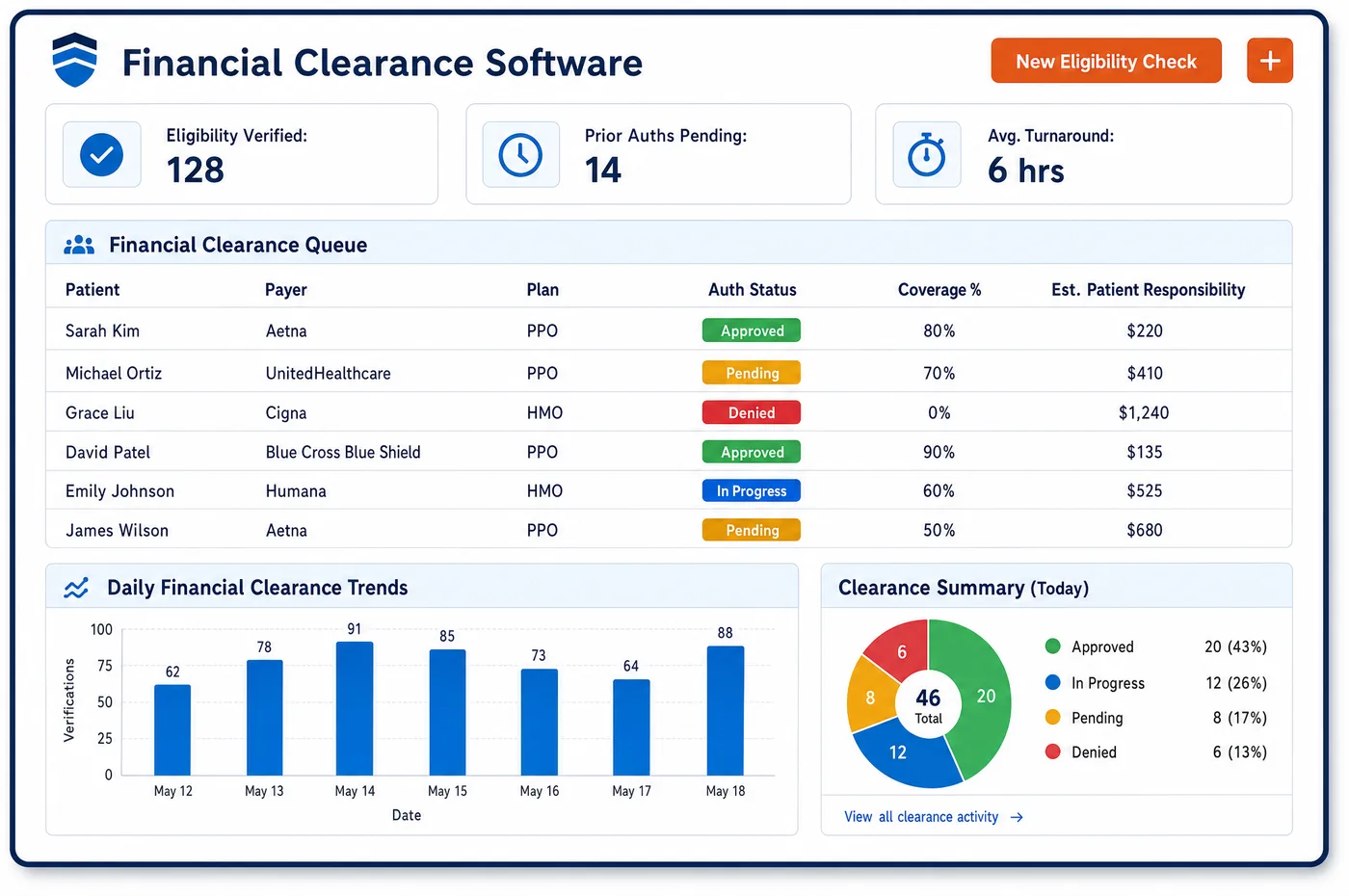
Financial Clearance in a Chiropractic Practice
Clearance in a chiropractic office runs on visit counts. A commercial plan may allow a set number of chiropractic visits each plan year, or may need approval before care goes on. A Medicare Advantage plan may need approval for the whole plan of care. Original Medicare needs no approval, but it pays only for manual manipulation of the spine to correct a subluxation, so exams, x-rays and extremity work by the chiropractor are the patient's to pay. Chiropractic financial clearance software checks the chiropractic benefit when the plan of care is set and again as visits are used. It shows the copay, the deductible left and the visits remaining. When care is about to pass an approved count, the next visit is held until a new approval is on file. When a Medicare patient moves to maintenance, the visit waits for a signed notice. Self-pay patients get an estimate.
Why Is Financial Clearance Different in Chiropractic?
Chiropractic benefits are counted, not just confirmed. Plans often cap visits, and some exclude chiropractic care altogether. A check that only says the patient is active misses the limit, so the practice finds out when the visit over the cap denies. Clearance in chiropractic has to know how many visits the plan allows and how many the patient has already used, including visits at other offices that the payer has counted.
Approvals are often tied to the plan of care. A January 2025 UnitedHealthcare notice for its Medicare Advantage plans says the request covers the whole plan, with its length and number of visits. Up to the first six visits of an initial plan can be covered without clinical review for a new patient, a new condition or a long gap in care. Past that point, the request is reviewed for medical necessity.
Original Medicare raises a different question: will Medicare pay at all? It covers spinal manipulation for a subluxation and nothing else a chiropractor provides. Extraspinal manipulation, exams and x-rays by the chiropractor are excluded by law. Maintenance care is denied as not medically necessary. Each of these needs the patient to know in advance, and the right modifier on the claim, before the practice can collect from the patient.
What Chiropractic Financial Clearance Software Handles
- Chiropractic benefit check (service type code 33)
- The benefits request asks for X12 service type code 33, which is chiropractic. Staff read the reply for the copay, the deductible and any visit limit. That way they see the chiropractic benefit, not a general office visit benefit. (X12 Service Type Codes (code 33, Chiropractic))
- Plan-of-care approval with a visit count
- For UnitedHealthcare Medicare Advantage plans, the prior authorization request covers the full plan of care and its number of visits. The initial evaluation itself does not need approval. Staff file the request and track approved visits against the schedule. (UnitedHealthcare: Medicare Advantage prior authorization updates for outpatient therapy and chiropractic services (January 2025))
- Commercial plan limits and exclusions
- Aetna's policy notes that some plans limit or exclude chiropractic care, and that care past maximum benefit is not medically necessary. Clearance checks the member's plan terms, not just the policy, before the course starts. (Aetna Clinical Policy Bulletin 0107: Chiropractic Services)
- Statutorily excluded services (GY, optional GX)
- Under Original Medicare, extraspinal CMT (98943), exams and x-rays by a chiropractor are not Medicare benefits. Claims for them carry the GY modifier. A notice the practice gives by choice, billed with GX, can warn the patient first. (CMS MLN Booklet: Medicare Advance Written Notices of Non-coverage (MLN006266))
- Maintenance care (GA or GZ)
- When the chiropractor expects Medicare to deny maintenance visits as not necessary, a signed ABN lets the practice bill the patient, and claims carry GA. Without a signed notice, claims carry GZ and the practice is liable. (CMS MLN Booklet: Medicare Advance Written Notices of Non-coverage (MLN006266))
- Estimates for self-pay patients
- Patients not using insurance are owed a good faith estimate of expected charges when they ask or book ahead. Clearance builds the estimate from the practice's self-pay prices for the planned visits. (CMS: What is a good faith estimate?)
How Does Chiropractic Financial Clearance Software Work?
1. Check the chiropractic benefit
When the plan of care is set, an eligibility check asks for the chiropractic benefit. Copay, deductible, visit limit and any review program are saved to the case.
2. Request approval when the plan needs it
If the payer requires approval, staff submit the plan of care with the number of visits requested. The approval number, dates and visit count are stored on the case.
3. Hold visits past the approved count
Visits booked past the approved count or end date are held on the schedule. Staff see the hold in the chiropractic patient schedule and request more visits before the patient arrives.
4. Sort out what Medicare won't pay
For Original Medicare, staff list the planned services that Medicare does not pay for and tell the patient. Maintenance visits wait for a signed notice. The right modifier then goes on to charge validation.
5. Give the patient the numbers
The patient sees the copay or self-pay price for each visit and what the plan does not cover. Self-pay patients get a cost estimate with the booking.
Chiropractic Financial Clearance Software vs. Generic Software
| Area | Generic approach | Unlimited Systems |
|---|---|---|
| Benefit check | A yes or no on active coverage. | The chiropractic benefit, with copay, deductible and visit limit. |
| Approved visits | Counted on paper, if at all. | Approved visits tracked against the schedule, with holds past the count. |
| Medicare exclusions | Exams and x-rays billed to Medicare and denied. | Excluded services listed for the patient and coded with GY. |
| Maintenance care | Billed with AT out of habit, or with no notice. | Held for a signed notice, then billed with GA. |
| Self-pay estimates | Prices quoted over the phone. | A written estimate sent with the booking. |
Who Uses It in a Chiropractic Practice
- Front desk: A clear answer at booking: what the patient owes today, how many visits the plan allows and whether approval is needed.
- Billing manager: Fewer denials for visits over a limit or past an approval. Medicare claims show up with the right notice and modifier already in place.
- Chiropractor: Fewer surprises for patients. The plan fits the benefit, and staff have time to ask for more visits before care stops.
Chiropractic Financial Clearance Software FAQs
Chiropractic financial clearance checks the chiropractic benefit on the patient's plan, including copay, deductible and any visit limit. It notes whether the payer requires approval for the plan of care, how many visits are approved, and which planned services the payer will not cover. It also prepares any notice or self-pay estimate the patient should get before treatment starts.
Original Medicare does not require prior approval for spinal manipulation. It pays only for manual manipulation of the spine to correct a subluxation, billed with the AT modifier for active care. Other services by the chiropractor are not covered. Medicare Advantage plans are different and may require approval for the plan of care, so staff check the plan type first.
The approval number, dates and visit count are saved to the patient's case. Each visit booked to the case counts against the approval. When a booking would pass the approved count or end date, the visit is held, and staff request more visits before the patient comes in rather than after the claim denies.
Under Original Medicare, the patient pays for exams, x-rays and other services the chiropractor provides, since Medicare covers only spinal manipulation for a subluxation. Extraspinal manipulation is not covered either. Maintenance care is denied as not necessary, and the patient can be billed for it only with a signed advance notice on file.
When the plan excludes chiropractic care, the patient is told before treatment and can choose to pay the practice's self-pay price. Staff record the exclusion on the case and give the patient a good faith estimate. If the patient's coverage changes later, a new benefit check updates the case.
Benefits can be checked again at any point in the course. Staff often recheck at the start of a new plan year, when the patient changes plans, or before a re-exam that may extend care. Each check updates the copay, deductible and visits remaining on the case, so the front desk works from current numbers.
Related Chiropractic Software
Front office
In the revenue cycle
Financial Clearance for related specialties
Sources
- X12 Service Type Codes (code 33, Chiropractic)
- UnitedHealthcare: Medicare Advantage prior authorization updates for outpatient therapy and chiropractic services (January 2025)
- Aetna Clinical Policy Bulletin 0107: Chiropractic Services
- CMS MLN Booklet: Medicare Advance Written Notices of Non-coverage (MLN006266)
- CMS: What is a good faith estimate?
GET STARTED
See Unlimited Systems in Action
Whether you're actively evaluating new technology or simply preparing for your next vendor renewal, Unlimited Systems can help you understand where your current workflows may be creating avoidable revenue risk.