

Billing & claims
Chiropractic Charge Validation Software
Check every chiropractic charge for the right modifier, notice, diagnosis and documentation before it becomes a claim.
Chiropractic Charge Validation Software checks each charge line before it becomes a claim. It confirms the AT modifier on active Medicare care, a signed notice behind any GA, the subluxation level as the first diagnosis, and payer edits such as NCCI. Lines that fail a check are held for staff with the reason shown.



 6,500+ specialty providers

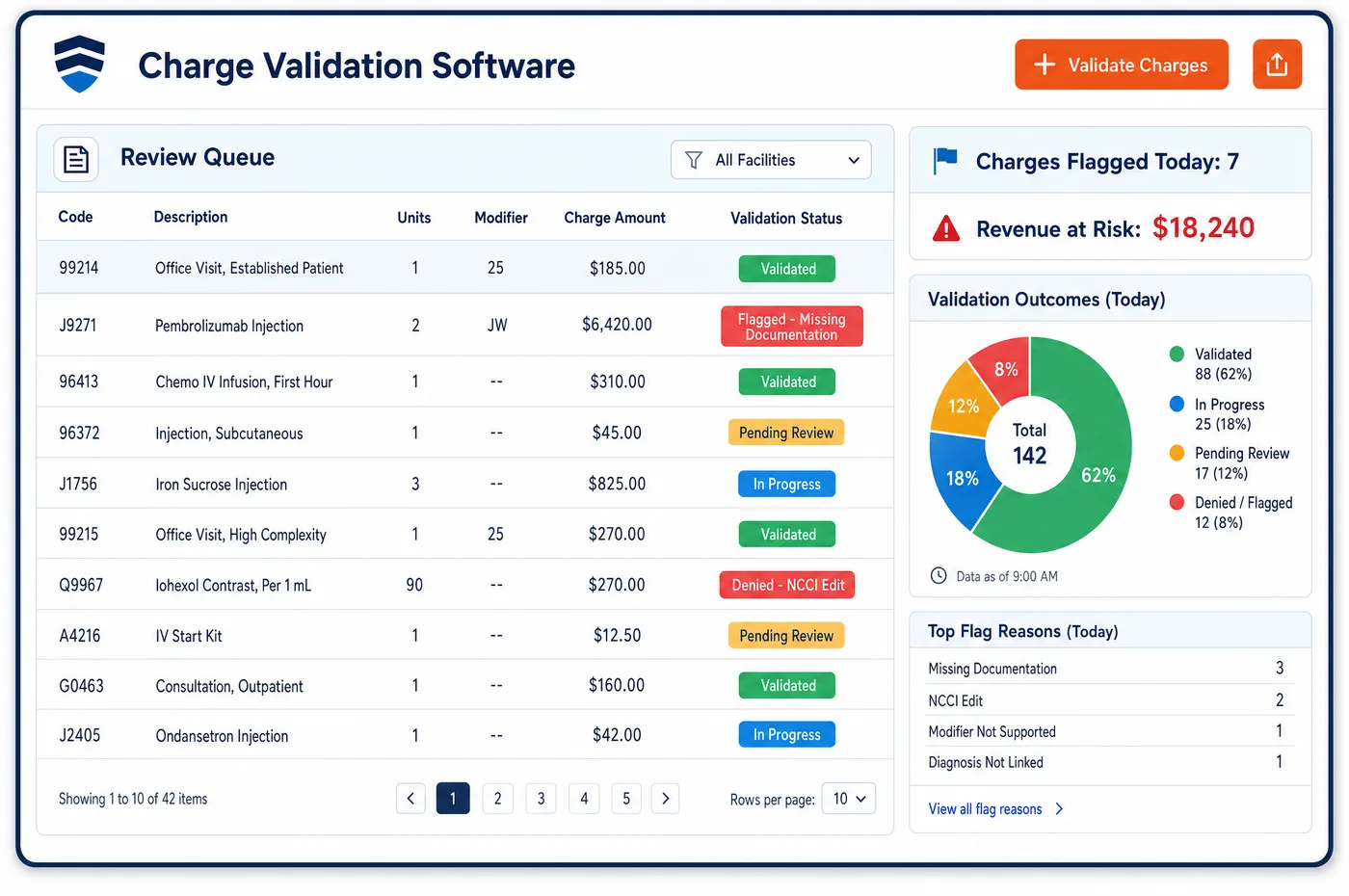
Charge Validation in a Chiropractic Practice
Charge validation for a chiropractic visit asks a short list of hard questions. Is this Medicare care active or maintenance, and does the modifier match? If the line carries GA, is a signed notice on file? Is the CMT code backed by the regions in the note, and does each region have its diagnosis pair? Is the subluxation level first? Is a therapy or exam line in the same region as CMT, or missing the modifier it needs? Would this visit pass an approved visit count or the one-a-day Medicare limit? Is the treatment start date present? Chiropractic charge validation software runs these checks on every line, using the case, the note and the payer's rules. A clean line moves on to billing. A line that fails is held with the reason, so the biller or chiropractor can fix it before a payer sees it. Fixes made on the case carry forward to later visits.
Why Is Charge Validation Different in Chiropractic?
Most chiropractic claim errors are small and repeat across many visits. A missing AT modifier, a GA with no notice on file, or a diagnosis list in the wrong order looks minor on one claim. Across a full plan of care, it becomes a stack of denials, or a pattern a payer's reviewers will notice. Validation has to catch the first one before it multiplies.
Documentation drives the charge more than in most fields. Medicare and its contractors expect a primary diagnosis of subluxation with its level, exam findings that meet at least two of the four P.A.R.T. criteria, and the exact segments adjusted. When a note lacks these, the charge may still go out, but it will not survive a records request. Charge validation in chiropractic is partly a check on the claim and partly a check on the note behind it.
Rules also differ by contractor and payer. One MAC tells chiropractors not to combine AT with denial modifiers on the same line, while another describes using GA when active care may be denied. Commercial plans have their own therapy and exam rules. Validation rules have to be set for the payers a practice actually bills, not copied from a generic list.
What Chiropractic Charge Validation Software Handles
- AT, GA and GZ on Medicare CMT
- Active care carries AT. Maintenance care drops AT and carries the GA modifier when a signed notice is on file, or the GZ modifier when it is not. A GA line with no notice on the record is held. (CMS Medicare Benefit Policy Manual, Chapter 15, Section 240: Chiropractic Services)
- P.A.R.T. findings in the note
- A subluxation shown by exam needs at least two of pain, asymmetry, range of motion change and tissue tone change, one of them asymmetry or range of motion. A line is held for review when the note does not show them. (CMS MLN Educational Tool: Medicare Documentation Job Aid for Chiropractic Doctors (MLN1232664))
- Diagnosis pairs for regions billed
- Noridian says documentation must support a primary and a secondary diagnosis for each region treated. When the region count on the CMT line exceeds the diagnosis pairs, the line is held. (Noridian JF Part B: Chiropractic Documentation Guidelines, Initial Visits vs. Subsequent Visits)
- Therapy and exams billed to Medicare
- Medicare excludes physical therapy and office visits by a chiropractor. Noridian notes that some excluded 97xxx services can be billed for denial with GP and GY. Lines without those modifiers are held. (Noridian JF Part B: Chiropractic Services (excluded services and GP/GY billing))
- Same-region therapy (NCCI)
- Manual therapy, massage and neuromuscular work in a spinal region that got CMT are bundled under NCCI edits. A therapy line in the same region is held, and a line in another region needs 59 or XS. (Medicare NCCI Policy Manual 2026, Chapter XI: Medicine (Section S, Chiropractic Manipulative Treatment))
- One Medicare treatment a day
- Medicare limits payment to no more than one chiropractic treatment per day. A second CMT line for the same Medicare patient on the same date is stopped before it reaches a claim, so the visit can be reviewed. (CMS Medicare Benefit Policy Manual, Chapter 15, Section 240: Chiropractic Services)
- Treatment start date on the claim
- Medicare edits check that the date of the initial visit or the flare-up of an existing condition is entered. A line whose case has no start date is held until staff add it. (Medicare Claims Processing Manual, Chapter 12, Section 220: Chiropractic Services)
How Does Chiropractic Charge Validation Software Work?
1. Receive lines from charge assembly
Coded lines arrive from chiropractic charge assembly with the case's payer and status. Validation starts as soon as the visit is closed.
2. Run payer and modifier checks
Each line is checked for AT, GA, GZ and GY use, notice status, and payer edits. MAC-specific rules apply to Medicare lines.
3. Check the note behind the line
The checks look for the subluxation level, P.A.R.T. findings, the segments adjusted and diagnosis pairs for each region. Gaps are sent to the chiropractor to fix.
4. Check limits and dates
The visit is checked against approved visit counts, the one-a-day Medicare limit and the start date on the case. Lines that fail are held, not sent.
5. Release and learn
Clean lines go to billing. Held lines and their reasons feed chiropractic denial management reports, so the same problem is fixed at its source.
Chiropractic Charge Validation Software vs. Generic Software
| Area | Generic approach | Unlimited Systems |
|---|---|---|
| Maintenance modifiers | GA added with no notice on file. | GA held until the notice is on the record. |
| Documentation | Charges sent no matter what the note says. | Lines held when P.A.R.T. findings or segments are missing. |
| Diagnosis pairs | Region count and diagnoses never compared. | Each region checked for its diagnosis pair. |
| Excluded Medicare services | Exams and therapy sent with no denial modifiers. | Held until GY, with GP for therapy, is added. |
| Payer rules | One generic rule set for every payer. | Rules set for each MAC and commercial plan the practice bills. |
Who Uses It in a Chiropractic Practice
- Biller: A short queue of held lines, each with the reason, instead of a long list of denials after the fact.
- Chiropractor: Prompt notice when a note is missing a finding or a diagnosis pair, while the visit is still fresh.
- Compliance lead: Proof that every Medicare charge was checked for the right modifier and notice before it was sent.
Chiropractic Charge Validation Software FAQs
Chiropractic charge validation most often catches a missing AT modifier on active Medicare care, GA without a signed notice, the wrong diagnosis order, therapy billed in the same region as CMT, a missing treatment start date, and visits past an approved count. Each one is held with its reason before the claim is built.
The case status tells it. When the chiropractor documents that care has become maintenance, the case changes, and later Medicare lines should not carry AT. A maintenance line then needs GA with a signed notice, or GZ without one. If the modifier and the case status disagree, the line is held.
Validation checks that the note behind each charge has what the payer expects: the subluxation level, exam findings that meet the P.A.R.T. rule, the segments adjusted, and diagnosis pairs for each region. When something is missing, the line is held and the chiropractor is asked to complete the note before the claim goes out.
Therapy lines are compared with the regions that got CMT. Under NCCI, manual therapy, massage and neuromuscular work in the same spinal region are bundled. In a different region, they need modifier 59 or XS. For Medicare, therapy by a chiropractor is excluded, so those lines are coded for denial or billed to the patient.
Rules can be set by contractor. Noridian, for example, says not to bill AT on the same line as GA, GX, GY or GZ, while WPS describes GA with AT when active care may be denied. The practice sets the rules for its own MAC, so Medicare lines are checked the way that contractor expects.
A line that fails is held in a queue with the reason shown, such as a missing notice or a diagnosis gap. The biller or chiropractor fixes the problem, often on the case or the note, and the line runs through the checks again. Once it passes, it moves on to billing.
Related Chiropractic Software
Billing & claims
In the revenue cycle
Charge Validation for related specialties
Sources
- CMS Medicare Benefit Policy Manual, Chapter 15, Section 240: Chiropractic Services
- CMS MLN Educational Tool: Medicare Documentation Job Aid for Chiropractic Doctors (MLN1232664)
- Noridian JF Part B: Chiropractic Documentation Guidelines, Initial Visits vs. Subsequent Visits
- Noridian JF Part B: Chiropractic Services (excluded services and GP/GY billing)
- Medicare NCCI Policy Manual 2026, Chapter XI: Medicine (Section S, Chiropractic Manipulative Treatment)
- Medicare Claims Processing Manual, Chapter 12, Section 220: Chiropractic Services
GET STARTED
See Unlimited Systems in Action
Whether you're actively evaluating new technology or simply preparing for your next vendor renewal, Unlimited Systems can help you understand where your current workflows may be creating avoidable revenue risk.