

Billing & claims
Chiropractic RCM Software
Run the chiropractic revenue cycle end to end, from payer sorting and visit counts to AT modifier claims, injury case receivables and cash plans.
Chiropractic RCM Software runs the whole revenue cycle for a chiropractic practice, from registration and benefit checks to claims, payments, denials and patient balances. It keeps insured care, Medicare maintenance care, car accident cases and cash plans on separate tracks, and it shows where each dollar is in the cycle at any point.



 6,500+ specialty providers

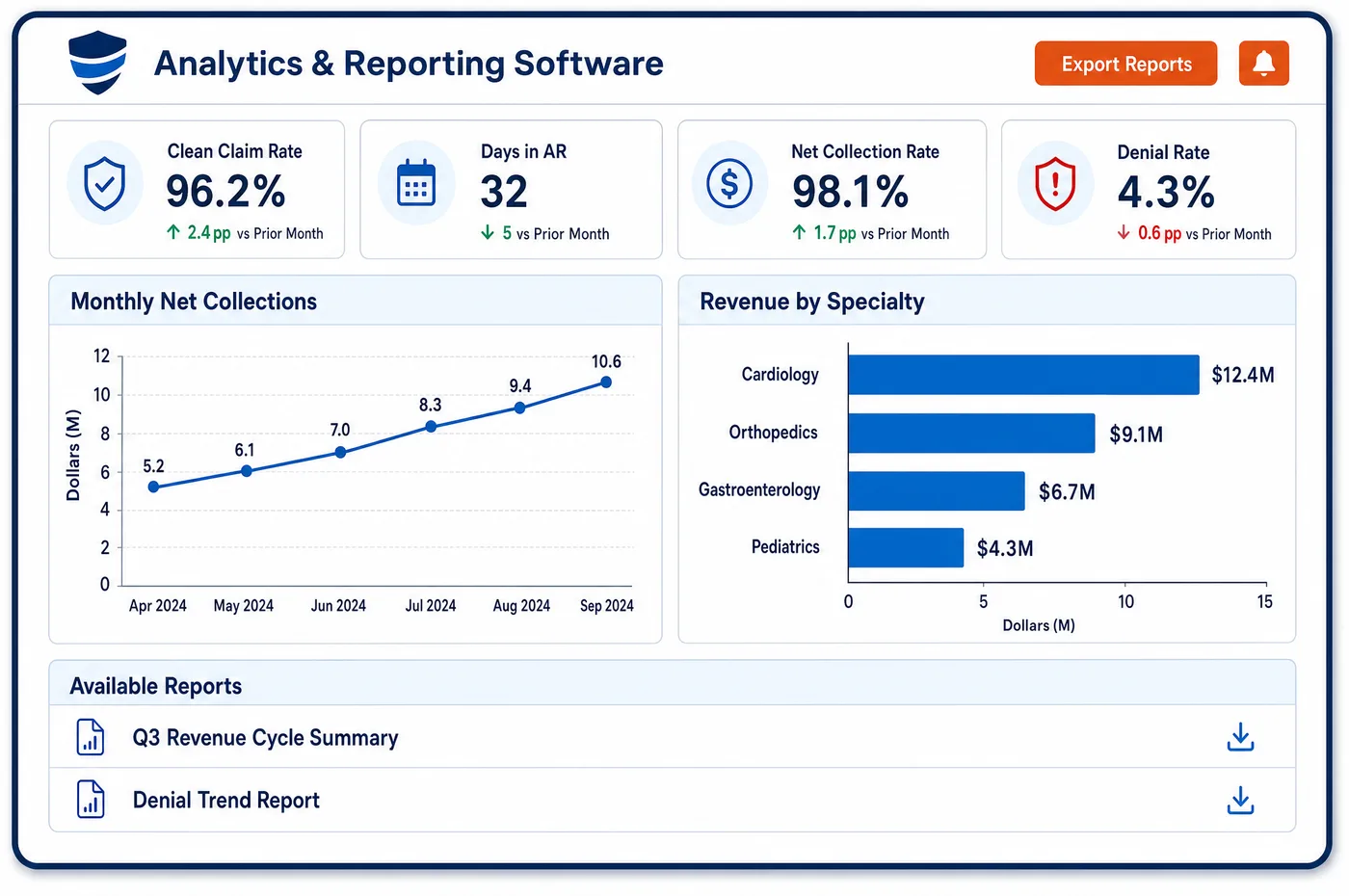
RCM in a Chiropractic Practice
Chiropractic RCM starts by sorting each visit to a payer track. Insured care goes through benefit checks, visit counts and any plan-of-care approval. Medicare visits carry the AT modifier while care is active, and they switch to GA with a signed notice once care becomes maintenance. Car accident visits go to the auto or liability carrier, or wait on a lien until the case settles. Cash plan visits never touch a claim. From there, the cycle is familiar: charges are built from the visit note, checked, sent as claims and posted from remittances. Denials are sorted by cause and worked. Patient balances go out on statements that match the ledger. Chiropractic RCM software keeps these tracks apart so each one can be measured on its own. A car accident case that waits on a settlement should not hide a slow commercial payer, and cash plan revenue should not mask a rise in Medicare denials.
Why Is RCM Different in Chiropractic?
Few specialties run so many payment models through one small front desk. A chiropractic office may bill Medicare, several commercial plans, Medicare Advantage plans, auto carriers and attorneys, while also selling cash plans. Each model has its own rules and its own pace of payment. RCM in this setting is less about one big claim and more about many small, repeat visits that each have to land on the right track.
The margin for error is thin. Visits are short and paid at modest rates, so a missing modifier or a visit past a limit is easy to miss and costly when it repeats across a whole plan of care. Medicare's rules are strict: no AT modifier means the visit is treated as maintenance and denied. Payers also review chiropractic records closely, so documentation has to support each claim.
Some revenue simply takes longer. Car accident cases can stay open while the injury claim works its way to a settlement. If those balances sit in the same aging buckets as insurance claims, the numbers mislead. A chiropractic revenue cycle needs separate views for insured care, injury cases and cash plans, with each track measured by its own yardstick.
What Chiropractic RCM Software Handles
- AT modifier on active care (Medicare)
- Medicare requires the AT modifier on claims for active or corrective treatment. Claims without it are treated as maintenance and denied. Rules check that every active-care CMT line to Medicare carries AT before the claim leaves. (CMS Medicare Benefit Policy Manual, Chapter 15, Section 240: Chiropractic Services)
- Diagnosis order on CMT claims
- Under WPS billing article A56273, the level of subluxation (M99.00 to M99.05) is the primary diagnosis and the neuromusculoskeletal condition is the secondary one. Claims are checked for that order before they go out. (CMS Medicare Coverage Database, WPS Billing and Coding Article A56273: Chiropractic Services)
- Course-of-treatment dates
- Medicare chiropractic claims carry the date the course of treatment began, plus the x-ray date when an x-ray showed the subluxation. The dates come from the case, so they match on every claim in the course. (Medicare Claims Processing Manual, Chapter 26: Completing and Processing Form CMS-1500 (Items 14 and 19))
- Injury case receivables
- Medicare requires claims to go to the no-fault, liability or workers' compensation insurer before Medicare. CMS also notes a practice may keep a claim or lien against a liability settlement after the Medicare timely filing period has lapsed. Injury balances are tracked on their own aging view. (CMS MLN Booklet: Medicare Secondary Payer (MLN006903))
- Therapy codes with CMT (NCCI)
- NCCI does not allow 97112, 97124 or 97140 in a spinal region that got CMT. Done in a different region, they can be billed with modifier 59 or XS by a provider eligible to bill them. That edit is applied for payers that follow NCCI. (Medicare NCCI Policy Manual 2026, Chapter XI: Medicine (Section S, Chiropractic Manipulative Treatment))
- Plan-of-care approvals
- Some Medicare Advantage plans approve chiropractic care as a plan of care with a set number of visits. Approved visits are tracked through the cycle, so claims for visits past the count are caught before they are sent. (UnitedHealthcare: Medicare Advantage prior authorization updates for outpatient therapy and chiropractic services (January 2025))
How Does Chiropractic RCM Software Work?
1. Sort each visit to a track
Every visit is tied to a case: insured, Medicare active, Medicare maintenance, injury or cash plan. The track sets which rules apply to the charge and who gets the bill.
2. Clear benefits and visit counts
Benefits, visit limits and approvals are checked before the course starts and as visits are used. Visits past a limit are held before they are billed.
3. Build and check the claim
Charges from the visit note are checked for region count, modifiers and diagnosis order. The clean claim then goes out through chiropractic medical billing.
4. Post and work denials
Remittances post to the ledger through payment posting for chiropractic. Denials are grouped by cause and worked in chiropractic denial management.
5. Track injury cases and cash plans apart
Injury balances and liens sit in their own view in chiropractic AR management. Cash plan revenue is tracked by plan, apart from insurance collections.
Chiropractic RCM Software vs. Generic Software
| Area | Generic approach | Unlimited Systems |
|---|---|---|
| Payer tracks | All visits flow through one claim queue. | Insured, Medicare, injury and cash plan visits each follow their own rules. |
| Medicare modifiers | AT added by habit to every visit. | AT on active care and GA or GZ on maintenance, set from the case. |
| Injury receivables | Mixed into insurance aging. | Tracked on their own view, with lien and settlement status. |
| Visit limits | Found when the claim denies. | Counted before the visit and before the claim. |
| Reporting | One blended collection number. | Results by payer track, so slow payers and denial trends stand out. |
Who Uses It in a Chiropractic Practice
- Practice owner: A clear view of revenue by payer track: insured care, Medicare, injury cases and cash plans. RCM results that show where money is stuck and why.
- Billing manager: Claims checked for chiropractic rules before they leave, denials grouped by cause, and injury balances kept out of the insurance aging.
- Front desk lead: Benefit checks, visit counts and patient balances in one place, so collections at check-in are right the first time.
Chiropractic RCM Software FAQs
Chiropractic RCM handles many short, repeat visits across very different payment models. Medicare pays only for spinal manipulation and requires the AT modifier for active care. Commercial plans cap visits or need approvals. Car accident cases may wait on a settlement. Cash plans sit outside insurance. The revenue cycle has to keep these tracks apart and measure each one on its own.
Both models can work. An in-house team knows the patients and the chiropractor's plans. An outside billing service may bring more staff depth. Either way, the practice needs software that applies chiropractic rules before claims go out and shows results by payer track, so the owner can see how well the revenue cycle is run.
Useful numbers include the share of Medicare CMT claims paid on first pass, denials by cause, visits per treatment plan, collections at check-in, and injury case balances by age. Cash plan renewals matter too. Each number should be split by payer track, since a blended figure can hide a problem on one track.
Car accident cases are set up with the carrier, claim number and any attorney or lien details. Claims go to the auto or liability carrier first, as Medicare Secondary Payer rules require for Medicare patients. Balances on those cases are tracked in their own view, with notes on settlement status, so they don't distort the insurance aging.
Cash plans can run through the same system on their own track. Plan visits are marked by type and posted to the plan, not sent as claims. Revenue from plans is reported apart from insurance collections, and the patient's ledger shows insured and cash balances side by side without mixing them.
Rules check each Medicare CMT claim before it leaves: the AT modifier on active care, GA or GZ on maintenance, the subluxation level as the primary diagnosis, and the treatment start date. Excluded services carry GY. Denials that still occur are grouped by cause, so the practice can fix the root of the problem.
Related Chiropractic Software
Billing & claims
RCM for related specialties
Sources
- CMS Medicare Benefit Policy Manual, Chapter 15, Section 240: Chiropractic Services
- CMS Medicare Coverage Database, WPS Billing and Coding Article A56273: Chiropractic Services
- Medicare Claims Processing Manual, Chapter 26: Completing and Processing Form CMS-1500 (Items 14 and 19)
- CMS MLN Booklet: Medicare Secondary Payer (MLN006903)
- Medicare NCCI Policy Manual 2026, Chapter XI: Medicine (Section S, Chiropractic Manipulative Treatment)
- UnitedHealthcare: Medicare Advantage prior authorization updates for outpatient therapy and chiropractic services (January 2025)
GET STARTED
See Unlimited Systems in Action
Whether you're actively evaluating new technology or simply preparing for your next vendor renewal, Unlimited Systems can help you understand where your current workflows may be creating avoidable revenue risk.