

Billing & claims
Chiropractic Medical Billing Software
Build, check and send chiropractic claims with the right modifiers, treatment dates and diagnosis order, then track each one until it pays.
Chiropractic Medical Billing Software turns each visit into a claim and sees it through to payment. It builds the claim with the CMT code, modifiers, treatment start date and diagnosis order the payer expects. It then sends the claim through the clearinghouse, tracks its status, and routes rejections back to staff to fix.



 6,500+ specialty providers

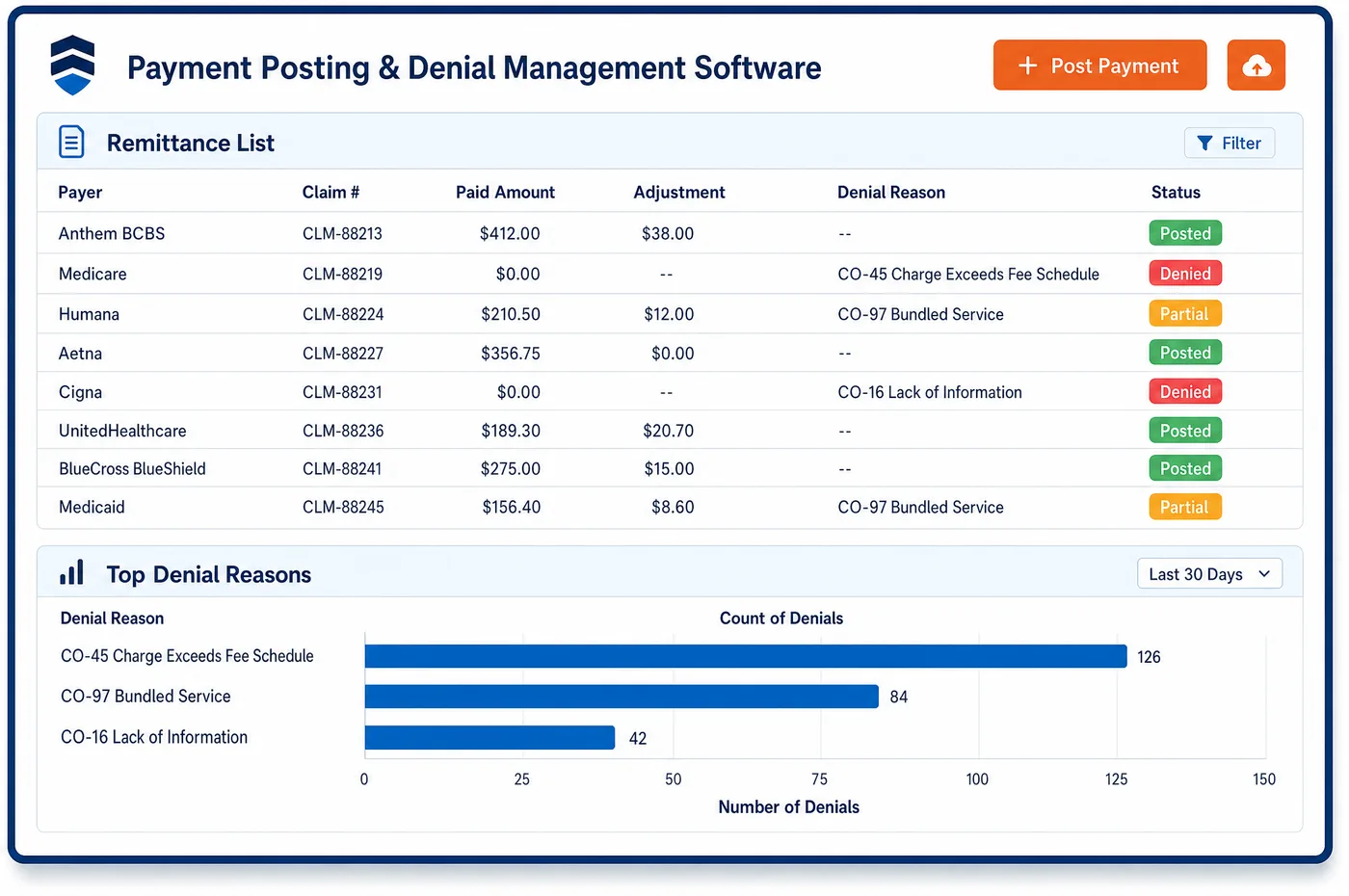
Medical Billing in a Chiropractic Practice
Billing for a chiropractic visit looks simple, one CMT code and a diagnosis or two, but the details decide whether it pays. For Medicare, the claim needs the AT modifier when care is active, the date the course of treatment began or the condition flared, and the x-ray date if an x-ray showed the subluxation. The subluxation level goes first in the diagnosis list, with the related condition after it. Services Medicare excludes carry GY. Chiropractic medical billing software builds each claim from the visit and its case, so those details are filled in the same way every time. The scrubber checks the claim before it leaves. Clean claims go out as electronic claims through the clearinghouse, and their status is tracked until the payer pays or denies. Rejections come back to a work queue with the reason attached. For car accident cases, the claim goes to the carrier on the case first.
Why Is Medical Billing Different in Chiropractic?
Chiropractic claims repeat. A patient on a full plan may generate a claim for each visit, all carrying the same start date, diagnosis order and modifier. An error in the case setup copies itself onto every claim in the course. Billing has to get the first claim right and keep the rest in step, or a whole plan of care comes back denied at once.
Medicare checks fields that other payers ignore. A missing treatment start date gets the claim sent back as unprocessable. A claim for manipulation without the AT modifier is treated as maintenance. Some MACs, Noridian among them, tell chiropractors not to put AT on the same line as GA, GX, GY or GZ. A biller who learned on other specialties can miss each of these.
The payer is not always a health plan. Car accident cases go to auto or liability carriers, which may need their own claim forms, records and claim numbers, and which follow state rules. Medicare patients with an open accident claim must be billed to that carrier first. When the carrier denies, the Medicare claim has to show the reason, or Medicare denies it too.
What Chiropractic Medical Billing Software Handles
- Treatment start or flare-up date (Item 14)
- Medicare wants the date of the initial treatment or of the flare-up of an existing condition in Item 14 or its electronic match. Claims without it can come back with CARC 16 and remark MA122, so the date is pulled from the case on every claim. (Medicare Claims Processing Manual, Chapter 12, Section 220: Chiropractic Services)
- X-ray date (Item 19)
- When an x-ray, not a physical exam, was used to show the subluxation, the x-ray date goes in Item 19. Entering it, with the start date, tells Medicare the required records are on file. (Medicare Claims Processing Manual, Chapter 26: Completing and Processing Form CMS-1500 (Items 14 and 19))
- AT modifier placement (Noridian)
- Noridian applies AT to 98940, 98941 and 98942 only and says not to bill AT with GA, GX, GY or GZ on the same line. Billing rules follow the MAC that pays the practice's claims. (Noridian JF Part B: Modifier AT (Acute or Active Treatment))
- Diagnosis order
- WPS article A56273 puts the subluxation level (M99.00 to M99.05) first and the neuromusculoskeletal condition second. The claim builds that order from the visit note, so a related condition never lands in the primary slot. (CMS Medicare Coverage Database, WPS Billing and Coding Article A56273: Chiropractic Services)
- Billing the accident carrier first
- Claims for a Medicare patient's accident care go to the no-fault or liability insurer before Medicare. If that insurer denies, the Medicare claim must give the reason, using the right claim adjustment reason code, or Medicare will deny it. (CMS MLN Booklet: Medicare Secondary Payer (MLN006903))
- Excluded services (GY)
- Exams, x-rays and extraspinal CMT by a chiropractor are not Medicare benefits. When the patient wants a Medicare denial, for example to bill a secondary plan, those lines carry GY. (CMS MLN Booklet: Medicare Advance Written Notices of Non-coverage (MLN006266))
How Does Chiropractic Medical Billing Software Work?
1. Build the claim from the case
The visit's charges, the case's payer, the start date and the diagnosis order fill the claim. Charges come from chiropractic charge validation, already checked for codes and modifiers.
2. Scrub before sending
The claim is checked for missing dates, modifier conflicts, diagnosis order and payer rules. Problems go back to the biller before the claim leaves.
3. Send through the clearinghouse
Clean claims go out as 837 claims through the clearinghouse. Acknowledgments come back and are matched to each claim.
4. Track status and fix rejections
Claim status is tracked until the payer pays or denies. Rejections come back to a work queue with the reason, so staff can fix and resend them.
5. Send secondary and accident claims
After the primary pays or denies, the secondary claim goes out with the primary's details. The full cycle, from front desk to final payment, is covered in chiropractic RCM.
Chiropractic Medical Billing Software vs. Generic Software
| Area | Generic approach | Unlimited Systems |
|---|---|---|
| Treatment dates | Typed by hand on each claim. | Pulled from the case, the same on every claim. |
| AT modifier | Added out of habit, or forgotten. | Set by the case status and checked against the MAC's rules. |
| Diagnosis order | Whatever order the note listed. | Subluxation level first, related condition second. |
| Accident claims | Sent to health insurance by mistake. | Sent to the carrier on the case first. |
| Rejections | Found days later in a clearinghouse report. | Routed to a work queue with the reason attached. |
Who Uses It in a Chiropractic Practice
- Biller: Claims that come out of the case already filled in, with checks that catch missing dates and modifier conflicts before they are sent.
- Billing manager: One view of claims sent, accepted, rejected and paid, split by payer and by insured, Medicare and injury cases.
- Chiropractor: Fewer records requests and denials, since the claim matches what the note and the case say about the treatment.
Chiropractic Medical Billing Software FAQs
Chiropractic medical billing checks the CMT code, the AT modifier for active Medicare care, the treatment start date, any x-ray date, and the diagnosis order with the subluxation level first. It looks for modifier conflicts and payer rules. For accident cases, it checks that the claim is going to the carrier on the case before any health plan.
A common reason is a missing date of initial treatment or flare-up, which Medicare expects in Item 14 or its electronic match. Those claims can return with CARC 16 and remark MA122. Pulling the date from the patient's case onto every claim in the course keeps it from being left blank.
Rules differ by contractor. Noridian tells chiropractors not to bill AT with GA, GX, GY or GZ on the same line, while some other MAC articles describe other uses. Practices should follow their own MAC's guidance. Billing rules can be set to match the contractor that processes the practice's Medicare claims.
Car accident claims go to the auto or liability carrier named on the injury case, with the claim number and date of injury. Rules vary by state and carrier. For a Medicare patient, the carrier is billed first. If the carrier denies, the Medicare claim includes the denial reason so Medicare can process it.
A rejected claim comes back to a work queue with the reason attached, such as a missing date or a bad member ID. Staff fix the problem and resend the claim. Because the fix is often made on the case, the same error does not repeat on the next claim in the course.
Excluded services such as exams and x-rays by a chiropractor can go on the claim with GY when the patient wants a Medicare denial, for example to bill a secondary plan. Otherwise, the practice can bill the patient directly for them. Either way, the patient should know before the visit that Medicare will not pay for them.
Related Chiropractic Software
Billing & claims
In the revenue cycle
Medical Billing for related specialties
Sources
- Medicare Claims Processing Manual, Chapter 12, Section 220: Chiropractic Services
- Medicare Claims Processing Manual, Chapter 26: Completing and Processing Form CMS-1500 (Items 14 and 19)
- Noridian JF Part B: Modifier AT (Acute or Active Treatment)
- CMS Medicare Coverage Database, WPS Billing and Coding Article A56273: Chiropractic Services
- CMS MLN Booklet: Medicare Secondary Payer (MLN006903)
- CMS MLN Booklet: Medicare Advance Written Notices of Non-coverage (MLN006266)
GET STARTED
See Unlimited Systems in Action
Whether you're actively evaluating new technology or simply preparing for your next vendor renewal, Unlimited Systems can help you understand where your current workflows may be creating avoidable revenue risk.