

Billing & claims
Chiropractic Denial Management Software
Sort chiropractic denials by cause, from missing AT modifiers and start dates to visit limits and accident claims, then fix the source.
Chiropractic Denial Management Software sorts each denied chiropractic claim by its cause, sends it to the right person, and tracks it to payment or appeal. It groups denials such as missing start dates, maintenance care, visit limits and accident coverage, so the practice can fix the setup that caused them instead of working the same denial again.



 6,500+ specialty providers

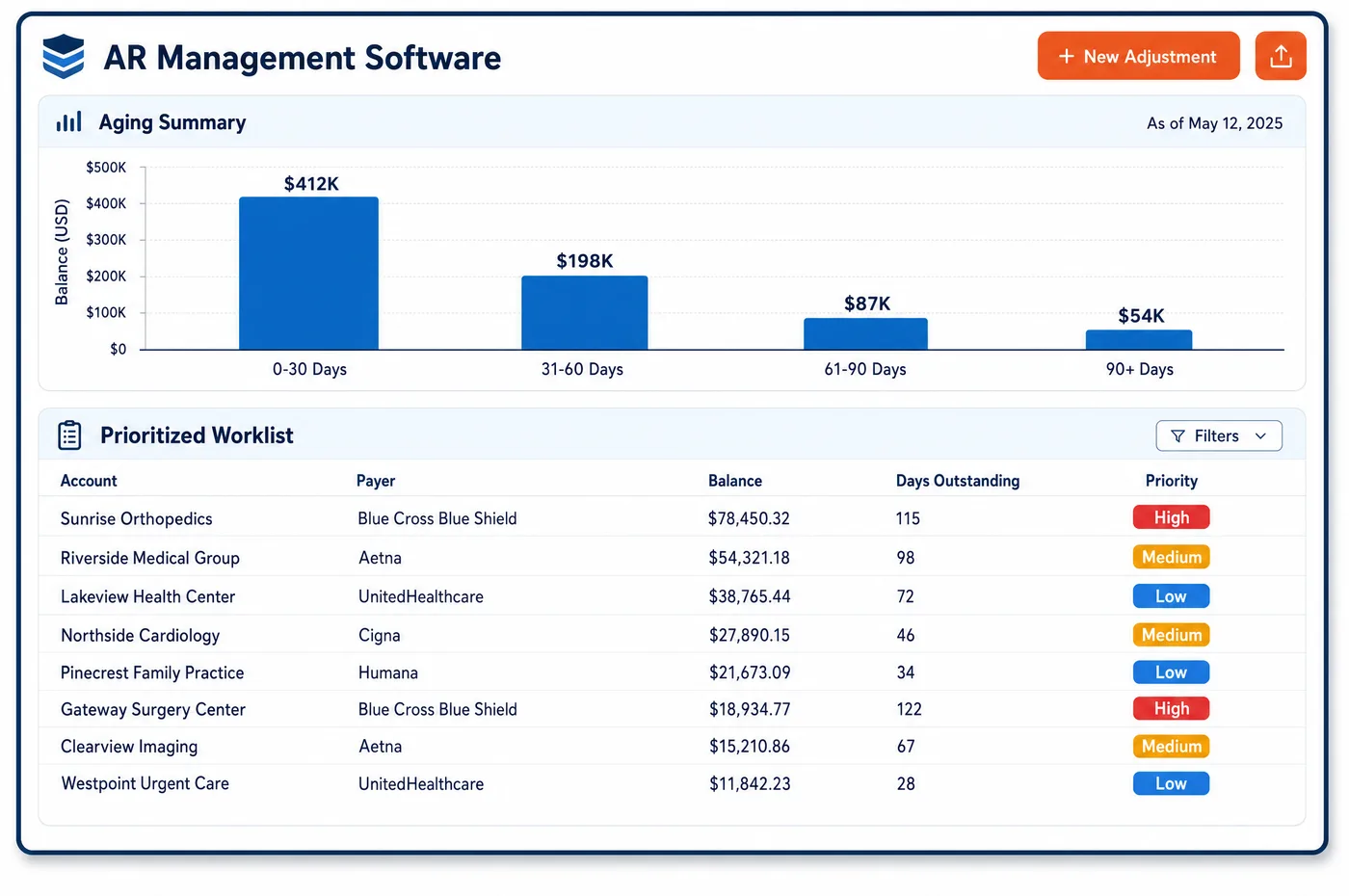
Denial Management in a Chiropractic Practice
Chiropractic denials tend to come in runs. One setup error on a case can deny every visit in the plan. Denial management for a chiropractic office starts by reading the reason codes on each remittance and grouping them. A Medicare claim missing its treatment start date comes back with CARC 16 and remark MA122, so the fix is to add the date to the case and resend. Care Medicare sees as unrelated to the cited subluxation level denies with CARC B22, which points back to the diagnosis pairs. Visits past a commercial limit or approval go to the staff who handle approvals. Accident-related denials go to whoever owns the injury case. Each group has its own work queue, ordered by value and filing deadline. Appeals pull the notes, the plan of care and any signed notice into one packet. Reports show which causes keep coming back, so chiropractic denial management fixes the source, not just the claim.
Why Is Denial Management Different in Chiropractic?
A single mistake repeats here. Chiropractic patients come often, and each visit produces a claim with the same case details. If the start date is missing, the AT modifier is wrong or the diagnosis order is off, every claim in the plan carries the error. Denials arrive in a batch, and working them one at a time wastes the team's day.
Many chiropractic denials are really documentation problems. Medicare treats care as maintenance when the record no longer shows a reasonable expectation of improvement. A payer asking for records wants the plan, the P.A.R.T. findings, the segments adjusted and the signatures. Winning an appeal depends on what the note already says. Denial work in chiropractic loops back to the chiropractor more often than in most fields.
Some denials point to the wrong payer, not the wrong claim. A Medicare patient with an open accident record will have related claims denied until the auto or liability carrier is billed. A commercial patient may have used part of the plan year's visits at another office. Sorting these out needs the case history, not just the remittance line.
What Chiropractic Denial Management Software Handles
- Missing start date (CARC 16, MA122)
- When the date of the initial visit or flare-up is missing, Medicare returns the claim with CARC 16 and remark MA122. These are sorted to a fix-and-resend queue, and the date is added to the case so later claims carry it. (Medicare Claims Processing Manual, Chapter 12, Section 220: Chiropractic Services)
- Not a covered condition (CARC 50)
- Medicare denies manipulation for conditions outside its coverage rules with CARC 50. These go to the chiropractor for review of the plan and the findings before any appeal. (Medicare Claims Processing Manual, Chapter 12, Section 220: Chiropractic Services)
- Not related to the cited level (CARC B22)
- Treatment for a condition not reasonably related to a subluxation at the spinal level specified is denied with CARC B22. The fix is often in the diagnosis pairs, so these go back through charge validation. (Medicare Claims Processing Manual, Chapter 12, Section 220: Chiropractic Services)
- Maintenance and GZ denials
- GZ tells Medicare a denial was expected and no notice was signed. On a maintenance claim billed that way, the practice is liable, so these are tracked as a cost of missing notices, not worked as appeals. (CMS MLN Booklet: Medicare Advance Written Notices of Non-coverage (MLN006266))
- Accident-related Medicare denials
- CMS notes MACs may deny claims because services seem tied to an accident on the patient's Medicare file even when they are not. Staff check the case, bill the carrier first where it applies, and give the reason when the carrier denies. (CMS MLN Booklet: Medicare Secondary Payer (MLN006903))
- Records requests and appeal packets
- CMS's job aid asks for records for every date of service, signatures and credentials, an attestation when a signature is missing, and a copy of any ABN. The appeal packet pulls these from the record in one step. (CMS MLN Educational Tool: Medicare Documentation Job Aid for Chiropractic Doctors (MLN1232664))
How Does Chiropractic Denial Management Software Work?
1. Read the reason codes
Each denial on a remittance is read for its group, reason and remark codes. The case, payer and visit are attached, so staff see the context with the code.
2. Group by cause
Denials are grouped into causes: missing data, maintenance, documentation, visit limits, wrong payer and non-covered services. Each cause has an owner and a queue.
3. Fix and resend, or prepare an appeal
Data errors are fixed on the case and resent. Clinical denials go to the chiropractor, and appeals follow the Medicare appeal levels or the payer's own process.
4. Work by value and deadline
Queues are ordered by amount and filing deadline, so the claims most at risk are worked first. Aging denials also show in chiropractic AR management.
5. Fix the source
Reports show which causes repeat by payer, chiropractor and case type. Fixes go into the case setup or the checks in chiropractic charge validation, so the next claim does not deny.
Chiropractic Denial Management Software vs. Generic Software
| Area | Generic approach | Unlimited Systems |
|---|---|---|
| Sorting | One long list of denials in date order. | Grouped by cause, with an owner for each group. |
| Repeat errors | The same denial worked on each claim in the plan. | Fixed once on the case, then resent as a batch. |
| Documentation denials | Appeals sent with whatever notes were handy. | Appeal packets built from the full record. |
| Wrong-payer denials | Rebilled to the same payer. | Checked against the case and sent to the right carrier. |
| Root cause | No view of why denials happen. | Reports by cause, payer and chiropractor. |
Who Uses It in a Chiropractic Practice
- Billing manager: Denial queues grouped by cause and ordered by value and deadline, plus reports that show which fixes would stop the most denials.
- Chiropractor: Clinical denials sent straight to them with the note and plan attached, and fewer of them over time as the root causes are fixed.
- Practice owner: A clear view of money lost to denials by cause, and proof that repeat problems are being fixed, not just worked.
Chiropractic Denial Management Software FAQs
Common chiropractic denials include a missing treatment start date, care Medicare treats as maintenance, treatment not tied to the cited subluxation level, visits past a plan limit or approval, services Medicare excludes, and accident-related claims sent to the wrong payer first. Grouping them by cause shows which ones come from the case setup and which from the notes.
Chiropractic denial management groups denials from the same case and cause together. If every visit in a plan denied for a missing start date, staff add the date to the case once and resend the whole batch. That turns many separate fixes into one, and later claims in the plan go out with the date already in place.
A GZ denial means the practice expected Medicare to deny the visit and had no signed notice, so the practice is liable. Appealing rarely makes sense unless the visit was in fact active care. These denials are better tracked as a sign that notices are being missed, and fixed at the front desk.
An appeal packet holds the records for every date of service on the claim, including the plan of care, the P.A.R.T. findings and the segments adjusted. It needs legible signatures and credentials, an attestation if a signature is missing, and a copy of any signed advance notice. Pulling these from the record saves staff from hunting for them.
Staff check the injury case first. If the care is related to the accident, the auto or liability carrier is billed, and if that carrier denies, the Medicare claim is resent with the denial reason. If the care is not related, staff show that on the claim so Medicare can pay it as the primary payer.
Reports group denials by cause, payer, chiropractor and case type. When one cause keeps returning, such as missing start dates on new cases, the fix goes into the case setup or a validation check. The next claims then go out clean, and the report shows whether that cause has dropped.
Related Chiropractic Software
Billing & claims
In the revenue cycle
Denial Management for related specialties
Sources
- Medicare Claims Processing Manual, Chapter 12, Section 220: Chiropractic Services
- CMS MLN Booklet: Medicare Advance Written Notices of Non-coverage (MLN006266)
- CMS MLN Booklet: Medicare Secondary Payer (MLN006903)
- CMS MLN Educational Tool: Medicare Documentation Job Aid for Chiropractic Doctors (MLN1232664)
- CMS Medicare Benefit Policy Manual, Chapter 15, Section 240: Chiropractic Services
GET STARTED
See Unlimited Systems in Action
Whether you're actively evaluating new technology or simply preparing for your next vendor renewal, Unlimited Systems can help you understand where your current workflows may be creating avoidable revenue risk.