

Billing & claims
Orthopedics Denial Management Software
Predict, sort, work and appeal orthopedic denials for global periods, modifiers, NCCI pairs, approvals and work injury claims, then fix the cause upstream.
Orthopedics Denial Management Software stops repeat orthopedic denials and works the ones that still happen. It scores claims before they go out, sorts incoming denials by reason code, and sends each one to the right person by value and deadline. It also groups denials by cause, so a global period or side error is fixed at the source.



 6,500+ specialty providers

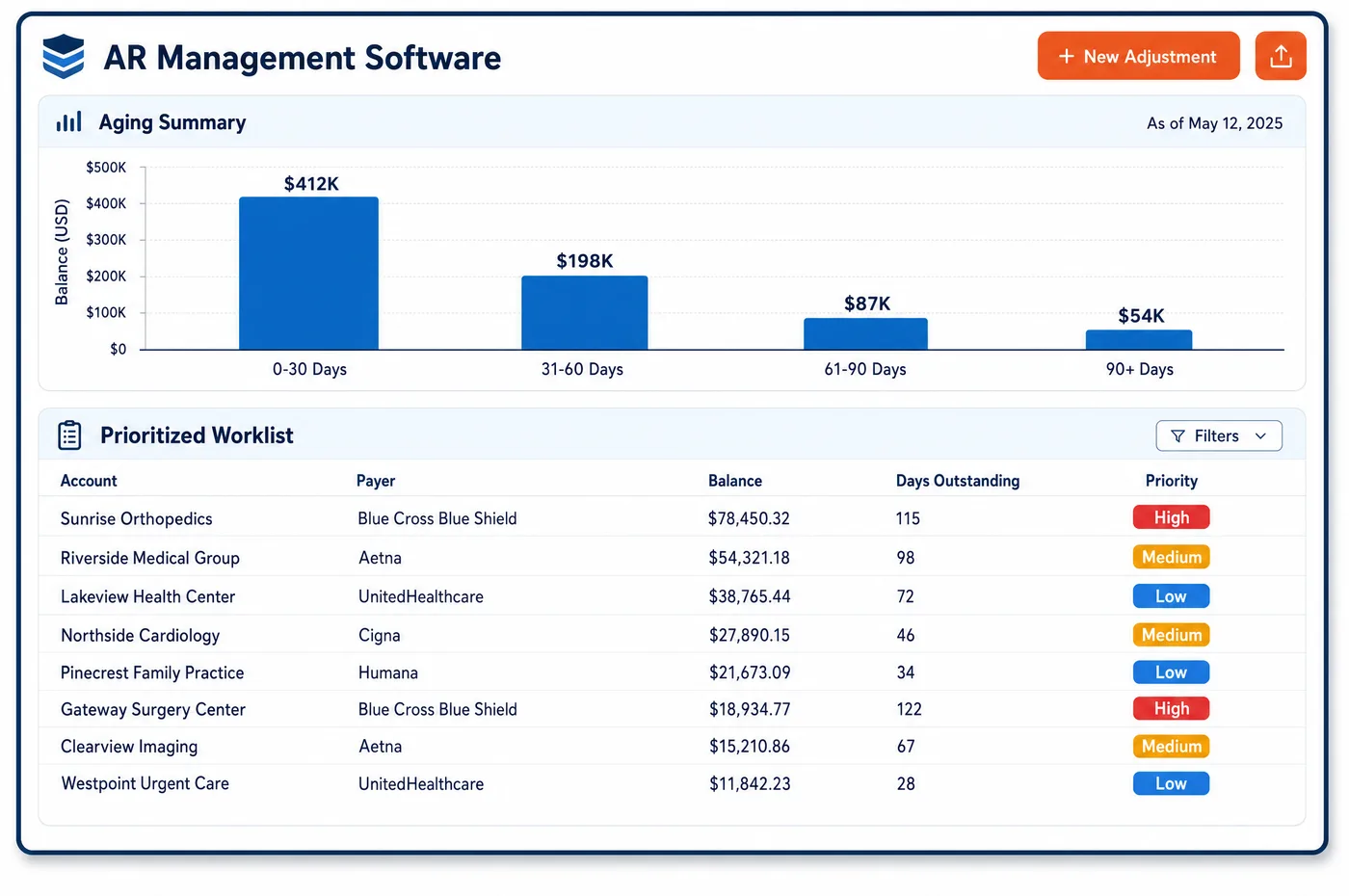
Denial Management in a Orthopedics Practice
Orthopedic denials tend to repeat in a few groups. A post-op visit comes back with CARC 97 because the payer says it is part of the surgery. A scope comes back with CARC 4 or 236 because a modifier or code pair did not fit. A surgery comes back with CARC 197 because the approval was missing. A work injury visit sent to the health plan comes back with CARC 19, a work injury that is the workers' compensation carrier's liability. Unlimited Systems learns these patterns from the practice's own remittances and checks new claims for them before they leave. Denials that still arrive are mapped from their reason code to a work queue. Each queue is sorted by dollars at risk and filing deadline, so the largest surgical claims near their limit are worked first. Each denial comes with the likely cause and the papers needed, such as the op note or the approval. Root-cause reports show which payer, code, provider and reason drive the most denials.
Why Is Denial Management Different in Orthopedics?
Orthopedic denials are large and often avoidable. A single denied joint replacement or spine case can outweigh dozens of clinic visits. Many of those denials come from a small set of causes: a visit billed inside the global period without 24 or 79, a missing or wrong side, an NCCI pair billed without a valid modifier, an approval that lapsed, or a work injury sent to the wrong payer. Each claim adjustment reason code points to one of these causes if someone reads it.
The fix is rarely at the denial desk. A CO-97 denial on a post-op visit is a scheduling and coding problem. A CARC 197 denial on a surgery is a clearance problem. A CARC 19 denial on a work injury is a registration problem. Orthopedics denial management software has to send each pattern back to the step that caused it. That means a modifier rule in charge validation, or a hold rule in financial clearance, so the same error does not come back every week.
Appeals still matter for the denials that should have been paid. A surgery with a valid approval, an unrelated visit inside the global period, or a bilateral case paid as one side may all be worth an appeal. Medicare has five appeal levels, starting with redetermination by the Medicare contractor. Work injury carriers and health plans have their own steps. Each appeal needs the right papers and must be filed before its deadline.
What Orthopedics Denial Management Software Handles
- CARC 97: included in another service
- This code means the payer treats the service as part of another one already paid. For post-op visits inside a global period, the queue checks whether the visit was unrelated and should have had 24 or 79. It then routes it for a corrected claim or a write-off. (X12 Claim Adjustment Reason Codes)
- CARC 4 and CARC 236: modifier and code pair conflicts
- CARC 4 means the code does not fit the modifier used. CARC 236 means a code or modifier pair conflicts with NCCI or a workers' compensation state rule. These denials are grouped so the modifier rule behind them can be fixed. (X12 Claim Adjustment Reason Codes)
- CARC 197 and 198: missing or exceeded approval
- CARC 197 means the approval was absent, and 198 means the service went past what was approved. Each one is matched to the approval record on the case. The pattern is sent back to clearance. (X12 Claim Adjustment Reason Codes)
- CARC 19 and CARC 22: work injury or another payer
- CARC 19 marks a work-related injury that is the workers' compensation carrier's liability, and CARC 22 says another payer may be primary. The queue checks the case for a work or accident carrier. The claim is redirected to that carrier, and registration is told why. (X12 Claim Adjustment Reason Codes)
- NCCI pairs and anatomic modifiers
- Denied pairs are reviewed against the record. If the services were on different joints or digits, the claim is corrected with RT, LT or a digit modifier rather than 59, as CMS asks. (CMS MLN1783722 Proper Use of Modifiers 59, XE, XP, XS & XU)
- Medicare redetermination and later levels
- Medicare Part A and B appeals move through five levels, starting with redetermination by the Medicare contractor. Each orthopedic appeal is tracked by level with its own deadline. (CMS Original Medicare (Fee-for-Service) Appeals)
How Does Orthopedics Denial Management Software Work?
1. Predict before submission
Each claim is checked against payer policy, coding edits and the practice's own denial history before it leaves. Claims that match past denial patterns are held with the reason. Staff fix them before the payer sees them.
2. Sort by reason code
Incoming denials are mapped from their CARC and remark codes to a work queue. Global period, modifier, approval and payer-order denials each have their own queue. Each one has an owner.
3. Work by value and deadline
Queues are sorted by dollars at risk and filing deadline. Large surgical denials near their limit come first. Low-value repeats are grouped for one fix.
4. Correct or appeal
Simple errors get a corrected claim. Denials that should have been paid get an appeal with the op note, approval or other records attached. Each appeal is tracked by level and date.
5. Fix the cause upstream
Root-cause reports group denials by payer, code, provider and reason. Each pattern is sent to the step that caused it, such as registration, clearance or charge validation. The rule there is changed so the denial stops.
Orthopedics Denial Management Software vs. Generic Software
| Area | Generic approach | Unlimited Systems |
|---|---|---|
| When denials are found | After the remittance arrives. | Predicted and fixed before the claim goes out. |
| Work order | Oldest first, whatever the value. | Sorted by dollars at risk and filing deadline. |
| Global period denials | Each post-op denial written off one by one. | Grouped and traced to the scheduling or coding rule. |
| Approval denials | Appealed without the approval record. | Matched to the approval on the case first. |
| Work injury denials | Resent to the same health plan. | Redirected to the work injury carrier on the case. |
| Root cause | Never tracked. | Reports by payer, code, provider and reason. |
Who Uses It in a Orthopedics Practice
- Denial specialist: Queues sorted by value and deadline, with the likely cause and the papers needed attached to each denial.
- Billing manager: Root-cause reports that show which payer, code and reason drive orthopedic denials, and which upstream rule to change.
- Revenue cycle director: Fewer repeat denials over time as patterns are fixed at registration, clearance and charge validation.
- Surgeon: Large surgical claims worked first, and appeals that include the op note without extra chasing.
Orthopedics Denial Management Software FAQs
Orthopedics denial management software predicts denials before claims go out, sorts the denials that arrive by reason code, and routes each one by value and filing deadline. It attaches the likely cause and the papers needed. It also groups denials by payer, code, provider and reason, so the upstream step that caused them, such as clearance or charge validation, can be fixed.
Common orthopedic denial causes include visits billed inside a global period, missing or wrong side modifiers, NCCI code pairs billed without a valid modifier, missing or lapsed approvals, and work or accident injuries billed to the health plan. Each shows up as a familiar reason code, such as CARC 97, 4, 236, 197 or 22, which helps sort them for the right fix.
Denial management reviews global period denials against the surgery date and the reason for the visit. If the visit was related, the denial is correct and the visit stays inside the package. If the visit was for an unrelated problem, a corrected claim with modifier 24, or 79 for a procedure, is sent with the notes. Repeat patterns go back to coding.
An orthopedic denial should be appealed when the service was billed correctly and should have been paid. Examples include a surgery with a valid approval on file, an unrelated visit inside a global period with clear notes, or a bilateral case paid as one side. Medicare appeals start with a redetermination by the contractor. Simple errors are better fixed with a corrected claim.
Work injury denials are handled by checking which payer owns the case. If a health plan denied a visit because another payer may be primary, the claim is sent to the workers' compensation carrier on the case. If the carrier denied it, the queue checks the claim number, the injury date and any state rule cited. Registration is told when the payer order was wrong.
AI does not replace the denial team. It removes sorting and research so staff spend their time fixing and appealing denials. Claims and denials the system cannot resolve with confidence go to a person. Every flag states its reason, so staff can trust it and act on it, and the team decides which upstream rules to change.
Related Orthopedics Software
Billing & claims
In the revenue cycle
Denial Management for related specialties
Sources
GET STARTED
See Unlimited Systems in Action
Whether you're actively evaluating new technology or simply preparing for your next vendor renewal, Unlimited Systems can help you understand where your current workflows may be creating avoidable revenue risk.