

Billing & claims
Orthopedics RCM Software
Run the full orthopedic revenue cycle, from the liable payer at sign-up to the last surgical and work injury dollar, on one platform.
Orthopedics RCM Software runs the orthopedic revenue cycle from start to finish. It covers sign-up, approvals, charge capture for surgery, injections and braces, claims to health plans and work injury carriers, payment posting, denials and patient balances. It also shows the numbers leaders use to see where surgical and ancillary revenue is lost.



 6,500+ specialty providers

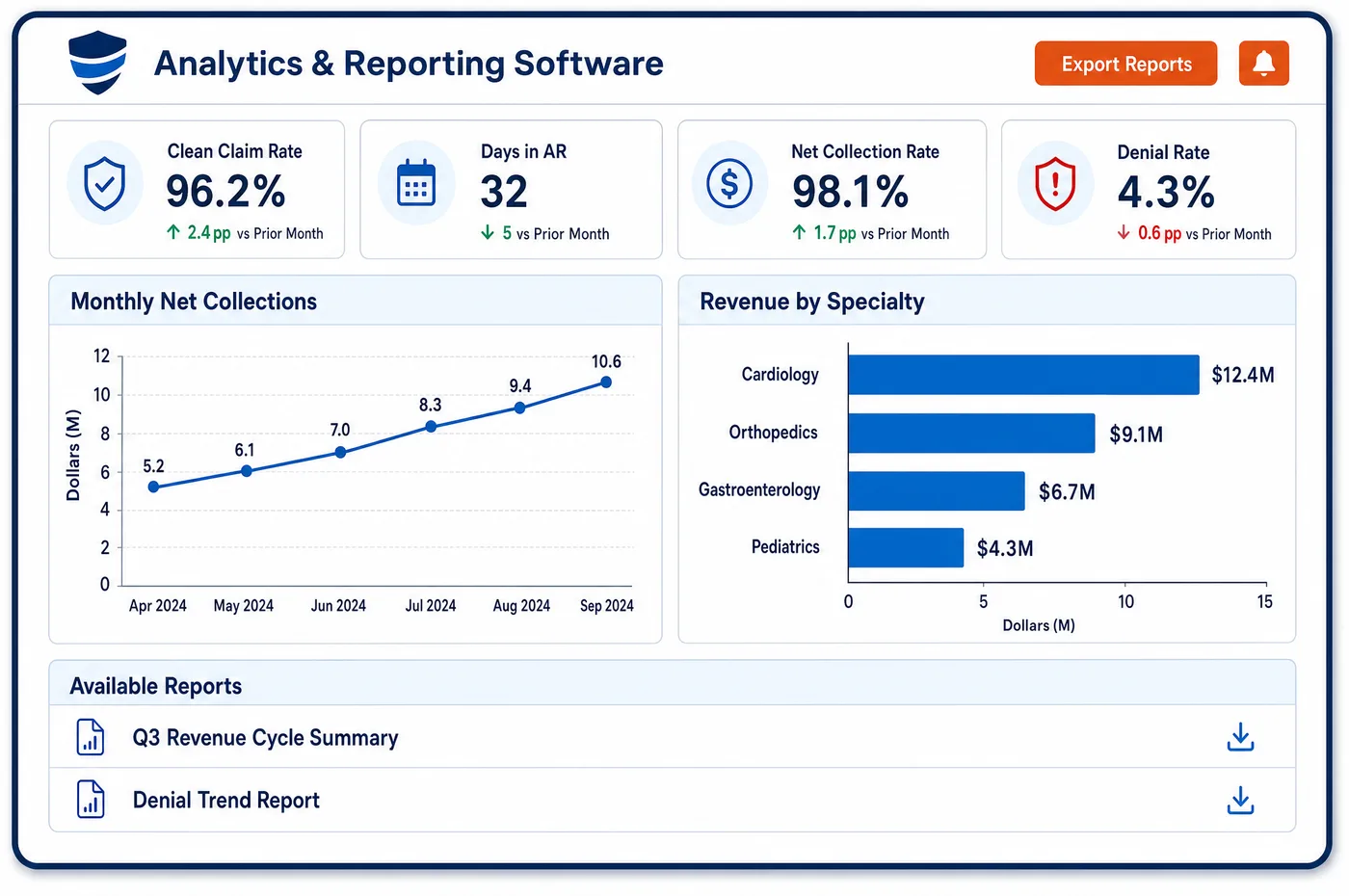
RCM in a Orthopedics Practice
An orthopedic revenue cycle has more branches than most. One patient can create a health plan claim for a clinic visit, a workers' compensation bill for a work injury, a DME claim for a brace and a surgical claim with several procedures. Unlimited Systems runs these on one platform. The liable payer is set at sign-up. Approvals are cleared before the case. Charges for surgery, injections and braces are captured from the record and checked against payer rules at checkout. Claims go out electronically, and the 835 remittance posts on its own, with reductions on secondary procedures compared to what was expected. Denials route to queues sorted by value and filing deadline. The same data feeds RCM reports on surgical collections, work injury AR, denial rate by payer and global period leakage. Practices can run the cycle in-house, or pair the software with outsourced RCM services for added billing help.
Why Is RCM Different in Orthopedics?
Orthopedic revenue depends on a few large surgical claims and many small ancillary ones. A missed modifier on a multi-procedure case can cost more than a week of clinic visits. Medicare pays the highest-valued procedure in full and the next ones at half, so the order of lines matters. A bilateral procedure with modifier 50 is paid at one and a half times the fee schedule amount. An orthopedics RCM program has to check that every surgical payment matches these rules, and flag underpayments when it does not.
The payer mix is also wider. Health plans, Medicare and Medicare Advantage sit beside workers' compensation carriers, auto and no-fault insurers, and DME claims that go to a DME contractor rather than the usual Medicare contractor. Work injury cases can stay open for a long time and need their own follow-up. Personal injury cases may wait on a settlement. A single aging report that lumps them together hides where cash is stuck, which is why orthopedic RCM tracks days in AR by payer type.
Value-based programs add one more layer. The TEAM model makes selected hospitals accountable for joint replacement, hip fracture and spinal fusion episodes, and surgeons' choices drive much of that cost. Leaders need RCM data that shows surgical volume, site of service and payer results together. The day-to-day claim work belongs to orthopedic medical billing, while root causes from orthopedic denial management feed back into the front end so the same error is fixed once.
What Orthopedics RCM Software Handles
- Multiple procedure payment rules (modifier 51)
- For codes with the standard multiple surgery indicator, Medicare ranks procedures by fee schedule amount. It pays the highest in full and the second through fifth at half. RCM posting compares each line to this ranking and flags short payments. (Medicare Claims Processing Manual, Chapter 12: Physicians/Nonphysician Practitioners)
- Bilateral surgery (modifier 50)
- When the bilateral indicator is 1, Medicare pays the lower of the billed amount or one and a half times the fee schedule amount. Expected payment for bilateral lines is built on that rule. (Medicare Claims Processing Manual, Chapter 12: Physicians/Nonphysician Practitioners)
- Global surgery package
- Medicare's global package covers related pre-op, intra-op and post-op care for 010 and 090 procedures in any setting, including the ASC and office. RCM reports track post-op visits so leaders can see global period leakage. (CMS MLN907166 Global Surgery Booklet (December 2025))
- DMEPOS supplier enrollment for braces
- A practice that bills Medicare for braces must enroll as a DMEPOS supplier. Physicians who furnish items to their own patients are exempt from the accreditation step. RCM keeps DME claims, payers and enrollment on their own track. (CMS Enroll as a DMEPOS Supplier)
- NCCI quarterly edit updates
- CMS updates the NCCI procedure-to-procedure and MUE files each quarter. The rules engine takes in each update, so the whole cycle checks claims against current edits. (CMS Medicare National Correct Coding Initiative (NCCI) Edits)
- TEAM episode accountability
- Hospitals in TEAM are accountable for joint replacement, hip and femur fracture, and spinal fusion episodes. RCM data on surgical volume and site of service helps surgeons work with those hospital partners. (CMS Innovation Center: Transforming Episode Accountability Model (TEAM))
How Does Orthopedics RCM Software Work?
1. Set the payer at sign-up
Registration captures the health plan and any work, auto or liability carrier. The payer order is set before the first visit. Errors here are the most costly to fix later.
2. Clear before the service
Coverage is checked when the visit or surgery is booked. MRI, surgery, brace and adjuster approvals are tracked and held if missing. Patients get an estimate for elective surgery.
3. Capture and check the charges
Charges for visits, surgery, injections and braces are captured from the record. They are checked for modifiers, global period status, NCCI edits and drug units at checkout. Problem charges go to a person with the reason.
4. Submit, post and follow up
Claims go out electronically, and acknowledgments and status are tracked. ERA payments post on their own, with secondary procedure reductions checked. Denials and short payments route to work queues sorted by value.
5. Measure and fix upstream
RCM reports show surgical collections, work injury AR, denial rate by payer and global period leakage. Root causes are traced back to the step that caused them. That step's rule is changed so the error stops.
Orthopedics RCM Software vs. Generic Software
| Area | Generic approach | Unlimited Systems |
|---|---|---|
| Scope | Separate tools for scheduling, claims and posting. | One platform from sign-up to final payment. |
| Surgical payments | Reductions accepted without a check. | Each line compared to multiple procedure and bilateral rules. |
| Payer types | Work injury and DME mixed in with health plan AR. | Each payer type tracked on its own track. |
| Edits | Edit tables updated when someone remembers. | NCCI updates loaded each quarter. |
| Metrics | Month-end reports built by hand. | Live RCM reports by payer, site and service line. |
| Staffing | All billing in-house, or all outsourced with no view. | In-house, outsourced help, or a mix, on the same data. |
Who Uses It in a Orthopedics Practice
- Physician owner: A clear view of surgical and ancillary revenue, where it leaks, and whether the cycle is getting faster.
- Revenue cycle director: RCM metrics by payer type and site, with root causes traced to the step that caused them.
- Billing manager: Sorted queues for denials and short payments, with surgical reductions already checked against the rules.
- Practice administrator: The choice to run billing in-house or add outsourced RCM help, without changing systems.
Orthopedics RCM Software FAQs
Orthopedics RCM software covers the whole revenue cycle for an orthopedic practice. That runs from registration and the liable payer, through approvals and scheduling, to charge capture for surgery, injections and braces. It continues with claims, payment posting, denials, work injury and personal injury AR, and patient balances. Reports show where surgical and ancillary revenue is lost.
The RCM metrics that matter most in orthopedics are surgical collections, denial rate by payer, days in AR by payer type, work injury AR and global period leakage. Short payments on multiple procedure and bilateral lines are worth tracking too. Each metric should be split by payer, site and surgeon, so leaders can see which part of the cycle needs work.
RCM handles workers' compensation and auto claims on their own track. The carrier, claim number and adjuster are set at sign-up and approvals are tracked before service. Claims follow carrier rules, payments are posted against the claim number, and open balances age in their own buckets. That keeps long-running work injury cases from hiding inside health plan AR.
Whether to outsource RCM depends on staff, volume and payer mix. Some orthopedic practices keep billing in-house and use the software to automate posting, edits and queues. Others pair the same software with outsourced revenue cycle services for added help on denials or work injury follow-up. Either way the data, rules and reports stay on one platform the practice can see.
Surgical payments are checked line by line against the expected amount. For Medicare, the highest-valued procedure is paid in full and the next ones at half, and a bilateral procedure with modifier 50 is paid at one and a half times the fee schedule amount. Payments that fall short of those rules, or of the payer contract, are flagged for follow-up.
Medical billing covers building, scrubbing, sending and tracking claims. RCM covers the whole cycle around it, from registration and approvals before the visit to posting, denials, AR and reporting after it. In an orthopedic practice the two share one platform, so a denial pattern found in billing can be fixed at registration or clearance, where it started.
Related Orthopedics Software
Billing & claims
RCM for related specialties
Sources
GET STARTED
See Unlimited Systems in Action
Whether you're actively evaluating new technology or simply preparing for your next vendor renewal, Unlimited Systems can help you understand where your current workflows may be creating avoidable revenue risk.