

Billing & claims
Orthopedics Charge Validation Software
Check every orthopedic charge for side, global period, NCCI edits and drug units before the claim goes out.
Orthopedics Charge Validation Software checks each orthopedic charge before it becomes a claim. It tests side and bilateral modifiers, multiple procedure order, global period status, NCCI pairs and unit limits, injection drug units and waste modifiers, and the match between diagnosis and procedure. Charges that fail are held with the reason attached.



 6,500+ specialty providers

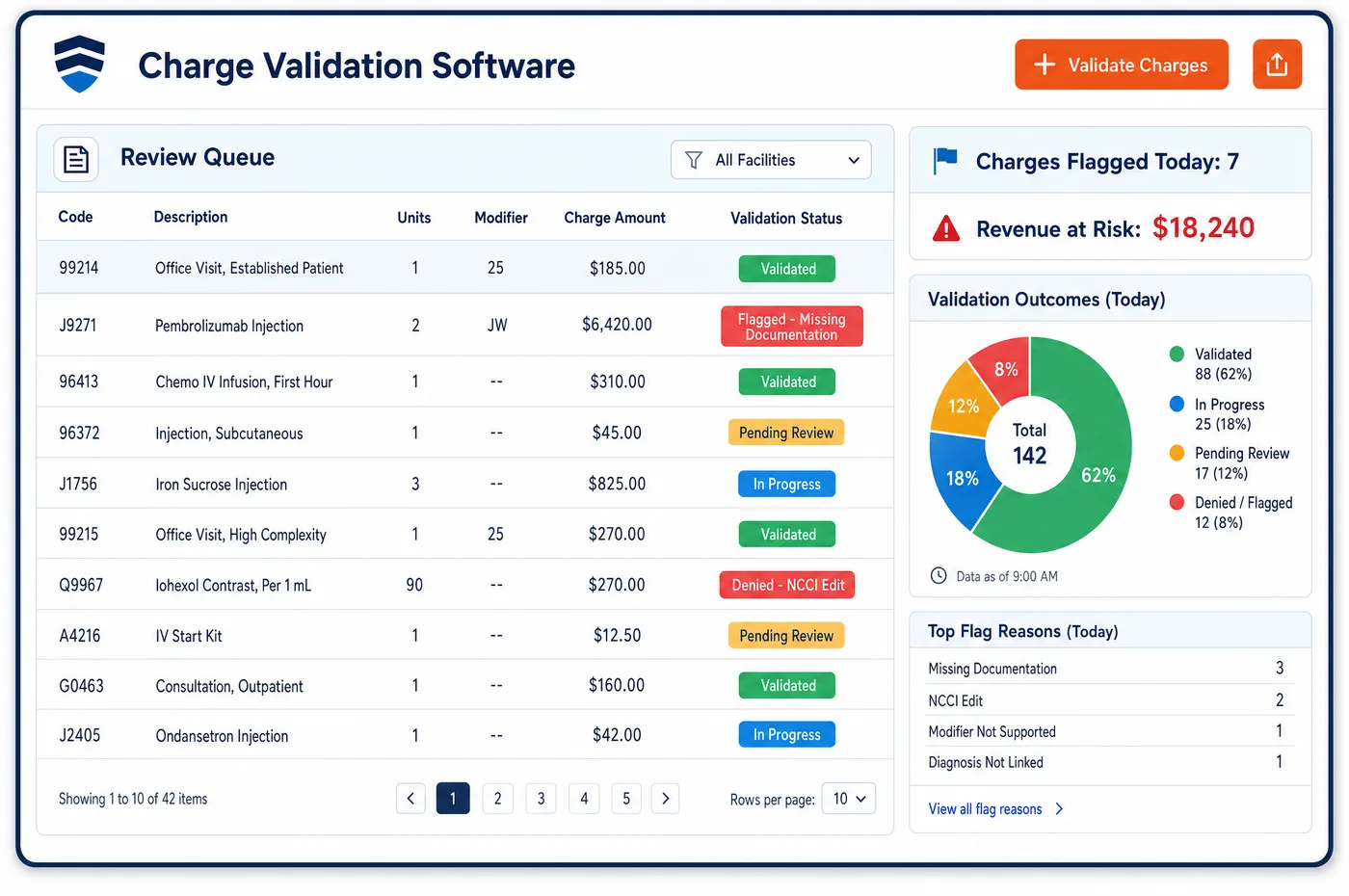
Charge Validation in a Orthopedics Practice
Charge validation in orthopedics works through a set of questions for each encounter. Does the side on the procedure match the side in the diagnosis? Is this visit inside the global period of an earlier surgery, and if so, which modifier applies? Do two procedures on the same day form an NCCI pair, and were they done on different joints, fingers or toes? Unlimited Systems runs these checks at checkout, not at month-end. Modifier rules enforce RT and LT, 50, 51 and the EJ modifier on later injections in a series. Drug lines are checked against the product's billing unit and the dose given, and single-dose drugs billed to Medicare must carry JW or JZ. Unspecified diagnosis codes are flagged when a more specific code with side is expected. Each failed line goes to a work queue with the rule that stopped it, and fixes are made while the op note is still fresh.
Why Is Charge Validation Different in Orthopedics?
Orthopedics has a dense set of coding rules. Paired joints need RT, LT or 50. Fingers and toes have their own modifiers, from FA and F1 to F9, and TA and T1 to T9. Many shoulder and knee scopes form NCCI edit pairs. Inside the global period, a visit or procedure may need 24, 25, 57, 58, 78 or 79, and each one means something different. A charge with the wrong modifier is denied or, worse, paid and later taken back in an audit.
The modifier choice depends on facts in the record. A return to the OR for a related problem takes 78. An unrelated procedure in the global period takes modifier 79. A planned second stage takes 58. Two procedures that form an NCCI pair can be billed together only when they were done on different sites or sessions. CMS asks coders to use the specific anatomic modifiers first, and to use 59 or the X modifiers only when no more specific one fits. Validation has to check the record, not just the code pair.
Injection billing adds its own checks. The procedure code needs a side, and later shots in a hyaluronan series need EJ on the drug line. If the drug is denied, the injection procedure is denied with it. Drug units must match each product's billing unit, and single-dose drugs billed to Medicare need JW or JZ. Orthopedics charge validation software checks these lines after charge assembly builds them. Patterns that still lead to denials go to orthopedic denial management to be fixed at the source.
What Orthopedics Charge Validation Software Handles
- Arthrocentesis with arthroscopy on the same joint
- Arthrocentesis codes 20600 to 20611 are not billed with an open or arthroscopic procedure on the same joint. Validation holds the pair unless the documentation shows a different joint and the line carries the matching side modifier. (Medicare NCCI Policy Manual 2026, Chapter IV: Musculoskeletal System (CPT 20000-29999))
- Finger and toe modifiers and MUEs
- Many finger and toe procedures have an MUE of one per line, based on FA, F1 to F9, TA and T1 to T9 being used for each digit. Validation checks that a digit modifier is on each line when the same procedure is done on more than one digit. (Medicare NCCI Policy Manual 2026, Chapter IV: Musculoskeletal System (CPT 20000-29999))
- Anatomic modifiers before 59 or XS
- CMS allows 59 or XS for separate sites only when no more specific anatomic modifier, such as RT, LT or a digit modifier, describes the service. Validation suggests the specific modifier first and flags 59 used where one would fit. (CMS MLN1783722 Proper Use of Modifiers 59, XE, XP, XS & XU)
- Global period modifiers 24, 25, 57, 58, 78 and 79
- Each charge on a patient with an open global period is checked against the surgery date and indicator. Validation asks for 24 or 79 for unrelated care, 78 for a related return to the OR, 58 for staged work, and flags 57 on minor procedures where it does not apply. (CMS MLN907166 Global Surgery Booklet (December 2025))
- Bilateral reporting with modifier 50
- For codes with a bilateral indicator that allows it, surgeon claims report one line with modifier 50 and one unit. Codes already defined as bilateral are not billed with 50. Validation checks both cases. (Medicare Claims Processing Manual, Chapter 12: Physicians/Nonphysician Practitioners)
- Hyaluronan injection rules
- The injection code needs RT, LT or 50, and only one injection service is allowed per knee when other drugs are given with the viscosupplement. Later shots in a series need EJ on the drug line. Units must match the product's billing unit. (WPS Billing and Coding Article A56157: Intraarticular Knee Injections of Hyaluronan)
- JW and JZ on single-dose drugs
- For Medicare, separately paid Part B drugs from single-dose containers must carry JW on a separate line for discarded drug, or JZ when none was discarded. Validation holds drug lines that carry neither. (CMS Discarded Drugs (JW and JZ modifiers))
How Does Orthopedics Charge Validation Software Work?
1. Check the side
The side on each procedure is compared to the side in the diagnosis and the documentation. Missing RT, LT, 50 or digit modifiers are flagged. Unspecified diagnosis codes are flagged when a specific one is expected.
2. Check the global period
Each charge is compared to any open global period for the patient. Visits and procedures inside it are tested for 24, 25, 57, 58, 78 or 79. Related post-op visits are kept at no charge.
3. Run NCCI and MUE edits
Code pairs are tested against current NCCI tables, and units are tested against MUEs. When a pair is allowed with a modifier, the record must support a separate site or session. Anatomic modifiers are preferred over 59.
4. Check drugs and supplies
Drug lines are tested for billing units, NDC where needed, EJ on later series shots, and JW or JZ on Medicare claims. Brace lines need a side and a matching order. Cast supply codes are checked against the fracture care rules.
5. Hold, explain and release
Lines that fail are held in a work queue with the rule and the reason. A coder fixes them while the case is fresh. Clean encounters move to the claim.
Orthopedics Charge Validation Software vs. Generic Software
| Area | Generic approach | Unlimited Systems |
|---|---|---|
| Side and bilateral | Laterality checked only when a payer denies. | Side checked against diagnosis and record at checkout. |
| Global period | Post-op visits billed by mistake and taken back later. | Every charge tested against open global periods. |
| NCCI pairs | Modifier 59 added to get past an edit. | Specific anatomic modifiers first, with the record checked. |
| Drug units | Vials billed as units. | Units checked against each product's billing unit. |
| Series modifiers | EJ left off later injections. | EJ required on later shots in a series. |
| Failed charges | Sent anyway and fixed after the denial. | Held with the rule and reason for a coder. |
Who Uses It in a Orthopedics Practice
- Coder: A short queue of failed charges, each with the rule that stopped it, while the op note is still fresh.
- Billing manager: Fewer modifier, global period and NCCI denials, and a list of the rules that fire most.
- Compliance lead: Modifier 59 used only where the record supports it, and drug units that match the dose given.
- Surgeon: Fewer queries after the fact, and payments that are not taken back in an audit.
Orthopedics Charge Validation Software FAQs
Orthopedics charge validation software checks side and bilateral modifiers, multiple procedure order, global period status, NCCI pairs and MUE limits, injection drug units, EJ, JW and JZ modifiers for Medicare, and the match between diagnosis and procedure. It runs at checkout. Charges that fail are held in a queue with the rule and the reason, so a coder can fix them before the claim goes out.
Charge validation compares each new charge to any open global period for the patient. A related post-op visit stays at no charge. An unrelated visit needs modifier 24, and an unrelated procedure needs 79. A related return to the OR takes 78, and a planned staged procedure takes 58. Validation asks for the right one based on the record.
Two procedures in an NCCI pair can be billed together only when the record shows they were done at separate sites or in separate sessions, and the pair allows a modifier. CMS asks for the most specific modifier first, such as RT, LT or a finger or toe modifier. Modifier 59 or XS is only for cases where no specific modifier fits.
An injection into the same knee as a scope on the same day is not billed separately. NCCI rules include arthrocentesis in the open or arthroscopic procedure on that joint. If the injection was into a different joint, it can be billed with the side of that joint. Validation checks the side on both lines before it releases the charge.
Charge validation checks that the injection code has RT, LT or 50, that the drug code's units match its billing unit, and that later shots in a series carry EJ on the drug line. For Medicare claims it also checks for JW or JZ on single-dose drugs. If the drug line would be denied, the injection line would be denied too, so both are held together.
Unspecified diagnosis codes are flagged because many orthopedic codes specify the side and, for injuries, the encounter stage. A procedure billed on the right knee with a diagnosis that does not name a side can be denied as inconsistent. Validation compares the diagnosis to the procedure side and the record, and asks for the specific code when one exists.
Related Orthopedics Software
Billing & claims
In the revenue cycle
Charge Validation for related specialties
Sources
- Medicare NCCI Policy Manual 2026, Chapter IV: Musculoskeletal System (CPT 20000-29999)
- CMS MLN1783722 Proper Use of Modifiers 59, XE, XP, XS & XU
- CMS MLN907166 Global Surgery Booklet (December 2025)
- Medicare Claims Processing Manual, Chapter 12: Physicians/Nonphysician Practitioners
- WPS Billing and Coding Article A56157: Intraarticular Knee Injections of Hyaluronan
- CMS Discarded Drugs (JW and JZ modifiers)
- CMS ICD-10 code files and official ICD-10-CM coding guidelines
GET STARTED
See Unlimited Systems in Action
Whether you're actively evaluating new technology or simply preparing for your next vendor renewal, Unlimited Systems can help you understand where your current workflows may be creating avoidable revenue risk.