

Billing & claims
Orthopedics Charge Assembly Software
Turn op notes, injection logs, cast and brace records into coded orthopedic charge lines for each encounter.
Orthopedics Charge Assembly Software gathers everything documented for an orthopedic encounter and turns it into coded charge lines. That covers the visit, each procedure in the op note, X-rays, injection procedures and drugs, casts and splints, and braces. Each line carries its codes, units, side and site before rule checks begin.



 6,500+ specialty providers

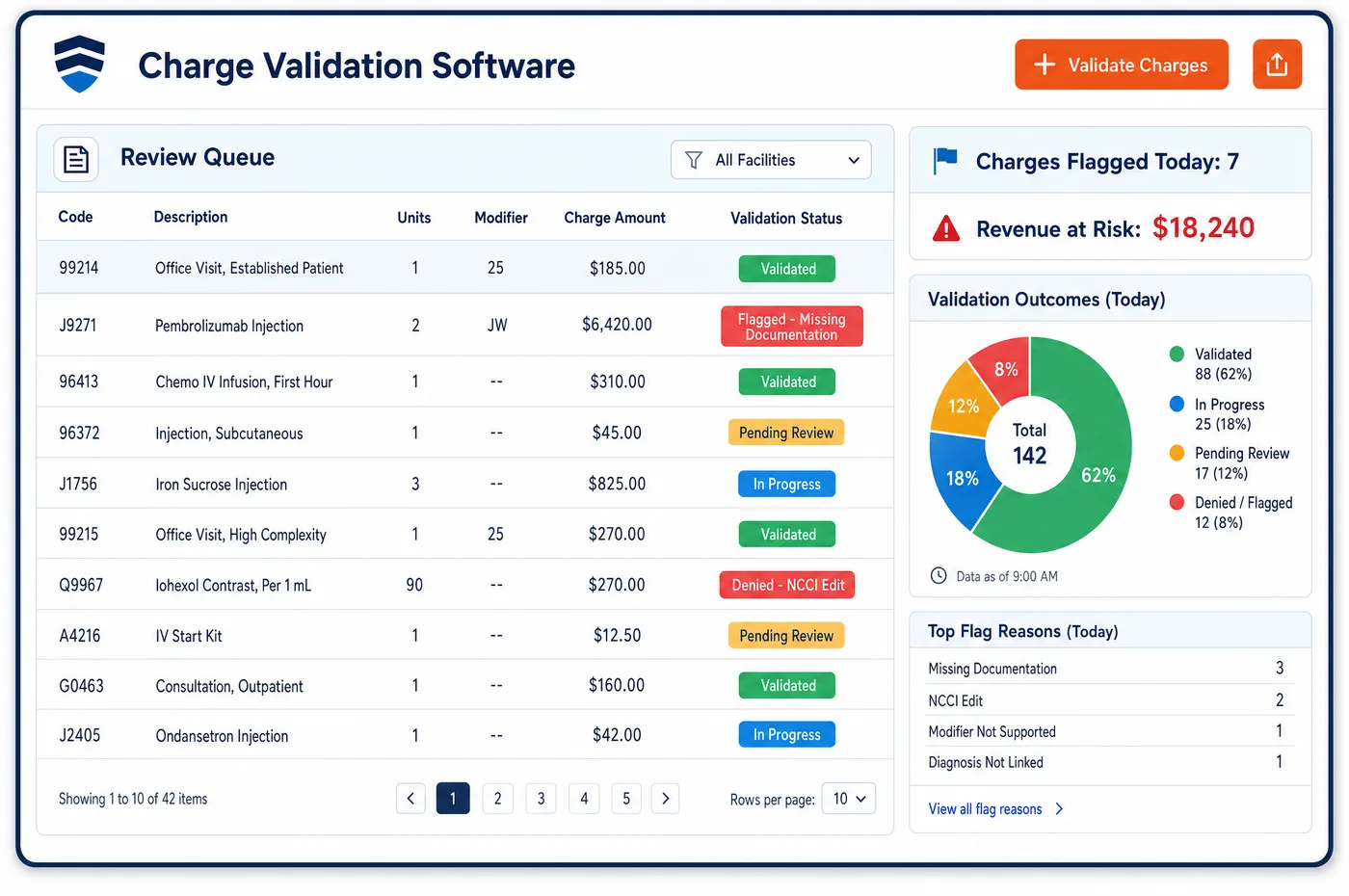
Charge Assembly in a Orthopedics Practice
An orthopedic encounter can produce many charges from many sources. A clinic visit may include an office X-ray, a knee injection with a hyaluronan drug, and a brace fitted at checkout. A surgery day produces the surgeon's procedures from the op note, an assistant's charges and, at an ASC, implant and supply charges for the facility. Unlimited Systems pulls these into one charge assembly per encounter. Visit codes and procedures come from the chart. Drug codes and units come from the injection record. Brace L-codes come from the dispensing log, and implant details come from the case log. Each line is tagged with the side, the provider and the place of service. Encounters that need a person, such as an op note with more procedures than usual or a missing drug record, are flagged and assigned to a coder as a task. The at-a-glance view shows billing history beside the new charges, so a coder can see what was billed for the same knee before.
Why Is Charge Assembly Different in Orthopedics?
Orthopedic charges come from more places than in most fields. The op note drives surgical codes, but the injection record drives drug units and the dispensing log drives brace codes. The case log holds implants for the ASC. When each source feeds billing on its own schedule, charges arrive late or not at all. Charge capture in orthopedics means gathering every source for the encounter into one place before anything is coded.
Some documented services are not separate charges at all. Initial casting is part of the fracture care code when the surgeon treats the fracture. Related post-op visits fall inside the global surgical package and are logged with a no-charge code. One unit of an arthrocentesis code covers a joint and its bursae, no matter how many bursae are injected. Charge assembly has to know these patterns so the lines reflect how the service is actually billed.
Drug and supply lines need care too. Hyaluronan products are billed per dose, per milligram or, for one product, per tenth of a milligram, so the same injection can mean one unit or dozens. Braces are billed by L-code with a side. Orthopedics charge assembly software turns each of these into a line with the right billing units, then hands the encounter to orthopedic charge validation for edits and payer rules.
What Orthopedics Charge Assembly Software Handles
- Fracture care and casting (Q4001 to Q4051)
- When the surgeon treats a fracture, the initial cast or splint is part of the fracture code and no casting line is added. When the cast is the only initial treatment, the encounter gets an E/M line, a casting code and a cast supply code from Q4001 to Q4051. (Medicare NCCI Policy Manual 2026, Chapter IV: Musculoskeletal System (CPT 20000-29999))
- Arthrocentesis units (20600 to 20611)
- Each joint and its bursae count as one unit. Charge assembly creates one line per joint injected, such as 20610 for a knee, with the side, even when bursae are also injected. (Medicare NCCI Policy Manual 2026, Chapter IV: Musculoskeletal System (CPT 20000-29999))
- Hyaluronan billing units
- Per-dose codes such as J7321, J7323, J7324, J7326 and J7327 get one unit per dose. Per-milligram codes such as J7318, J7325 and J7329 get units by the milligram. J7328 is billed per tenth of a milligram. Units are set from the product in the injection record. (WPS Billing and Coding Article A56157: Intraarticular Knee Injections of Hyaluronan)
- Discarded drug lines (JW and JZ)
- For Medicare, drugs from single-dose containers get a separate JW line for any discarded amount. If nothing was discarded, the administered line carries JZ. (CMS Discarded Drugs (JW and JZ modifiers))
- Post-op visits logged with 99024
- Related post-op visits in a global period get a 99024 line with no charge. The visit is still recorded on the encounter, so the global period history is complete. (CMS MLN907166 Global Surgery Booklet (December 2025))
- Add-on codes with global indicator ZZZ
- Add-on codes are added with the primary procedure they belong to. They take the global period of the primary code, so the assembly links each add-on to its primary line. (CMS MLN907166 Global Surgery Booklet (December 2025))
How Does Orthopedics Charge Assembly Software Work?
1. Gather every source
The chart, op note, injection record, dispensing log and case log feed one assembly per encounter. Charges are pulled in as each source is signed. Nothing waits for a paper superbill.
2. Code the lines
Visit, procedure, X-ray, drug, supply and brace lines are coded from the documentation. Each line gets its units, side, provider and place of service. Add-on codes are linked to their primary procedure.
3. Apply the packaging patterns
Initial casts inside fracture care are left off. Related post-op visits get a no-charge line. Arthrocentesis is set to one unit per joint.
4. Flag what needs a person
Event-driven checks flag encounters that need human review, such as a long op note or a missing drug record. Each one is assigned to a coder as a task. Coders see billing history beside the new lines.
5. Hand off to validation
The finished assembly moves to charge validation for edits, modifiers and payer rules. Lines that pass go on to the claim. Lines that fail come back with the reason.
Orthopedics Charge Assembly Software vs. Generic Software
| Area | Generic approach | Unlimited Systems |
|---|---|---|
| Charge sources | Op note, injection log and brace log keyed in separately. | All sources gathered into one assembly per encounter. |
| Drug units | Units entered as vials or doses by habit. | Units set from each product's billing unit. |
| Casting | Cast codes billed with fracture care. | Initial cast left inside fracture care when it applies. |
| Post-op visits | Not recorded, or billed in error. | Logged with 99024 and no charge. |
| Work assignment | Shared queue with no owner. | Flagged encounters assigned to a coder as tasks. |
| History | Prior claims checked in another screen. | Billing history shown beside the new charges. |
Who Uses It in a Orthopedics Practice
- Coder: One assembly per encounter with every source pulled in, and flags only on the encounters that need a person.
- Billing manager: Charges that arrive on time, with drug units, cast rules and post-op visits handled before the claim.
- ASC business office: Implant and supply details from the case log, ready to match to the procedure charge.
- Surgeon: Op notes that turn into charge lines without being re-read by several people, and fewer queries after the fact.
Orthopedics Charge Assembly Software FAQs
Orthopedics charge assembly software gathers the documentation for an encounter and turns it into coded charge lines. It pulls the visit and procedures from the chart and op note, drug codes and units from the injection record, brace codes from the dispensing log, and implants from the case log. Each line gets its units, side, provider and place of service before validation.
Charge assembly leaves the initial cast inside the fracture care code when the surgeon treats the fracture. The casting code and cast supply code are only added when the cast is the only initial treatment and the surgeon does not plan definitive care. In that case the encounter can also carry an E/M service, if it is significant and separate.
Hyaluronan injection units are set from each product's billing unit. Per-dose codes get one unit for each dose. Per-milligram codes get one unit for each milligram given, so a single Synvisc-One injection is billed in milligrams. Gelsyn-3 is billed per tenth of a milligram. Charge assembly reads the product from the injection record and sets the units.
Post-op visits are part of charge assembly even though they are not paid separately. A related visit inside a global period gets a 99024 line with no charge. Recording it keeps the encounter history complete, supports CMS reporting where it applies, and lets staff see when a visit was really for an unrelated problem that needs its own charge.
Encounters get flagged when event-driven checks find something a person should look at. Examples include an op note with many procedures, a drug line with no matching injection record, a brace with no side, or an implant on the case log with no matching procedure. Each flagged encounter is assigned to a coder as a task with the billing history in view.
Charge assembly builds the charge lines from documentation. Charge validation then checks those lines against coding edits, modifiers, payer policy and documentation rules. In orthopedics, assembly sets the codes, units and side for each procedure, drug and brace. Validation then tests the lines against NCCI edits, global period rules and payer limits before the claim is built.
Related Orthopedics Software
Billing & claims
In the revenue cycle
Charge Assembly for related specialties
Sources
GET STARTED
See Unlimited Systems in Action
Whether you're actively evaluating new technology or simply preparing for your next vendor renewal, Unlimited Systems can help you understand where your current workflows may be creating avoidable revenue risk.