

Front office
Orthopedics Patient Scheduling Software
Book clinic visits, X-rays, injection series, casting and surgery blocks on one orthopedic calendar.
Orthopedics Patient Scheduling Software books each kind of orthopedic visit with the time, room and staff it needs. New injuries, fracture checks, post-op visits, injections and casting each have their own slot type. Surgery is booked into the surgeon's block at the ASC or hospital, and the clinic follow-ups are planned around it.



 6,500+ specialty providers

Patient Scheduling in a Orthopedics Practice
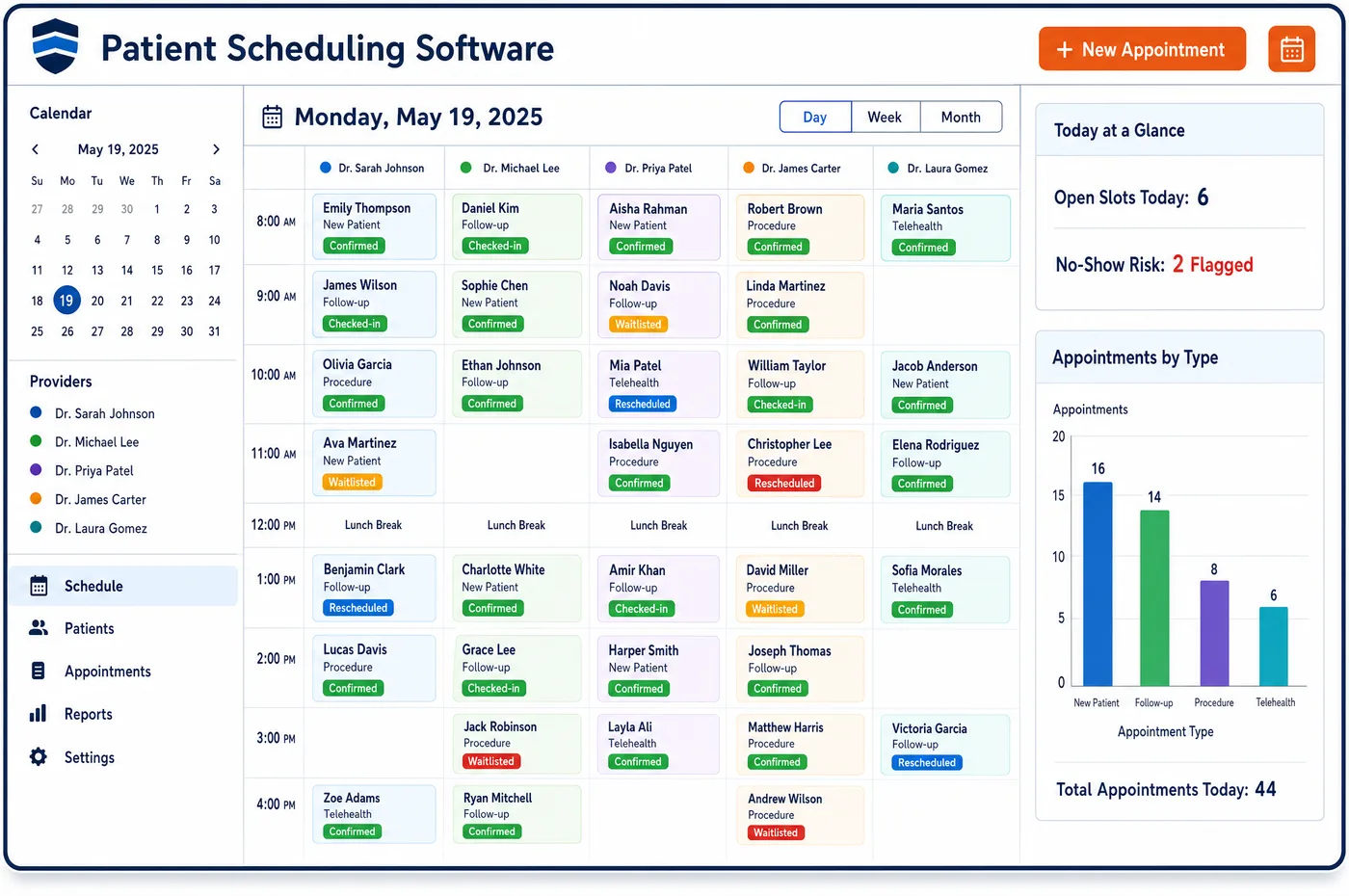
A surgeon's week in orthopedics splits between clinic days and OR days. Unlimited Systems builds templates for both. Clinic templates set slot types for new patients, fracture follow-ups, post-op checks and injection visits, and they hold the X-ray room and casting room when a visit needs them. OR templates hold the surgeon's block time at each ASC or hospital. When a knee replacement is booked, the scheduler can lay out the post-op visits inside the global window at the same time. For an injection series, the scheduler books the weekly visits for one knee as a set. Each slot shows if coverage and any needed approval are in place, so a case without one is held. When a patient cancels, the waitlist gets a text and the slot can refill without phone calls. Every change syncs to the EHR, so the clinic and the chart show one calendar.
Why Is Patient Scheduling Different in Orthopedics?
Orthopedic scheduling has to juggle people, rooms and places. The same surgeon may see patients in two clinics, read X-rays in a third, and operate at an ASC and a hospital in one week. A new injury visit often needs an X-ray first. A fracture check may need the casting room. A visit booked only against the provider's name leaves the room or the tech out, and the patient waits.
Surgery adds its own rules. A major procedure carries a global period, so the post-op visits are part of the surgical payment and need to be planned, not just added later. A planned second-side knee or a staged repair is billed with modifier 58, so the scheduler links it to the first case. Bilateral knee replacements done by two surgeons at once are billed as co-surgery, which means two surgeons' blocks must line up. None of this can be booked well on a plain calendar.
Injections follow a pattern too. Viscosupplement products are given as a single shot or as a short weekly series, and the left and right knees are separate series. Booking the whole series at once keeps the timing right and avoids gaps. Orthopedics patient scheduling software also checks that the case is cleared, through orthopedic financial clearance, before the slot is locked. Reminders and waitlist texts then keep the calendar full.
What Orthopedics Patient Scheduling Software Handles
- Global period post-op visits (code 99024)
- When surgery is booked, the scheduler lays out the related post-op visits inside the global window. These visits are logged with code 99024, and the slot is marked so the desk does not expect a separate charge. (CMS MLN907166 Global Surgery Booklet (December 2025))
- Staged procedures with modifier 58
- A planned second procedure, such as the other knee, is booked as a staged case linked to the first. Linking them tells billing to use modifier 58, which starts a new global period. (CMS MLN907166 Global Surgery Booklet (December 2025))
- Co-surgeons with modifier 62
- When two surgeons work on one case, such as bilateral knee replacements, the scheduler books both surgeons into the same OR time. Each surgeon's claim then carries modifier 62. (CMS MLN907166 Global Surgery Booklet (December 2025))
- Assistant at surgery (80, 82 and AS)
- Cases can be booked with an assistant surgeon or a PA. The scheduler shows the assistant on the case so billing can check if the procedure allows assistant payment before adding 80, 82 or AS. (CMS MLN907166 Global Surgery Booklet (December 2025))
- Hyaluronan injection series per knee
- Products such as Synvisc, Euflexxa and Orthovisc are given as weekly series, while Durolane, Gel-One and Monovisc are single shots. The scheduler books a series per knee, and a left knee series is kept apart from a right knee series. (WPS Billing and Coding Article A56157: Intraarticular Knee Injections of Hyaluronan)
- Place of service by booking location
- Each slot carries its site: office (POS 11), ASC (POS 24) or hospital outpatient (POS 19 or 22). The place of service code then follows the visit to the claim. (CMS Place of Service Code Set)
How Does Orthopedics Patient Scheduling Software Work?
1. Build clinic and OR templates
Clinic templates set slot types and lengths for each provider and site. OR templates hold block time at each ASC and hospital. Rooms such as X-ray and casting are tied to the slots that need them.
2. Book by visit type
Staff pick the visit type, and the scheduler offers slots with the right provider, room and length. New injuries can be paired with an X-ray slot. Post-op visits are matched to the surgeon who did the case.
3. Plan surgery and follow-ups together
When surgery is booked, the post-op visits inside the global window are offered at the same time. Staged or co-surgeon cases are linked. The patient leaves with the full plan.
4. Check readiness before locking
Each booking shows if coverage and any approval are in place. Cases that are not cleared are held. Staff can fix the gap or move the date.
5. Remind, confirm and refill
Patients get reminders by text or email and can confirm by reply. If a patient cancels, the waitlist is texted and the slot can refill. Changes sync to the EHR through HL7 scheduling messages.
Orthopedics Patient Scheduling Software vs. Generic Software
| Area | Generic approach | Unlimited Systems |
|---|---|---|
| Slot types | One visit length for every patient. | Slot types for new injury, fracture, post-op, injection and casting visits. |
| Rooms and equipment | X-ray and casting rooms booked on paper. | Rooms tied to the slots that need them. |
| Surgery follow-up | Post-op visits added one at a time later. | Global period visits planned when surgery is booked. |
| Injection series | Each shot booked as its own visit. | Weekly series booked per knee as a set. |
| Cleared cases | Cases booked before approval is in. | Bookings held until coverage and approval are confirmed. |
| Cancellations | Staff call patients to fill gaps. | Waitlist texts that refill the open slot. |
Who Uses It in a Orthopedics Practice
- Scheduler: Slot types and templates that match each orthopedic visit, with rooms and readiness shown on the same screen.
- Surgery coordinator: OR blocks at each site, linked staged and co-surgeon cases, and post-op visits planned at the time of booking.
- Orthopedic surgeon: Clinic days that run on time, with X-ray and casting ready when the patient is roomed.
- Practice administrator: One calendar across clinics, ASCs and hospitals, plus reminders and outreach that cut empty slots.
Orthopedics Patient Scheduling Software FAQs
Orthopedics patient scheduling software books by visit type, room and site, not just by provider. It holds X-ray and casting rooms, keeps surgeon block time at ASCs and hospitals, plans post-op visits inside the global period when surgery is booked, and books injection series per knee. It also checks that each case is cleared before the slot is locked, and it refills cancellations from a waitlist.
Post-op visits are planned when the surgery is booked. The scheduler knows the global period for the procedure and offers the follow-up visits inside it, with the surgeon who did the case. These visits are part of the surgical payment and are logged with code 99024, so the slot is marked post-op and no separate visit charge is expected.
The scheduler can book a whole injection series at once. For weekly viscosupplement products, the visits for one knee are booked as a set, so timing stays on track. A series for the other knee is kept separate, as Medicare contractors treat each knee as its own series. Single-shot products are booked as one visit.
Patient scheduling links staged and bilateral cases. A planned second-side surgery is booked as a staged case tied to the first, which tells billing to use modifier 58. When two surgeons operate together, such as on bilateral knee replacements, both surgeons are booked into the same OR time, and each claim carries the co-surgeon modifier.
Scheduling checks coverage and approval status before a surgery slot is locked. If an MRI, scope, joint replacement or brace still needs approval, or if a work injury still needs the adjuster's sign-off, the booking is held. Staff see the reason and can finish the request or move the date. This keeps unapproved cases off the OR schedule.
Cancellations are filled from a waitlist. When a slot opens, patients on the list get a text offering the time, and the first to accept is booked. The slot type still applies, so a post-op slot goes to a post-op patient and an injection slot to an injection patient. Changes sync to the EHR right away.
Related Orthopedics Software
Front office
In the revenue cycle
Patient Scheduling for related specialties
Sources
GET STARTED
See Unlimited Systems in Action
Whether you're actively evaluating new technology or simply preparing for your next vendor renewal, Unlimited Systems can help you understand where your current workflows may be creating avoidable revenue risk.