

Payments & AR
Orthopedics AR Management Software
Work orthopedic AR by value, payer type and deadline, so surgical claims and work injury cases never age out unseen.
Orthopedics AR Management Software tracks every unpaid orthopedic claim from submission to payment. It ranks surgical claims by value and filing deadline. It follows workers' compensation, auto and personal injury cases by adjuster or attorney. It also checks claim status with payers, so collectors call only when a call is needed.



 6,500+ specialty providers

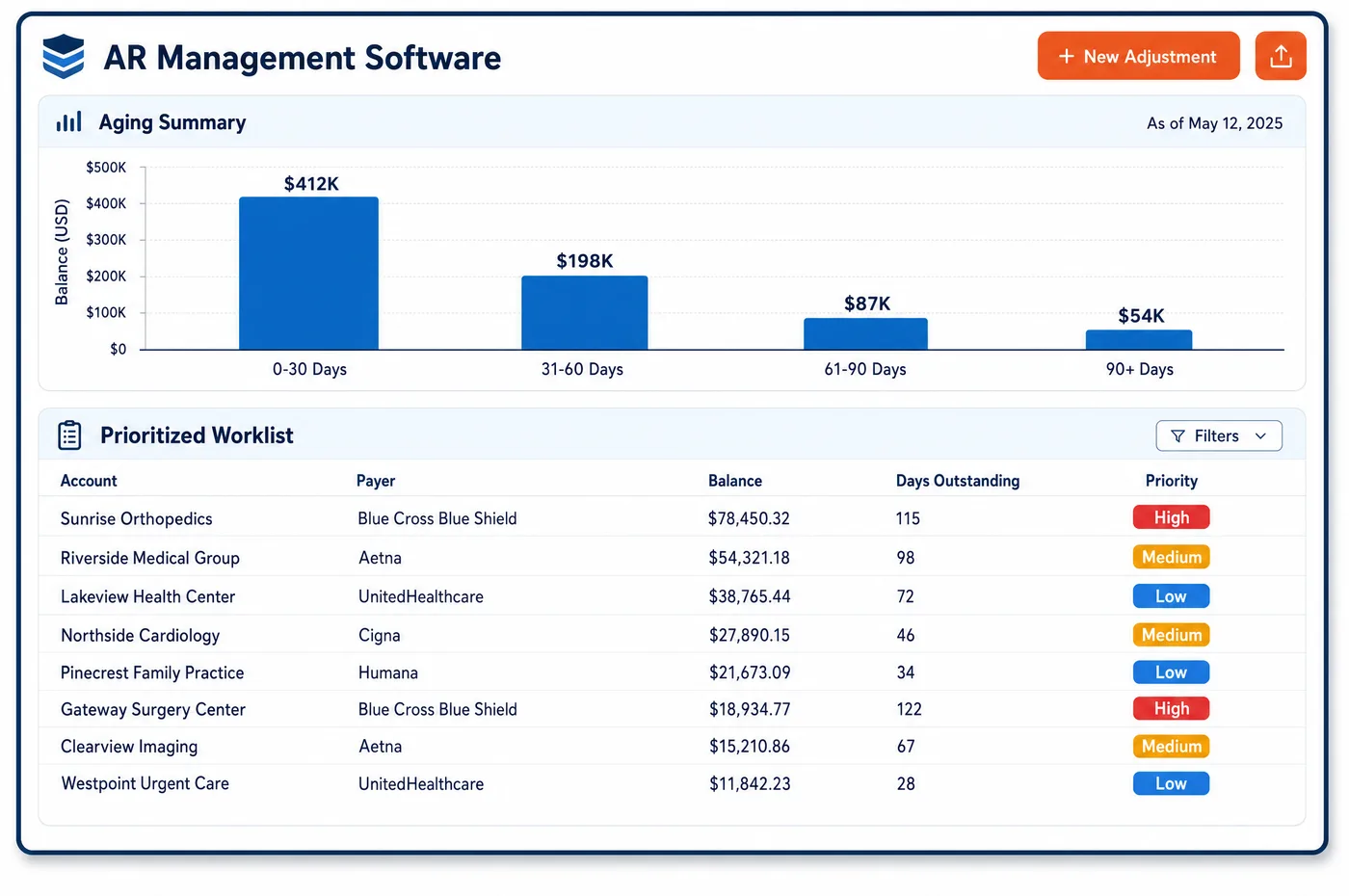
AR Management in a Orthopedics Practice
An orthopedic AR list mixes very different debts. A total knee claim may be stuck on a missing implant invoice. A work injury visit may wait on the adjuster to accept the claim. A fracture case from a car crash may sit behind a no-fault carrier and then Medicare. The system sorts open claims by balance, payer type and age. It shows the timely filing limit for each payer next to the balance. Bulk 276 status requests run before anyone picks up the phone, and the 277 answer lands on the claim. Claims that are pending, denied or never received each go to a different queue. When the primary payer pays, the secondary claim is built and sent from the posted remit. Collectors open a worklist each morning that starts with the claims most at risk, not the oldest ones.
Why Is AR Management Different in Orthopedics?
Orthopedic AR is lumpy. A few surgical claims can hold more value than hundreds of office visits, and each has more ways to stall. The authorization may not match the CPT code billed. A multi-procedure case may draw a modifier dispute. The payer may ask for the operative note. A list sorted by date of service puts those claims behind small balances. Collectors need to see value and deadline together, grouped in aging buckets by payer.
Injury cases follow other rules. Workers' compensation carriers want the claim number, the employer and the date of injury, and they may hold payment until the claim is accepted. Auto and no-fault carriers pay first in many states, and Medicare pays second under Medicare Secondary Payer rules. Liability-based accounts can wait on a settlement. They can stay open far longer than health plan claims, so they need their own follow-up dates and contacts.
AR work also depends on clean data upstream. If a remit was posted to the wrong account, the claim looks unpaid when it is not, so collectors rely on accurate payment posting. If the claim was denied, it belongs in denial management with its reason code, not in a general follow-up pile. Good AR management keeps those lines of work apart.
What Orthopedics AR Management Software Handles
- Medicare timely filing
- Medicare claims must be filed within one calendar year of the date of service. The worklist shows that deadline on each Medicare claim, so a rejected claim is fixed and resent in time. (Medicare Claims Processing Manual, Chapter 1: General Billing Requirements)
- X12 276/277 claim status
- Status requests run in bulk for open claims. The 277 response, such as pending, finalized or not found, is stored on the claim and decides which queue it joins. (X12 transaction sets, including 276/277 Health Care Claim Status)
- Medicare Secondary Payer on injury cases
- When an injury involves workers' compensation, no-fault or liability insurance, the account shows which payer is primary. Medicare is billed as secondary when MSP rules require it. (CMS Coordination of Benefits and Recovery overview (Medicare Secondary Payer))
- CMS-1500 items 10a to 10c
- Claims flag whether the condition is related to work, an auto accident or another accident. AR checks those items when a health plan denies a claim as another payer's liability. (NUCC 1500 Health Insurance Claim Form reference instructions)
- CARC 29 and CARC 197 denials
- Timely filing (CARC 29) and missing precertification (CARC 197) denials are tagged on arrival. Each goes to the right owner with the payer and the dates already on screen. (X12 Claim Adjustment Reason Codes)
- Global-period follow-up
- Open visits inside a surgical global period are checked for modifier 24 or 79 before anyone appeals. That stops staff from chasing visits that were bundled correctly. (CMS MLN Global Surgery Booklet)
How Does Orthopedics AR Management Software Work?
1. Load open claims
Every unpaid claim enters AR when it is sent. Each one carries its payer, balance, date of service and filing deadline.
2. Check status in bulk
Automated 276 requests go to payers that support them. The 277 answer updates each claim before collectors start work.
3. Rank the worklist
Claims are sorted by balance, time left to file and payer type. Surgical claims near a deadline rise to the top.
4. Split out injury cases
Workers' compensation, auto and personal injury accounts go to staff who know those payers. Their follow-up dates track the adjuster or attorney, not the health plan.
5. Escalate stuck claims
Claims with no answer after repeat follow-up move to a supervisor or the payer's provider representative. Notes from each touch stay on the claim.
6. Bill the next payer
Once the primary pays, the secondary claim is built from the posted remit. Any patient share moves on to patient billing.
Orthopedics AR Management Software vs. Generic Software
| Area | Generic approach | Unlimited Systems |
|---|---|---|
| Worklist order | Oldest claims first, whatever their value. | Value, deadline and payer type weighed together. |
| Claim status | Phone calls and payer portals, one claim at a time. | Bulk 276/277 checks before anyone calls. |
| Injury cases | Mixed in with health plan claims. | Tracked by adjuster, claim number and attorney contact. |
| Filing deadlines | Found when the CARC 29 denial arrives. | Shown on every claim before the limit passes. |
| Secondary claims | Built by hand from a list. | Created from the posted primary remit. |
Who Uses It in a Orthopedics Practice
- AR collector: A daily list that starts with the claims most at risk, with the 277 status and past notes already on screen.
- Workers' compensation specialist: Cases grouped by carrier and adjuster, with the claim number, employer and injury date on every account.
- Revenue cycle director: Aging by payer, site and surgeon, plus a view of claims near their filing limit, so staff can be moved before money is lost.
Orthopedics AR Management Software FAQs
AR management for orthopedics has to handle a few high-value surgical claims, many small office claims and long-running injury cases at once. Each needs a different follow-up pace. The worklist ranks claims by value and filing deadline. It routes workers' compensation, auto and personal injury accounts to staff who know those payers.
Workers' compensation claims are tracked by carrier, adjuster and claim number. The account shows the employer and the date of injury, which carriers ask for first. If a carrier is holding payment until the claim is accepted, the follow-up date is set to match. Notes from each call stay on the account for the next person.
Personal injury accounts are kept apart from health plan AR. Each one lists the attorney, the lien or letter of protection on file and the case status. Staff set follow-up dates that fit the settlement process. When a settlement payment arrives, it posts to the case, and any balance left is reviewed before anything else happens.
Claim status checks run as bulk 276 requests to payers that accept them. The 277 response is saved on each claim and moves it to the right queue, such as pending, paid or not on file. Collectors only call when the electronic answer is missing or unclear, which keeps phone time for the claims that need it.
Every claim shows the filing limit for its payer. Medicare allows one calendar year from the date of service, and commercial and workers' compensation limits vary by contract and state. Claims near their limit rise to the top of the worklist, so a rejected or missing claim is fixed and resent in time.
Medicare is billed as secondary when another payer, such as workers' compensation, no-fault or liability insurance, is primary for the injury. The account records which payer comes first. AR staff follow up with the primary carrier, and the Medicare claim follows MSP rules so it is not denied as another payer's liability.
Related Orthopedics Software
Payments & AR
In the revenue cycle
AR Management for related specialties
Sources
- Medicare Claims Processing Manual, Chapter 1: General Billing Requirements
- X12 transaction sets, including 276/277 Health Care Claim Status
- CMS Coordination of Benefits and Recovery overview (Medicare Secondary Payer)
- NUCC 1500 Health Insurance Claim Form reference instructions
- X12 Claim Adjustment Reason Codes
- CMS MLN Global Surgery Booklet
GET STARTED
See Unlimited Systems in Action
Whether you're actively evaluating new technology or simply preparing for your next vendor renewal, Unlimited Systems can help you understand where your current workflows may be creating avoidable revenue risk.