

Analytics & value-based care
Allergy & Immunology Analytics Software
See why allergy revenue moves: shot adherence, dose and test unit cuts, biologic margin, and payer rules for spirometry and FeNO.
Allergy & Immunology Analytics Software shows the numbers that drive an allergy practice and explains why they move. It tracks shot visits and missed doses, 95165 doses billed against injections given, test units paid and cut, biologic margin by drug and payer, and denial trends for codes such as 94060 and 95012.



 6,500+ specialty providers

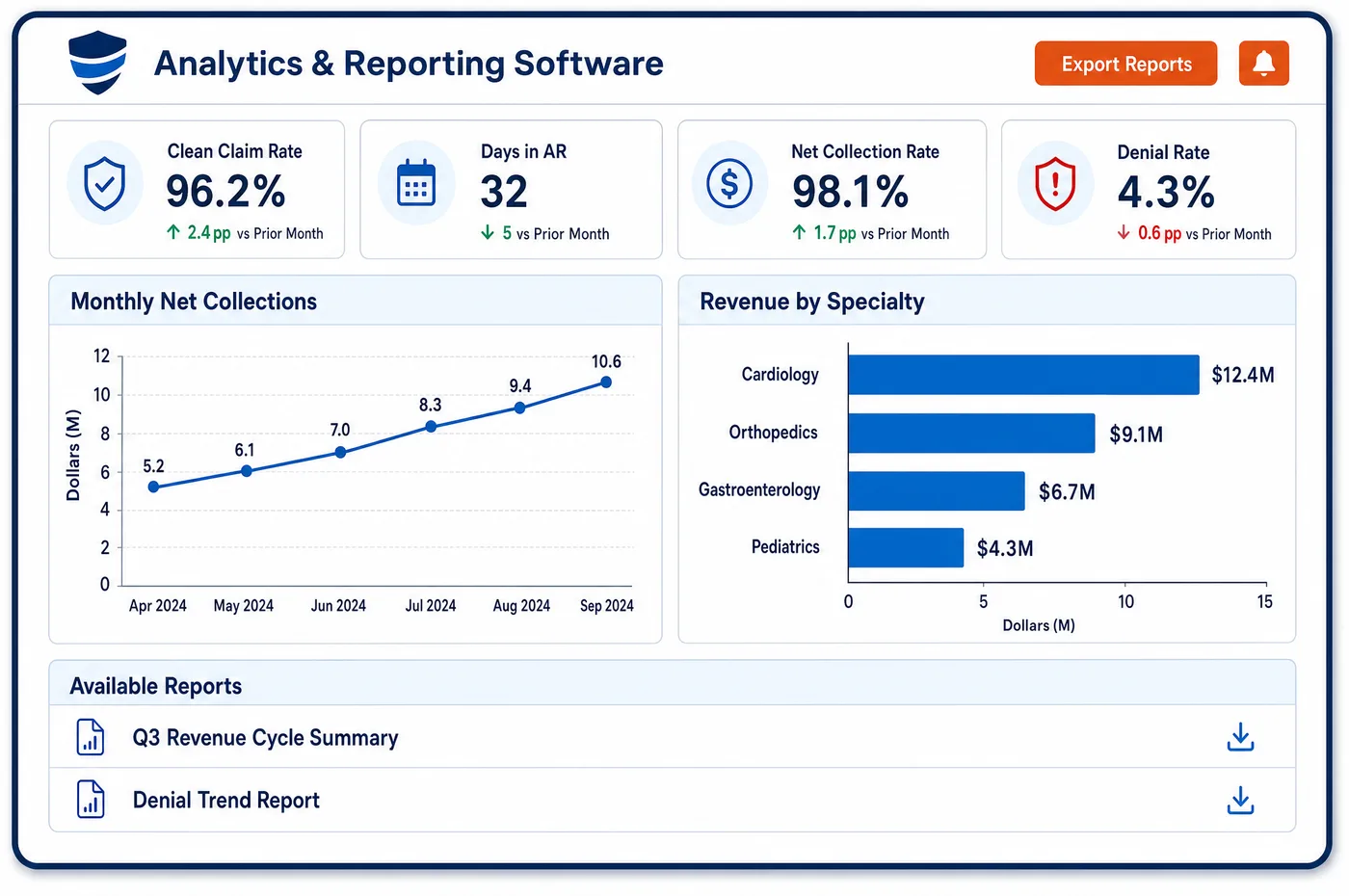
Analytics in a Allergy & Immunology Practice
Revenue in an allergy practice rests on a few repeat patterns. Immunotherapy patients have to keep coming for shots, so missed visits show up first as lost injection revenue and later as patients who drop out. Antigen preparation is paid by the dose, so doses billed should line up with vials prepared and shots given. Testing pays per test, and payers cut units when they think a panel is too large. Biologics bring large payments and real cost. Unlimited Systems analytics puts all of this in one data set. Falling collections might trace back to a payer cutting 95165 units, a new FeNO policy, or fewer shot visits at one site. KPIs such as denial rate and days in AR drill down from the practice to the payer, provider and claim. Benchmarks set each allergy KPI beside its own past values and beside peer specialty averages.
Why Is Analytics Different in Allergy & Immunology?
Allergy revenue depends on patient habits as much as on coding. A maintenance patient who stops coming for shots stops creating claims, yet nothing on a denial report shows it. Analytics that tracks shot visits per patient, the gap since the last injection and progress from build-up to maintenance shows the drop while staff can still reach out.
Payer rules for allergy tests and lung tests also vary widely. Medicare pays allergy tests per test and does not count positive or negative controls. Some commercial payers cover FeNO testing (95012) for asthma, while others call it investigational. NCCI treats the bronchodilator given during 94060 as part of the test, so billing 94640 with it is a misuse. Trends by code and payer show which rules cost the practice money and where a fix belongs.
Biologic margin is the third moving part. Payment for each dose depends on the payer's rate, which for Medicare follows the quarterly ASP file, while cost depends on what the practice paid. A drug can slip from profit to loss when either side changes. Analytics for an allergy group compares payment with cost by drug, payer and quarter, so leaders see the change before the next order.
What Allergy & Immunology Analytics Software Handles
- Dose reconciliation for 95165
- Medicare bills the doses planned when a vial is prepared, capped by the vial size. Doses billed are compared with vials prepared and shots given, so a gap in either direction shows by provider and site. (Medicare Claims Processing Manual, Chapter 12, Section 200: Allergy Testing and Immunotherapy)
- Allergy test units and controls
- Medicare does not count positive or negative controls as tests. Paid and cut units for 95004, 95024 and 95018 are trended by payer, so unit problems stand out early. (CMS NCCI Policy Manual for Medicare Services 2026, Chapter XI (pulmonary testing; allergy testing and immunotherapy))
- Spirometry 94010 and 94060
- NCCI treats the bronchodilator given in 94060 as part of the test, and repeat spirometry tries within one service count as one unit. Denials on these codes are trended by payer and provider. (CMS NCCI Policy Manual for Medicare Services 2026, Chapter XI (pulmonary testing; allergy testing and immunotherapy))
- FeNO testing (95012)
- Medica covers FeNO for diagnosing eosinophilic airway inflammation and judging steroid response, while Blue Shield of California calls it investigational. Denials for 95012 by payer show which policies reach the practice. (Medica Coverage Policy: Exhaled Breath Tests for Asthma and Other Inflammatory Pulmonary Conditions (CPT 95012))
- Biologic margin by quarter
- Medicare drug payment follows the quarterly ASP file. Payment for J2357, J2182, J0517 and J2356 is compared with acquisition cost each quarter, payer by payer. (CMS ASP Pricing Files (Medicare Part B drugs))
- Denial reasons by code
- CARC 151, CARC 119 and CARC 197 are trended by code and payer. Repeat patterns go back as rules for the claim scrubber. (X12 Claim Adjustment Reason Codes)
How Does Allergy & Immunology Analytics Software Work?
1. Pull one data set
Scheduling, charges, remittances and drug costs sit in one data set. A shot visit, its claim and its payment can be read together.
2. Track the core KPIs
Collections, denial rate, days in AR and clean-claim rate are tracked by payer, provider and site. Allergy measures add shot visits, missed doses and dose reconciliation.
3. Find why a number moved
A dip in allergy collections is traced back to the payer, code or site behind it. Users drill from the KPI down to the claims behind it.
4. Benchmark the practice
The practice is measured against its past results and against peer specialty averages. Gaps show where to look first.
5. Send fixes upstream
Denial patterns become rules for charge validation. Results go out on a schedule through allergy reporting and appear on dashboards for each role.
Allergy & Immunology Analytics Software vs. Generic Software
| Area | Generic approach | Unlimited Systems |
|---|---|---|
| Shot adherence | Noticed when a patient stops coming. | Missed doses and gaps shown by patient and provider. |
| Dose billing | Checked only at audit. | Doses billed compared with vials prepared and shots given. |
| Payer rules | Learned one denial at a time. | Denials trended by code and payer, with fixes sent to the scrubber. |
| Biologic margin | Worked out in a spreadsheet now and then. | Payment compared with cost by drug, payer and quarter. |
| Benchmarks | No outside comparison. | Peer specialty averages beside the practice's own trend. |
Who Uses It in a Allergy & Immunology Practice
- Practice administrator: Shot visit volume, missed doses and collections by site, with the reason behind each change.
- Billing director: Denial rate by code and payer for testing, spirometry, FeNO and biologics, with the claims behind each trend.
- Physician owner: Biologic margin by drug and payer, and a clear view of whether immunotherapy patients are staying on schedule.
Allergy & Immunology Analytics Software FAQs
Analytics for an allergy practice should track shot visits and missed doses, 95165 doses billed against vials prepared, test units paid and cut, biologic margin by drug and payer, and denial trends by code. Standard measures such as collections, denial rate and days in AR sit beside them, with drill-down to the payer, provider and claim.
Shot history shows how long it has been since each patient's last injection and whether they moved from build-up to maintenance. Patients with growing gaps are listed by provider. Staff can reach out before the patient drops out, which protects both the treatment plan and the shot-visit revenue that comes with it.
Coverage for FeNO testing, billed as 95012, differs by payer. Medica covers it for diagnosing eosinophilic airway inflammation and judging steroid response, while Blue Shield of California treats it as investigational. Trending 95012 denials by payer shows which policies apply, so the practice can check coverage before testing.
Payment for each biologic is compared with the practice's acquisition cost by drug, payer and quarter. For Medicare, payment follows the quarterly ASP file, so a new quarter can move a drug's margin. Leaders see which drugs and contracts are thin or negative, and they can act before the next purchase.
Spirometry codes 94010 and 94060 are trended by payer and provider. NCCI treats the bronchodilator given during 94060 as part of the test and calls billing 94640 with it a misuse. When denials cluster on these codes, the trend shows whether the cause is a bundling edit, a frequency limit or a coverage rule.
Benchmarks line the practice up against its prior results and against regional and national specialty averages for measures such as days in AR and collection rate. A gap points to where the practice should look first. Drill-down then shows whether the cause is a payer, a code or a site.
Related Allergy & Immunology Software
Analytics & value-based care
In the revenue cycle
Analytics for related specialties
Sources
- Medicare Claims Processing Manual, Chapter 12, Section 200: Allergy Testing and Immunotherapy
- CMS NCCI Policy Manual for Medicare Services 2026, Chapter XI (pulmonary testing; allergy testing and immunotherapy)
- Medica Coverage Policy: Exhaled Breath Tests for Asthma and Other Inflammatory Pulmonary Conditions (CPT 95012)
- Blue Shield of California Medical Policy: Measurement of Exhaled Nitric Oxide and Exhaled Breath Condensate
- CMS ASP Pricing Files (Medicare Part B drugs)
- X12 Claim Adjustment Reason Codes
GET STARTED
See Unlimited Systems in Action
Whether you're actively evaluating new technology or simply preparing for your next vendor renewal, Unlimited Systems can help you understand where your current workflows may be creating avoidable revenue risk.