

Billing & claims
Allergy & Immunology Charge Validation Software
Check every allergy charge line against NCCI, MUEs, LCDs and payer dose rules, with modifiers 25, JW, JZ and EJ confirmed before release.
Allergy & Immunology Charge Validation Software checks every allergy charge line against coding edits, payer policy and the record before the claim goes out. It applies NCCI and MUE edits to testing, extract and shot lines, checks diagnosis lists for biologics, and confirms modifiers such as 25, JW, JZ and EJ where each one applies.



 6,500+ specialty providers

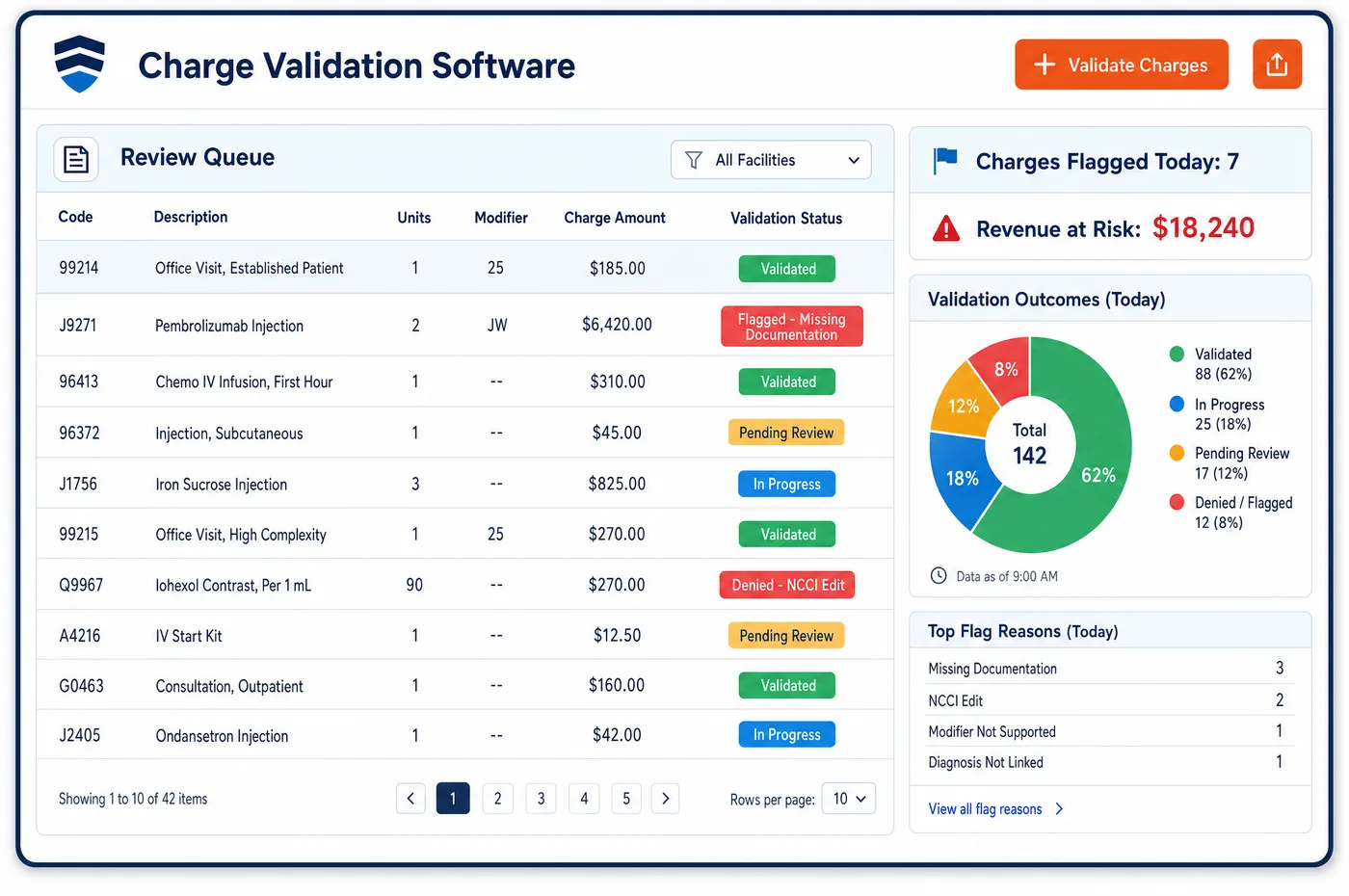
Charge Validation in a Allergy & Immunology Practice
Validation runs after charges are built and before the claim is sent. Allergy & immunology charge validation software first checks code pairs. Testing and immunotherapy on one date are held unless new allergens were tested. Test lines on the same date as rapid desensitization are flagged, and a patch test billed with a photo test is sent back for the photo patch code. Next, units are checked against the MUE for each code and against the payer's limits, such as a Medicare contractor's maximum test counts. Extract lines are checked against the payer's dose rule. Drug lines are checked for an approval on file, a covered diagnosis, the NDC and the right waste modifier. Visit lines with a shot or biologic must carry modifier 25 and a note that supports a separate service. Lines that fail are held with the reason, so a coder can fix them before the payer sees them.
Why Is Charge Validation Different in Allergy & Immunology?
Allergy claims carry many edits that are easy to miss. NCCI pairs testing with immunotherapy, sets rules for photo patch tests and folds testing into rapid desensitization. MUEs cap units per day. Each Medicare contractor's LCD lists which diagnoses support which tests and drugs. A single missed edit can deny a line, and the same miss tends to repeat across many visits.
Modifiers are where allergy claims are most often challenged. A visit billed with a shot needs modifier 25 and a note that shows separate work. Drug lines from single-dose containers need JW or JZ for Medicare. One contractor wants EJ on maintenance shots. Getting these right depends on both the payer and what the record shows.
Payer rules also differ on the basics. Medicare counts extract doses by the cc, rejects the complete-service shot codes, and changes 95144 to 95165 when the same practice gives the shot. Many other payers follow CPT. Charge validation in allergy has to apply the right rule set to each claim, using the lines built by allergy charge assembly, before the claim reaches the payer.
What Allergy & Immunology Charge Validation Software Handles
- Testing and shots on one date (NCCI)
- NCCI says allergy testing and immunotherapy are generally not reported on the same date unless new allergens are tested. Potency checks of a vial before a shot are part of the shot and can't be billed as tests. Same-day test and shot lines are held for a coder's review. (CMS NCCI Policy Manual for Medicare Services, Chapter XI, Section K: Allergy Testing and Immunotherapy (2026))
- Photo patch tests (95052)
- NCCI bars billing patch tests (95044) plus photo tests (95056) in place of the photo patch code, 95052. The edit flags that pair on one claim so it can be recoded. (CMS NCCI Policy Manual for Medicare Services, Chapter XI, Section K: Allergy Testing and Immunotherapy (2026))
- Rapid desensitization (95180)
- Allergy testing is part of a rapid desensitization procedure billed with 95180 and is not billed on its own. Test lines on the same date as 95180 are flagged. (CMS NCCI Policy Manual for Medicare Services, Chapter XI, Section K: Allergy Testing and Immunotherapy (2026))
- Medically unlikely edits
- CMS sets MUEs, the most units of a code normally billed for one patient on one date. Test, extract and drug units are checked against the current MUE before a Medicare claim goes out. (CMS: Medicare NCCI Medically Unlikely Edits (MUEs))
- Diagnosis list for omalizumab
- The Medicare billing article for omalizumab lists the diagnosis codes that support it, including moderate and severe persistent asthma, nasal polyps and certain urticaria codes. Omalizumab lines are checked against that list for patients in the article's states. (CMS Medicare Coverage Database, Billing and Coding Article A52448: Omalizumab)
- Maintenance modifier EJ (CGS)
- CGS requires the EJ modifier on maintenance immunotherapy claims in Kentucky and Ohio. For that contractor, shot claims are checked for EJ once the patient's course reaches maintenance. (CMS Medicare Coverage Database, Billing and Coding Article A59981: Allergen Immunotherapy (AIT) with Subcutaneous Immunotherapy (SCIT) (CGS))
- Testing limits (Palmetto)
- Palmetto's LCD treats more than 70 prick and 40 intradermal tests for an inhalant workup as not reasonable and necessary. Medicare test lines above those counts are held for review. (CMS Medicare Coverage Database, LCD L40328: Allergy Diagnostic Testing (Palmetto GBA, effective 2026-09-27))
How Does Allergy & Immunology Charge Validation Software Work?
1. Check code pairs
NCCI pairs are checked first, such as testing with immunotherapy, testing with 95180, and patch tests with photo tests. Pairs that need a reason are held for a coder.
2. Check units
Units are compared with the MUE for each code and with any payer or LCD limit. Lines over a limit are held with the limit shown.
3. Check diagnoses and approvals
Biologic lines are matched to the payer's diagnosis list and to the approval on file. A dose past the approved count is held for allergy financial clearance to update.
4. Check modifiers
Modifier 25 on visits, JW or JZ on Medicare drug lines and EJ for the contractor that needs it are each checked against the record. Missing or unsupported modifiers stop the line.
5. Release clean lines
Lines that pass go to the claim, and held lines go to a work queue with the reason. Fix patterns feed back to the template or rule that caused them, with results tracked in allergy denial management.
Allergy & Immunology Charge Validation Software vs. Generic Software
| Area | Generic approach | Unlimited Systems |
|---|---|---|
| NCCI pairs | Checked after a denial. | Checked on every claim before release. |
| Units | No check until the payer cuts the line. | Checked against MUEs and LCD limits. |
| Biologic lines | Sent without a diagnosis or approval check. | Matched to the diagnosis list and approval. |
| Modifiers | Added from habit. | Checked against the record and payer rule. |
| Payer rules | One rule set for all payers. | Medicare and commercial rules applied by payer. |
Who Uses It in a Allergy & Immunology Practice
- Coder: A short queue of held lines, each with the edit and the reason, instead of reviewing every claim by hand.
- Compliance lead: Proof that NCCI, MUE and LCD checks run on every claim, and that modifier 25 is used only when the note supports it.
- Physician owner: Fewer denials and fewer audit findings on shots, testing and biologics.
Allergy & Immunology Charge Validation Software FAQs
Charge validation on allergy claims checks NCCI code pairs, MUE unit limits, payer and LCD limits, diagnosis lists for biologics and the modifiers each line needs. It also applies payer dose rules to extract lines. Lines that fail are held with the reason, so a coder fixes them before the claim reaches the payer.
Allergy testing and immunotherapy are generally not billed on the same date, according to NCCI, unless the physician tests for new allergens that day. Testing a vial's potency before a shot is part of the shot and is not billed as a test. Same-day pairs are held so the coder can confirm the reason.
Medicare pays a visit on the same day as a shot only with modifier 25 and a significant, separate service in the note. A visit line without the modifier, or with a note that shows only the routine pre-shot check, is flagged. That protects the practice from denials and from audit findings on modifier 25.
Biologic lines are checked for an approval on file, a diagnosis on the payer's list, the NDC, units within limits and the right waste modifier. For Medicare, a line from a single-dose container needs JW for waste or JZ for none. A line missing any of these is held before it can deny.
CGS, the Medicare contractor for Kentucky and Ohio, requires the EJ modifier on maintenance immunotherapy claims. The rule is set for that contractor only. Once the record shows a patient has reached maintenance, shot lines billed to CGS are checked for EJ, and lines without it are held.
Each test, extract and drug line is compared with the current Medicare MUE for its code before the claim goes out. Lines over the limit are held with the limit shown. The coder can then correct the count, or confirm that the record supports it, before the claim is released.
Related Allergy & Immunology Software
Billing & claims
In the revenue cycle
Charge Validation for related specialties
Sources
- CMS NCCI Policy Manual for Medicare Services, Chapter XI, Section K: Allergy Testing and Immunotherapy (2026)
- CMS: Medicare NCCI Medically Unlikely Edits (MUEs)
- CMS Medicare Coverage Database, Billing and Coding Article A52448: Omalizumab
- CMS Medicare Coverage Database, Billing and Coding Article A59981: Allergen Immunotherapy (AIT) with Subcutaneous Immunotherapy (SCIT) (CGS)
- CMS Medicare Coverage Database, LCD L40328: Allergy Diagnostic Testing (Palmetto GBA, effective 2026-09-27)
- Medicare Claims Processing Manual, Chapter 12, Section 200: Allergy Testing and Immunotherapy
GET STARTED
See Unlimited Systems in Action
Whether you're actively evaluating new technology or simply preparing for your next vendor renewal, Unlimited Systems can help you understand where your current workflows may be creating avoidable revenue risk.