

Billing & claims
Allergy & Immunology RCM Software
Run the allergy revenue cycle end to end, from testing units and extract doses to biologic drug claims, denials and frequent shot copays.
Allergy & Immunology RCM Software runs the revenue cycle for an allergy practice, from booking to the last patient payment. It ties together testing units, extract doses, shot claims, biologic drug lines, remittances, denials and patient balances on one platform. Its reports show which service line is slowing cash and why.



 6,500+ specialty providers

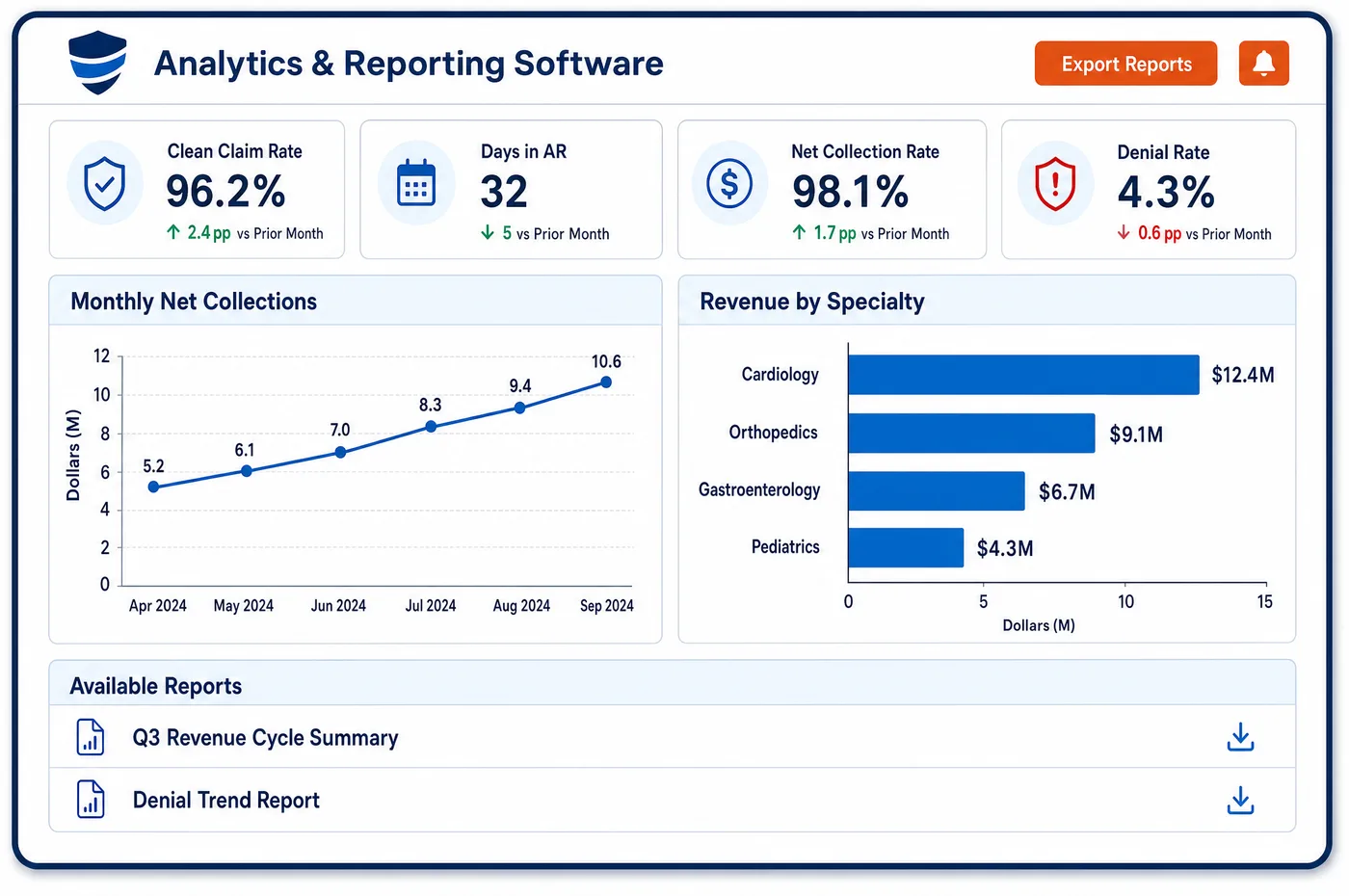
RCM in a Allergy & Immunology Practice
An allergy revenue cycle starts before the patient arrives. Registration and clearance confirm the right plan, the testing benefit and any biologic approval. At the visit, the record captures the tests done, the vials made, the shots given and any drug given. Charges are built from that record and checked against payer rules, such as the Medicare dose rule for 95165 and NCCI edits on same-day E/M visits. Claims go out, remittances post, and denials are sorted by cause and service line. Patient balances from frequent shot copays are collected by text, card on file or statement. Allergy & immunology RCM software keeps every step on one record, so a denial can be traced back to its source. A testing denial for too many units points back to the plan of care. A biologic denial for no approval points back to clearance. Leaders see the cycle by service line, payer and provider.
Why Is RCM Different in Allergy & Immunology?
An allergy practice runs three kinds of revenue at once. Testing brings many small lines per visit. Immunotherapy brings a steady stream of low-cost shot and extract claims over a long course. Biologics bring a few high-cost drug claims, where one denial can wipe out the margin on many visits. RCM in allergy has to manage all three without letting one hide problems in another.
Each stream fails in its own way. Testing claims deny for units over a limit or diagnoses that don't match the payer's list. Extract claims deny when doses are counted the wrong way for the payer. Biologic claims deny for missing approvals, the wrong benefit, or a missing NDC or waste modifier. A single denial rate for the whole practice hides which stream is leaking.
Many allergy groups are small, and some weigh keeping billing in-house against sending it out. Either way, someone has to know the Medicare dose rule, the payers that use the CPT dose, and each payer's biologic rules. Allergy & immunology RCM software gives an in-house team the tools for that work and gives owners reports to check it, whoever does the billing.
What Allergy & Immunology RCM Software Handles
- Testing units (95004, 95024, 95027)
- Medicare pays allergy tests per test, so the claim must show the number of tests, such as 25 units of 95004 for 25 prick tests. The RCM view tracks units billed against units paid by payer, so short pays on test lines are found. (Medicare Claims Processing Manual, Chapter 12, Section 200: Allergy Testing and Immunotherapy)
- Antigen preparation doses (95165, Medicare)
- For Medicare, a 95165 dose is a 1 cc aliquot, and no more than 10 doses may be billed per 10 cc vial. The doses billed are the number planned when the vial is made, even if dose changes later stretch or shorten the vial. (Medicare Claims Processing Manual, Chapter 12, Section 200: Allergy Testing and Immunotherapy)
- Commercial dose definitions
- Specialty societies note that most payers other than Medicare use the CPT dose, which the physician sets, rather than a 1 mL dose. Dose rules are stored by payer, so the same vial bills correctly to each plan. (AAAAI, AAOA and ACAAI: Guidance for the Evaluation by Payors of Claims Submitted Using CPT Codes 95165, 95115 and 95117 (2024))
- Biologic waste modifiers (JW, JZ)
- For Medicare Part B drugs from single-dose containers, discarded drug is reported with JW, and a line with no waste carries JZ. Biologic lines are checked for the right modifier, and drug payments are compared with the practice's buy-and-bill cost. (CMS: Discarded Drugs and Biologicals (JW and JZ modifier policy))
- Denials by cause (CARC 119, 151, 197)
- Benefit limits (119), frequency limits (151) and missing approvals (197) are the reason codes behind many allergy denials. The cycle groups them by service line, so testing, shot and biologic problems are fixed where they start. (X12 Claim Adjustment Reason Codes)
- Medicaid NDC rules
- State Medicaid programs require NDCs on claims for many drugs given in the office. The RCM process checks biologic lines for the NDC before they go to a Medicaid plan. (eCFR: 42 CFR 447.520, FFP conditions relating to physician-administered drugs (NDC reporting))
How Does Allergy & Immunology RCM Software Work?
1. Front end: plan and approval
Registration and clearance confirm the plan, testing benefit and biologic approval before the visit. Many allergy denials are prevented here or not at all.
2. Middle: charges from the record
Test counts, vial doses, shots and drug doses are turned into charges and checked against payer rules. Lines with errors wait for a fix before any claim is sent.
3. Claim: send and track
Clean claims are sent electronically, with acknowledgments and status followed. The allergy medical billing workflow handles the claim steps inside the cycle.
4. Back end: post remittances and work denials
Remittances post from the 835, and denials route to queues by cause, value and deadline. Root causes go back to the front end, where allergy denial management fixes them at the source.
5. Patient balances and reports
Shot copays and deductibles are collected by text, card on file or statement. Leaders follow the cycle on dashboards by service line, payer and provider.
Allergy & Immunology RCM Software vs. Generic Software
| Area | Generic approach | Unlimited Systems |
|---|---|---|
| Service lines | One denial rate for the whole practice. | Testing, shots and biologics tracked as separate lines. |
| Extract doses | Billed the same way to every payer. | Dose rules stored by payer. |
| Biologic margin | Checked now and then in a spreadsheet. | Drug payments compared with cost by drug and payer. |
| Denials | Corrected claim by claim. | Grouped by cause and fixed at the step that caused them. |
| Oversight | Owners see a monthly summary. | Owners see live reports on denials, AR and collections. |
Who Uses It in a Allergy & Immunology Practice
- Billing director: One view of the cycle by service line, with work queues sorted by value and deadline, and the payer dose and drug rules in one place.
- Physician owner: Clear measures of practice health, such as clean claim rate, denials by service line and biologic margin by payer.
- Practice administrator: Reports that show which payers or service lines slow cash, and a view of days in AR across testing, shots and biologics.
Allergy & Immunology RCM Software FAQs
Allergy RCM software covers the whole revenue cycle: registration, eligibility and biologic approvals, charges from the record, claim submission, remittance posting, denial work and patient balances. Each step uses the same patient record. A denial at the end can be traced back to the step where it started and fixed there, instead of being corrected one claim at a time.
Useful allergy RCM measures include clean claim rate, denials by service line, units denied on testing and extract claims, biologic approval rate, biologic margin by payer, and days in AR. Shot adherence also matters, since missed shots are lost visits. Trends by payer and provider show where problems start.
Both in-house and outside billing can work. An in-house team keeps direct control and sees problems early. An outside service can fill staff gaps. Either way, someone must know the Medicare dose rule for extract, the payers that use the CPT dose, and each payer's biologic rules. Live reports let owners check the work.
Biologics cost the practice a great deal per dose, and payment varies by payer and contract. A drug that is paid late, short or not at all can erase the margin on many shot and testing visits. Tracking payment against cost by drug and payer shows which contracts or drugs need attention.
Medicare counts a 95165 dose as a 1 cc aliquot and caps billing at 10 doses per 10 cc vial. Specialty societies say most other payers use the CPT dose set by the physician. If the practice bills every payer the same way, some claims are overbilled and others underbilled. Storing the rule by payer avoids both.
Most allergy denials start before the claim. Missing biologic approvals, the wrong benefit, test counts over a limit and diagnoses that don't match the payer's list all trace to steps before billing. Grouping denials by cause and service line shows which step to fix, so the same denial does not keep coming back.
Related Allergy & Immunology Software
Billing & claims
RCM for related specialties
Sources
- Medicare Claims Processing Manual, Chapter 12, Section 200: Allergy Testing and Immunotherapy
- AAAAI, AAOA and ACAAI: Guidance for the Evaluation by Payors of Claims Submitted Using CPT Codes 95165, 95115 and 95117 (2024)
- CMS: Discarded Drugs and Biologicals (JW and JZ modifier policy)
- X12 Claim Adjustment Reason Codes
- eCFR: 42 CFR 447.520, FFP conditions relating to physician-administered drugs (NDC reporting)
GET STARTED
See Unlimited Systems in Action
Whether you're actively evaluating new technology or simply preparing for your next vendor renewal, Unlimited Systems can help you understand where your current workflows may be creating avoidable revenue risk.