

Billing & claims
Allergy & Immunology Charge Assembly Software
Turn test sheets, extract records, shot logs and biologic doses into coded allergy charge lines with the right units every time.
Allergy & Immunology Charge Assembly Software turns what was documented at an allergy visit into coded charge lines. Test counts become 95004, 95024 or 95027 units, new vials become 95165 doses, shots become 95115 or 95117, and biologic doses become J-code units with an NDC and an administration line.



 6,500+ specialty providers

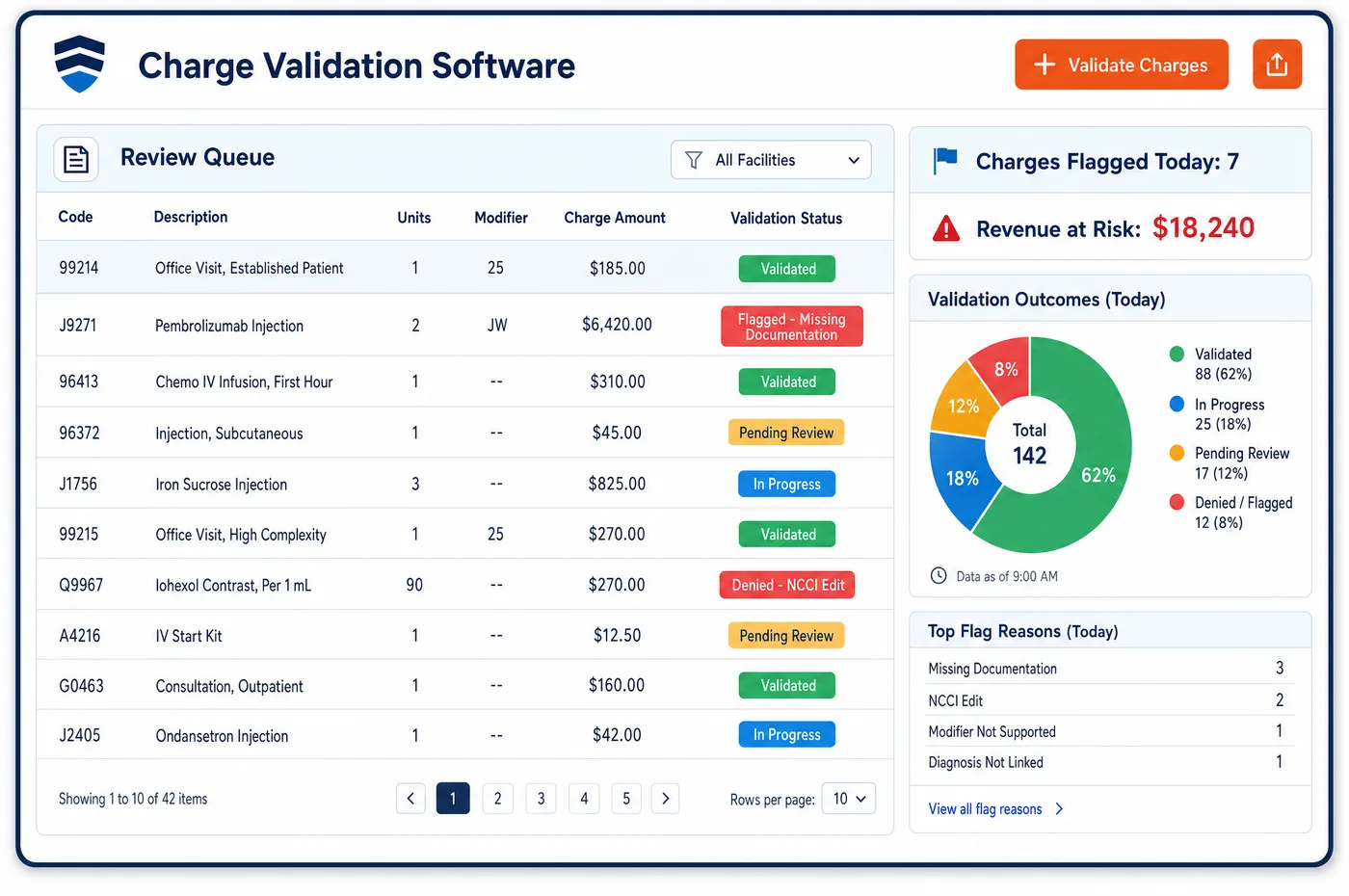
Charge Assembly in a Allergy & Immunology Practice
Each allergy service leaves a record that can be counted. Allergy & immunology charge assembly software reads those records and builds the charge lines. From the test sheet, it counts the allergens placed by method, leaving out the positive and negative controls, and builds prick, intradermal or sequential test lines. From the extract record, it takes each new vial and the doses planned for it, then applies the payer's dose rule. Venom vials are coded at the venom level the patient's therapy uses. From the shot log, it counts injections for the day and picks 95115 or 95117. From the drug record, it turns the dose in milligrams into HCPCS units, adds the NDC and the waste modifier, and adds the administration code. Visits are added only when the physician documents a separate service. The assembled lines then go to validation before they reach a claim.
Why Is Charge Assembly Different in Allergy & Immunology?
Allergy charges come from logs and counts, not just a visit note. The test sheet shows how many prick and intradermal tests were placed. The extract record shows how many vials were made and how many doses each holds. The shot log shows how many injections were given. Charge assembly has to turn each of these counts into the right code and unit.
Small counting rules change the result. Controls are not billed as tests. A single test and a sequential test for the same dilution can't both be billed. Medicare counts extract doses by the cc and bills the doses planned when the vial was made. Venom extracts should bill at the highest venom code the patient's therapy allows. Each rule has to be applied every time.
Biologics add drug math. The dose in milligrams has to become billing units for the J-code, with the NDC and the administration code added. A visit on the same day needs its own documented reason. When the record holds the counts and the dose, charge assembly builds these lines the same way for every patient and passes them to allergy charge validation for the edits.
What Allergy & Immunology Charge Assembly Software Handles
- Test counts without controls
- NCCI says positive and negative controls are not counted in the number of tests. If six allergens are tested with two controls, six units are billed. Test lines are built from the allergens actually placed, with controls left out. (CMS NCCI Policy Manual for Medicare Services, Chapter XI (2026): Section K, Allergy Testing and Immunotherapy, and drug administration)
- Single and sequential tests (95024, 95027)
- NCCI allows a single test and sequential tests on the same day when they use different allergens or different dilutions. A positive single test followed by three more dilutions of that allergen is one unit of the single-test code and three of the sequential code. (CMS NCCI Policy Manual for Medicare Services, Chapter XI (2026): Section K, Allergy Testing and Immunotherapy, and drug administration)
- Planned doses per vial (95165)
- Medicare bills the doses planned at the time the vial is prepared and makes no change if later dose adjustments stretch or shorten it. Each new vial becomes a 95165 line with its planned doses, capped at 10 per 10 cc vial for Medicare. (Medicare Claims Processing Manual, Chapter 12, Section 200: Allergy Testing and Immunotherapy)
- Venom codes (95145 to 95149)
- Medicare wants venom preparation billed at the highest venom code that fits the patient's therapy, such as 95148 for four venoms. When doses fall out of step, a catch-up vial of one venom is billed with 95145 only until the set is back in sync. (Medicare Claims Processing Manual, Chapter 12, Section 200: Allergy Testing and Immunotherapy)
- Injection count (95115, 95117)
- Code 95115 covers a single injection and 95117 covers two or more. The injection count comes from the shot log, so a patient getting shots from three vials in one visit produces one 95117 line. (AAAAI, AAOA and ACAAI: Guidance for the Evaluation by Payors of Claims Submitted Using CPT Codes 95165, 95115 and 95117 (2024))
- Biologic billing units (J2357)
- J2357 is omalizumab per 5 mg, so a 300 mg dose is 60 units. UnitedHealthcare lists a maximum of 600 mg, or 120 units, per dose. The drug line is built from the dose given, with the administration code and the NDC added. (UnitedHealthcare Commercial Medical Benefit Drug Policy 2026D0034AV: Maximum Dosage and Frequency)
- Administration with a visit (96372, 99211)
- NCCI says drug administration codes include the work of 99211, so 99211 is not billed with them. A higher-level visit can be added with modifier 25 when a significant, separate service is documented. (CMS NCCI Policy Manual for Medicare Services, Chapter XI (2026): Section K, Allergy Testing and Immunotherapy, and drug administration)
How Does Allergy & Immunology Charge Assembly Software Work?
1. Read the test sheet
Allergens placed are counted by method, with controls left out. Single and sequential tests for different dilutions become separate lines with their own units.
2. Read the extract record
Each new vial becomes a preparation line with the doses planned for it. The payer's dose rule is applied, such as Medicare's 1 cc dose and per-vial cap.
3. Read the shot log
The day's injections are counted, and one injection line is built: 95115 for one shot or 95117 for two or more. Shots given by staff are tied to the supervising physician from allergy patient scheduling.
4. Read the drug record
The biologic dose becomes HCPCS billing units, with the NDC, the waste modifier and the administration code added. The dose is checked against the approval on file.
5. Add visits and pass to validation
A visit line is added only with a documented separate service and modifier 25. The full set of lines goes to validation and then to allergy medical billing.
Allergy & Immunology Charge Assembly Software vs. Generic Software
| Area | Generic approach | Unlimited Systems |
|---|---|---|
| Test units | Counted by hand from the test sheet, controls included. | Counted from the record by method, controls left out. |
| Extract doses | Doses guessed at billing time. | Doses taken from each vial as planned. |
| Venom vials | Billed one venom at a time. | Billed at the venom level the therapy uses. |
| Drug units | Milligrams converted on a calculator. | Units set from the dose and the J-code. |
| Same-day visits | Added to every shot visit. | Added only with a documented separate service. |
Who Uses It in a Allergy & Immunology Practice
- Allergy nurse: Test sheets and shot logs that feed charges straight to billing, with no separate charge slip to fill out.
- Coder: Charge lines built from the counts, with J-code units, NDCs and modifiers already set for review.
- Billing manager: The same counting rules applied to every visit, so test, extract and drug charges stop drifting between staff.
Allergy & Immunology Charge Assembly Software FAQs
Charge assembly in an allergy practice turns test sheets, extract records, shot logs and drug records into coded charge lines. It counts tests by method without controls, takes the planned doses from each new vial, picks the right injection code, and turns biologic doses into billing units with an NDC and an administration code.
Controls are not billed as tests. NCCI says the number of tests reported can't include positive or negative controls. If a patient is tested with six allergens plus a positive and a negative control, six tests are billed. Charge lines are built from the allergens actually placed.
For Medicare, a 95165 dose is a 1 cc aliquot, and a 10 cc vial bills at most 10 doses. A vial filled to 6 cc bills 6 doses. The number billed is the number planned when the vial was made, and it doesn't change if later dose changes make the vial last a longer or shorter time.
The dose in milligrams is divided by the amount in one unit of the drug's HCPCS code. Omalizumab's J2357 is per 5 mg, so a 300 mg dose is 60 units. The line also gets the NDC, any waste modifier and the administration code, and the dose is checked against the approval.
A visit is added only when the physician documents a significant, separate service, such as a new problem or a change in asthma care. It then carries modifier 25. NCCI treats the work of 99211 as part of drug administration, so a nurse check before a biologic dose is not billed as a visit.
Medicare wants venom preparation billed at the highest venom code the patient's therapy allows, such as 95147 for three venoms. If one venom runs out early because of dose changes, a catch-up vial of that venom is billed with the single-venom code until the set is back in step.
Related Allergy & Immunology Software
Billing & claims
In the revenue cycle
Charge Assembly for related specialties
Sources
- CMS NCCI Policy Manual for Medicare Services, Chapter XI (2026): Section K, Allergy Testing and Immunotherapy, and drug administration
- Medicare Claims Processing Manual, Chapter 12, Section 200: Allergy Testing and Immunotherapy
- AAAAI, AAOA and ACAAI: Guidance for the Evaluation by Payors of Claims Submitted Using CPT Codes 95165, 95115 and 95117 (2024)
- UnitedHealthcare Commercial Medical Benefit Drug Policy 2026D0034AV: Maximum Dosage and Frequency
GET STARTED
See Unlimited Systems in Action
Whether you're actively evaluating new technology or simply preparing for your next vendor renewal, Unlimited Systems can help you understand where your current workflows may be creating avoidable revenue risk.