

Billing & claims
Allergy & Immunology Denial Management Software
Sort, rank and work testing, shot, extract and biologic denials, attach the right proof, and fix repeat causes where they start.
Allergy & Immunology Denial Management Software prevents, sorts and works denials across testing, shots, extract and biologics. It groups denials by reason code, payer and service line, ranks open claims by value and deadline, attaches the records an appeal needs, and feeds root causes back to the step where they started.



 6,500+ specialty providers

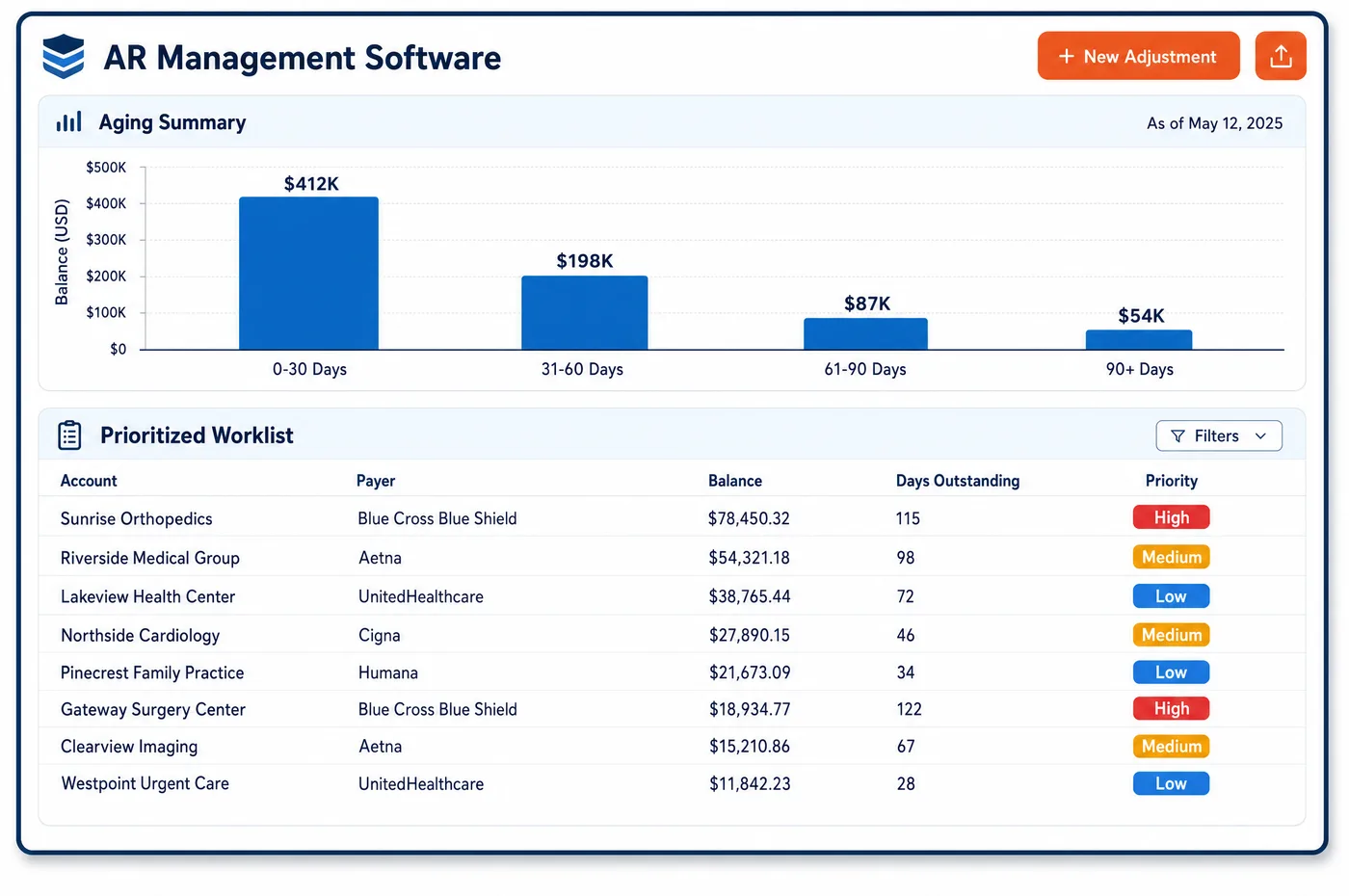
Denial Management in a Allergy & Immunology Practice
Allergy denials are sorted the moment the remittance posts. Each denial's reason code maps to a work queue: approval problems go to the clearance team, unit and dose issues go to coding, and modifier problems go to the billers who own the charge rules. Queues rank claims by value and filing deadline, so a denied biologic claim is worked before a small test line. Allergy & immunology denial management software attaches what each appeal needs from the record, such as the treatment plan and extract order for a 95165 denial, the shot log for an injection denial, or the approval and dose for a drug denial. Denials are also grouped by cause over time. When the same payer denies extract doses for the same reason again and again, the dose rule for that payer is fixed. Before claims go out, past denial patterns are used to flag claims likely to deny.
Why Is Denial Management Different in Allergy & Immunology?
Allergy denials come in two sizes. Testing and shot claims deny in volume for small amounts, often for unit limits, dose counts or a missing modifier. Biologic claims deny less often but for large amounts, usually for approval or benefit problems. Working denials oldest first lets a costly drug claim age while staff clear small ones.
Most allergy denials are preventable, and many repeat. A payer that counts doses differently will deny every vial claim until the rule is changed. A note template that leaves out separate work will cost modifier 25 visits across every shot clinic. Denial management in allergy has to find the root cause and fix it at the source, not just appeal the same denial again.
Appeals also need the right proof. Payers sometimes ask for compounding logs, lot numbers or full dosing schedules for extract and shot claims. Specialty societies have published what payers reasonably need instead. A denial team that can pull the treatment plan, extract order and shot log from one record answers faster and with less paper.
What Allergy & Immunology Denial Management Software Handles
- Benefit and frequency limits (CARC 119, 151)
- Testing and extract claims often deny when a plan's limit is reached (119) or the payer thinks the units are too many (151). Denials are grouped by reason code, payer and service, so a rule can be fixed once for every patient it affects. (X12 Claim Adjustment Reason Codes)
- Missing approvals (CARC 197)
- Biologic claims without an approval on file come back with reason code 197. These are routed to the staff who handle approvals, with the drug, dose and date of service, and the front-end gap is logged. (X12 Claim Adjustment Reason Codes)
- Visit denials on shot days
- Medicare pays a visit on the same day as a shot only with modifier 25 for a significant, separate service. Visit denials on shot days are traced to the note template or the charge rule that let them through. (Medicare Claims Processing Manual, Chapter 12, Section 200: Allergy Testing and Immunotherapy)
- Extract dose documentation (95165)
- Specialty societies say compounding logs and lot numbers are not needed to support 95165 claims. They list the treating physician, indications, the plan and its date, the response, and a signed extract order. Appeals send that set, not every log in the chart. (AAAAI, AAOA and ACAAI: Guidance for the Evaluation by Payors of Claims Submitted Using CPT Codes 95165, 95115 and 95117 (2024))
- Injection documentation (95115, 95117)
- For 95115 and 95117, the same guidance lists the date, patient, dose with volume and dilution, injection site and who gave the shot. Shot log entries carry those details, so an appeal can be built from the log. (AAAAI, AAOA and ACAAI: Guidance for the Evaluation by Payors of Claims Submitted Using CPT Codes 95165, 95115 and 95117 (2024))
- Missing waste modifiers (Medicare)
- Medicare requires JW for discarded drug and JZ when nothing is discarded from a single-dose container. Biologic lines returned for a missing modifier are fixed and resent, and the drug rule is checked so the miss doesn't repeat. (CMS: Discarded Drugs and Biologicals (JW and JZ modifier policy))
How Does Allergy & Immunology Denial Management Software Work?
1. Sort by reason code
Each denial is read from the 835 and routed by reason code. Approval, unit, dose and modifier denials each go to the team that can fix them.
2. Rank by value and deadline
Open denials are sorted by amount and filing or appeal deadline. A biologic denial near its deadline rises above small test lines.
3. Attach the proof
The plan, extract order, shot log or approval is attached from the record. Appeals carry what payers reasonably need, not every page in the chart.
4. Fix the root cause
Denials are grouped by cause, payer and service line. A repeat cause goes back to the rule, template or front-end step that caused it, such as allergy charge validation.
5. Prevent the next one
Before claims go out, past denial patterns flag lines likely to deny. Results are tracked over time in allergy RCM reports.
Allergy & Immunology Denial Management Software vs. Generic Software
| Area | Generic approach | Unlimited Systems |
|---|---|---|
| Work order | Oldest denials first. | Sorted by value and deadline. |
| Routing | One shared inbox. | Queues by reason code and team. |
| Appeal proof | Whole chart copied and faxed. | Plan, order, log or approval attached. |
| Repeat denials | Appealed one by one. | Root cause fixed at the source. |
| Prevention | Learned from the next denial. | Past patterns flag claims before release. |
Who Uses It in a Allergy & Immunology Practice
- Denial specialist: Queues sorted by reason and value, with the proof for each appeal already attached.
- Billing manager: Denial trends by payer and service line, so dose rules, modifier rules and approval steps are fixed where they fail.
- Physician owner: Fewer lost biologic dollars and fewer repeat denials on testing and shots.
Allergy & Immunology Denial Management Software FAQs
Denial management for allergy claims sorts each denial by reason code, routes it to the team that can fix it, and ranks open claims by value and deadline. Appeals get the right records from the chart. Denials are grouped by cause over time, so repeat problems are fixed at the step where they start.
Extract claims often deny because the payer counts doses differently from how they were billed. Medicare counts a 95165 dose as a 1 cc aliquot, capped at 10 per 10 cc vial, while many other payers use the CPT dose. Other causes are plan limits on doses and missing treatment plan details.
For shot claims, specialty societies list the date, the patient, the dose with volume and dilution, the injection site and who gave the shot. For extract claims, they list the treating physician, indications, the plan and its date, response, and a signed extract order. They say lot numbers and compounding logs are not needed.
Biologic denials go near the top of the queue because of their value. A missing approval goes to the clearance team, which may seek a retro approval where the payer allows it. A wrong-benefit denial is checked against the drug benefit. A missing NDC or waste modifier is fixed and resent. Each cause is logged so it can be prevented.
Past denials show which payers, codes and modifiers tend to fail. Those patterns are used to flag claims before release, such as an extract line billed with a dose rule the payer has denied before. The coder fixes the line, so the claim goes out clean the first time.
Allergy practices see many small denials on test and shot lines and a few large ones on biologics. Working oldest first lets a costly drug claim age past its appeal deadline. Sorting by value and deadline puts the biggest and most urgent denials first, while grouped small denials are fixed in batches.
Related Allergy & Immunology Software
Billing & claims
In the revenue cycle
Denial Management for related specialties
Sources
- X12 Claim Adjustment Reason Codes
- Medicare Claims Processing Manual, Chapter 12, Section 200: Allergy Testing and Immunotherapy
- AAAAI, AAOA and ACAAI: Guidance for the Evaluation by Payors of Claims Submitted Using CPT Codes 95165, 95115 and 95117 (2024)
- CMS: Discarded Drugs and Biologicals (JW and JZ modifier policy)
GET STARTED
See Unlimited Systems in Action
Whether you're actively evaluating new technology or simply preparing for your next vendor renewal, Unlimited Systems can help you understand where your current workflows may be creating avoidable revenue risk.