

Billing & claims
Allergy & Immunology Medical Billing Software
Build, scrub and send allergy claims with the right test units, extract doses, NDCs and waste modifiers, then track each one to payment.
Allergy & Immunology Medical Billing Software builds, checks and sends claims for allergy testing, shots, extract preparation and biologic injections. It sets test and dose units, adds NDCs and waste modifiers to drug lines, applies payer rules before submission, and tracks each claim until it is paid or worked as a denial.



 6,500+ specialty providers

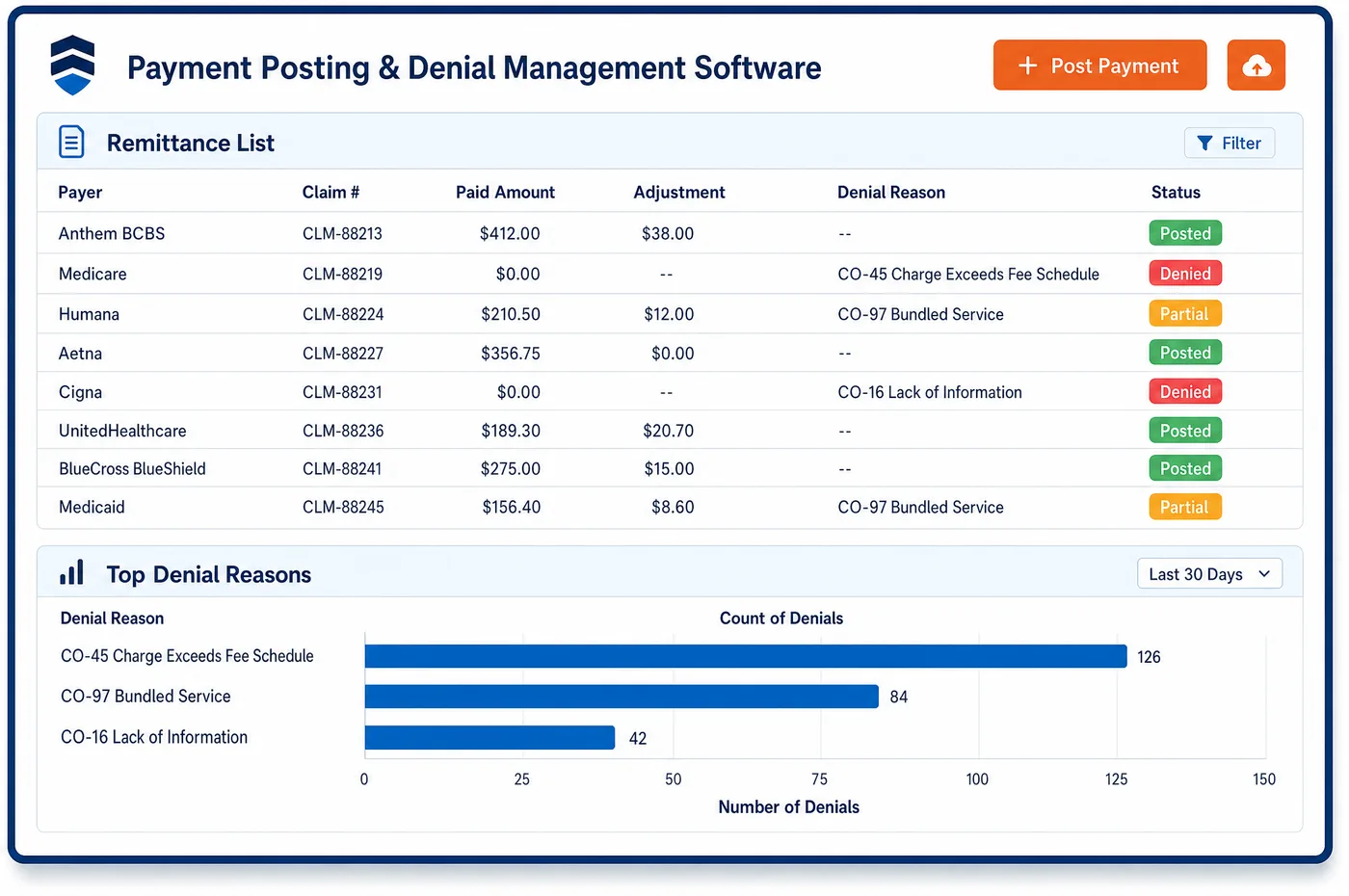
Medical Billing in a Allergy & Immunology Practice
Billing starts with charges built from the record: the number of tests by type, the injection count, the doses in each new vial, any biologic dose and any separate visit. Allergy & immunology medical billing software puts those charges on claim lines with the right units for each payer. Testing lines carry the number of tests. A shot visit carries one injection code plus the preparation code with its doses. Biologic lines carry billing units from the dose, the NDC in the format the payer needs, and JW or JZ for Medicare. The scrubber checks codes, modifiers, units, provider details and coverage rules at checkout. Clean claims go to the clearinghouse as X12 837P files. Acknowledgments and status come back, and rejected lines are fixed the same day. When the primary payer pays, the secondary claim is sent from that remittance, so a parent's second plan is billed on time.
Why Is Medical Billing Different in Allergy & Immunology?
Allergy claims are long and detailed. One testing visit can produce lines for prick tests, intradermal tests and a visit, each with its own unit count. A shot visit may carry an injection line and a preparation line with doses. A biologic visit adds a drug line in billing units, an NDC and a waste modifier. Medical billing has to build each line correctly before anything else matters.
Payers read these claims differently. Medicare rejects the complete-service shot codes and counts extract doses by the cc. Medicaid plans want the NDC on drug lines. Commercial plans may follow the CPT dose and their own unit limits. A billing team that builds every claim the same way will see rejections that differ by payer for no clear reason.
Volume adds pressure. A busy shot clinic produces many small claims each day, and a single setup error repeats on every one. Clean claim building, fast correction of rejections and secondary claims sent from the primary payment keep the work moving. Medical billing is the claim stage of the wider allergy revenue cycle.
What Allergy & Immunology Medical Billing Software Handles
- NDC on the claim line (N4 format)
- When an NDC is required, Medicare's claim form rules place it in the shaded part of the line with the N4 qualifier, the 11-digit NDC and a unit qualifier such as UN or ML. Biologic lines are built in that format for the payers that need it. (Medicare Claims Processing Manual, Chapter 26: Completing and Processing Form CMS-1500 (NDC reporting in item 24))
- Complete-service codes (95120 to 95134)
- Medicare does not accept 95120 through 95134, which bundle the extract and the injection. Medicare claims carry the injection code (95115 or 95117) and the preparation code (95144 to 95170) as separate lines. (Medicare Claims Processing Manual, Chapter 12, Section 200: Allergy Testing and Immunotherapy)
- Single-dose vial code (95144)
- Medicare says 95144 is for extract made for another provider to inject. When the same practice makes and gives the extract, Medicare pays the 95165 rate, so claims use 95165 from the start. (Medicare Claims Processing Manual, Chapter 12, Section 200: Allergy Testing and Immunotherapy)
- Same-day visit with modifier 25
- Under Medicare, a visit on the same day as a shot is paid only with modifier 25 for a significant, separately identifiable service. The claim carries the E/M with modifier 25 only when the note supports it. (Medicare Claims Processing Manual, Chapter 12, Section 200: Allergy Testing and Immunotherapy)
- Claim files and status (837P, 277CA)
- Claims go out as X12 837P files, and the clearinghouse returns acknowledgments and status. A rejected test or drug line is fixed and resent quickly, before it ages. (X12 Transaction Sets: 837 Claims, 277CA Acknowledgment and 835 Remittance)
- Waste lines on partial vials (JW)
- For Medicare, a discarded amount from a single-dose container goes on its own line with JW. When a vial is only partly used, the claim is built with the given line and the JW line together. (CMS: Discarded Drugs and Biologicals (JW and JZ modifier policy))
How Does Allergy & Immunology Medical Billing Software Work?
1. Pull charges from the record
Test counts, injections, vial doses and drug doses come from the record, not from a paper slip. The allergy charge assembly step has already turned them into coded lines.
2. Set units and drug details
Units are set by payer, such as Medicare's 1 cc dose for 95165. Drug lines get billing units, an NDC where needed and the right waste modifier.
3. Scrub before sending
Codes, modifiers, units and coverage rules are checked at checkout. Lines that fail the allergy charge validation edits go to a fix queue with the reason.
4. Send and track
Clean claims go to the clearinghouse electronically. Acknowledgments, rejections and status are tracked, and rejected lines are fixed and resent.
5. Bill the secondary
When the primary remittance posts, the secondary claim is built and sent. Patient balances move to statements once all payers have paid.
Allergy & Immunology Medical Billing Software vs. Generic Software
| Area | Generic approach | Unlimited Systems |
|---|---|---|
| Shot codes | Complete-service codes sent to every payer. | Injection and preparation lines split for Medicare. |
| Drug lines | NDC typed in by hand, when remembered. | NDC, units and waste modifier set from the dose. |
| Units | Same unit rules for every payer. | Units set by payer rule. |
| Rejections | Found at month-end. | Tracked from acknowledgments and fixed the same day. |
| Secondary claims | Filed by hand, often late. | Sent from the primary remittance. |
Who Uses It in a Allergy & Immunology Practice
- Biller: Claims built with the right units and drug details for each payer, and a fix queue for lines that fail the scrubber.
- Billing manager: Rejection and status tracking for every claim, and secondary claims that go out without manual work.
- Physician owner: Shot, testing and biologic revenue that reaches the payer clean, with fewer claims held for rework.
Allergy & Immunology Medical Billing Software FAQs
Medical billing for allergy practices deals with long claims and payer-specific units. A testing visit may carry many test units. A shot visit splits the injection from the extract preparation. A biologic visit adds a drug line with billing units, an NDC and a waste modifier. Each payer reads these lines a bit differently.
Medicare does not accept 95120 through 95134, the codes that bundle the extract with the injection. For Medicare, the practice bills the injection code, 95115 or 95117, and the preparation code, such as 95165, as separate lines. Some other payers accept the complete-service codes, so the rule is set by payer.
When an NDC is needed, it goes on the drug line with the N4 qualifier, the 11-digit NDC and a unit qualifier such as UN or ML. State Medicaid programs require NDCs on many office-given drug claims, and many commercial plans ask for them too. The NDC comes from the dose recorded at the visit.
A visit on the same day as an allergy shot is billed only when it is a significant, separately identifiable service, and Medicare requires modifier 25 on that visit. A routine check before the shot is part of the shot service. The note has to show the extra work, such as a new problem or a change in asthma care.
Acknowledgments and rejections come back from the clearinghouse and land in a work queue the same day. Each rejected line shows the reason, such as a bad unit count or a missing NDC. Billers fix and resend it right away, so rejections don't sit until month-end and run into filing limits.
Children are often covered by both parents' plans. When the primary payer's remittance posts, the secondary claim is built from it and sent electronically. That keeps a family's second plan billed on time, and only the true remaining balance goes to the parent's statement.
Related Allergy & Immunology Software
Billing & claims
In the revenue cycle
Medical Billing for related specialties
Sources
- Medicare Claims Processing Manual, Chapter 26: Completing and Processing Form CMS-1500 (NDC reporting in item 24)
- Medicare Claims Processing Manual, Chapter 12, Section 200: Allergy Testing and Immunotherapy
- X12 Transaction Sets: 837 Claims, 277CA Acknowledgment and 835 Remittance
- CMS: Discarded Drugs and Biologicals (JW and JZ modifier policy)
- eCFR: 42 CFR 447.520, FFP conditions relating to physician-administered drugs (NDC reporting)
GET STARTED
See Unlimited Systems in Action
Whether you're actively evaluating new technology or simply preparing for your next vendor renewal, Unlimited Systems can help you understand where your current workflows may be creating avoidable revenue risk.