

Front office
Allergy & Immunology Financial Clearance Software
Check testing and shot benefits, get biologic approvals on the right benefit, and give patients a cost estimate before the first shot.
Allergy & Immunology Financial Clearance Software confirms coverage and cost before testing, shots or biologics start. It checks the plan, sends and tracks biologic approvals on the medical or drug benefit, looks for copay help, and gives the patient an estimate. The first bill should not be the first time a patient hears the cost.



 6,500+ specialty providers

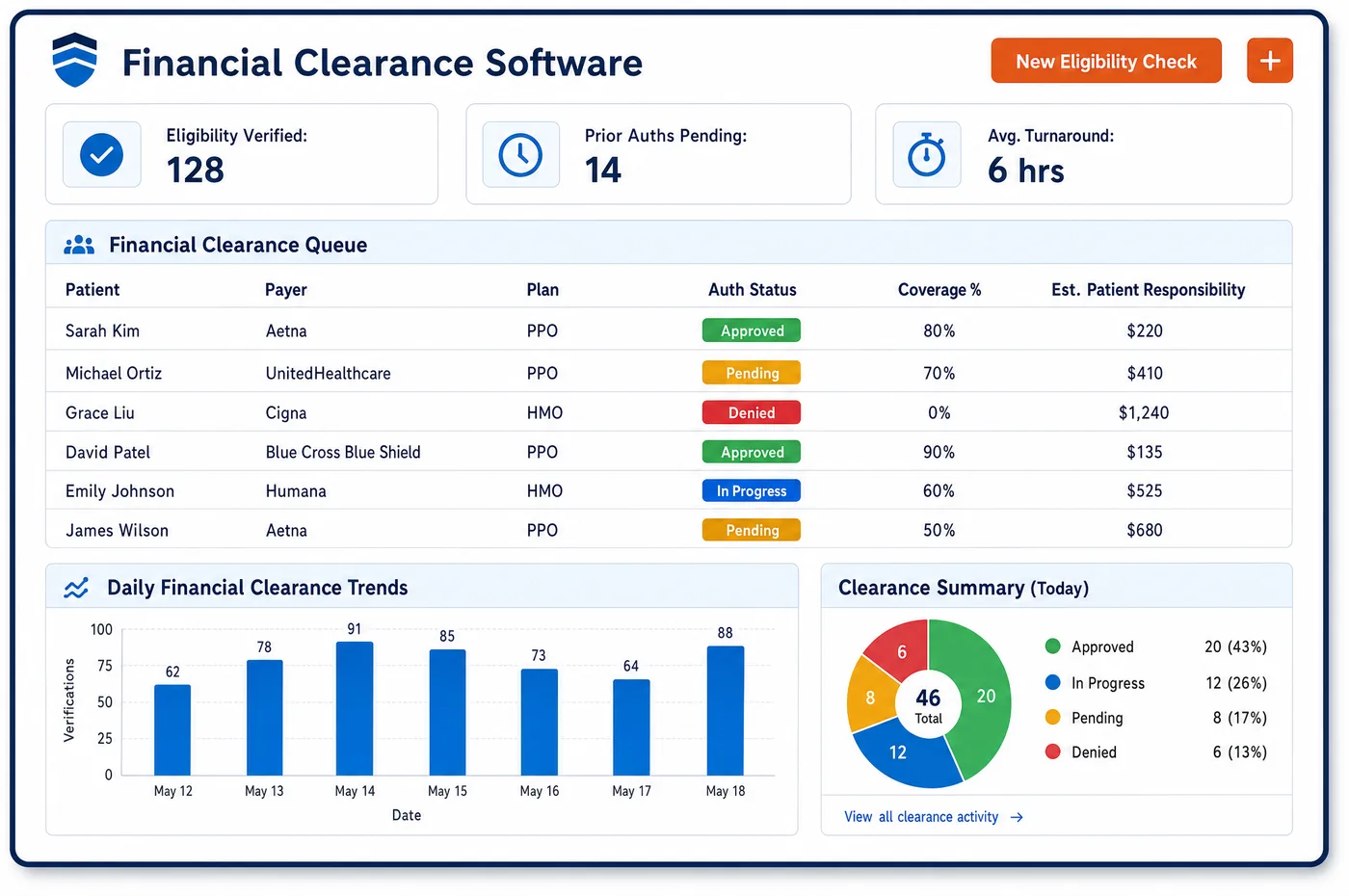
Financial Clearance in a Allergy & Immunology Practice
Clearance in allergy covers three kinds of care, each with its own rules. Skin and blood tests are checked against the plan's allergy testing benefit, which some payers return as its own line in the 271 reply. Shots are checked for the copay per visit, since a patient in build-up may come in each week. Biologics take the most work. Staff first decide if the drug is given in the office, under the medical benefit, or at home, under the drug benefit. Then they send the prior auth with the facts the payer asks for, such as blood eosinophil counts, asthma control and current inhalers. Allergy & immunology financial clearance software tracks each request and its dates. It holds the shot visit until the approval is on file and checks insured patients for maker copay programs. Last, the patient gets an estimate for the test, the shot or the drug.
Why Is Financial Clearance Different in Allergy & Immunology?
Allergy services look small one at a time, but they add up. A testing visit can carry dozens of test units. A shot patient may owe a copay at each visit for a long stretch. Patients who don't hear about these costs early tend to stop, and allergy shots only work when the course is finished.
Biologics are where the money is at risk. Drugs such as omalizumab, mepolizumab, benralizumab and tezepelumab cost a great deal per dose. Payers want prior auth with clinical proof, and many send self-injected doses to the drug benefit. A dose given in the office without approval on the right benefit is often a loss the practice can't get back.
Medicare adds its own limits. Some Medicare contractors cap test counts. One contractor's shot policy says allergy drops under the tongue are not reasonable and necessary. An Advance Beneficiary Notice may be needed before a service like that. Financial clearance in allergy has to know each payer's rules before the visit, not after the denial.
What Allergy & Immunology Financial Clearance Software Handles
- Testing service type (STC 79)
- X12 lists service type code 79 for allergy testing. When a payer answers that code in its 271 reply, staff see the testing benefit itself. The 270 check goes out when the visit is booked. (X12 Service Type Codes (used in 270/271 eligibility transactions))
- Biologic approval criteria
- UnitedHealthcare's commercial policy for Nucala and Fasenra asks for severe asthma and a blood eosinophil count of at least 150 cells per microliter. The drug must be used with inhaled controller medicine, and a lung or allergy specialist must prescribe it. Where the payer takes it, the request goes out as an X12 278. (UnitedHealthcare Commercial Medical Benefit Drug Policy 2026D0055AA: Respiratory Interleukin-5 Inhibitor)
- Site of care review
- UnitedHealthcare's site-of-care policy reviews doses of drugs such as Xolair, Nucala, Fasenra and Tezspire given in a hospital outpatient clinic. For a hospital-based allergy clinic, the setting is cleared along with the drug. (UnitedHealthcare Commercial Medical Benefit Drug Policy 2026D0121V: Provider Administered Drugs, Site of Care)
- Self-given doses (Medicare)
- Medicare Part B does not cover omalizumab when patients give it to themselves. Clearance confirms that a Medicare patient's doses will be given in the office before the drug is billed to Part B. (CMS Medicare Coverage Database, Billing and Coding Article A52448: Omalizumab)
- Test count limits (Medicare)
- Palmetto's allergy testing LCD says more than 70 skin prick tests and 40 intradermal tests for an inhalant workup are not reasonable and necessary. For Medicare patients in its states, the planned count is checked against that limit first. (CMS Medicare Coverage Database, LCD L40328: Allergy Diagnostic Testing (Palmetto GBA, effective 2026-09-27))
- Allergy drops (Medicare)
- CGS's shot policy lists sublingual immunotherapy as not reasonable and necessary. When a Medicare patient in its states wants allergy drops, staff explain the cost and give an ABN before the service. (CMS Medicare Coverage Database, LCD L40056: Allergen Immunotherapy (AIT) with Subcutaneous Immunotherapy (SCIT) (CGS))
- Maker copay programs
- Insured patients starting a biologic are checked for the maker's copay program before the first dose. OIG has warned that maker copay coupons raise kickback concerns when federal programs pay for the drug. So Medicare patients are pointed to other help, such as charity funds. (HHS-OIG Special Advisory Bulletin: Pharmaceutical Manufacturer Copayment Coupons (2014))
How Does Allergy & Immunology Financial Clearance Software Work?
1. Check coverage at booking
A 270 check runs when the visit is booked. The 271 reply shows copays, deductibles and the testing benefit where the payer returns it, so plan changes are caught early.
2. Sort the drug benefit
For each biologic, staff note whether it is given in the office under the medical benefit or at home under the drug benefit. That choice decides where the request goes.
3. Send and track the request
The request goes out with eosinophil counts, control scores and inhaler history from the record. Approval numbers, dates and dose counts are saved, and allergy patient scheduling holds the shot visit until approval is on file.
4. Look for financial help
Insured patients are checked for maker copay programs, and others for charity help. Credits are noted, so the patient's balance is right from the start.
5. Give the estimate
The patient gets an estimate for the test, the shot copay or the drug before the service. Uninsured patients get a good faith estimate, and later balances go out through allergy invoicing.
Allergy & Immunology Financial Clearance Software vs. Generic Software
| Area | Generic approach | Unlimited Systems |
|---|---|---|
| Testing benefits | General office benefit assumed for testing. | Testing benefit checked when the payer returns it. |
| Biologic benefit | Requests sent to the medical plan by default. | Medical or drug benefit chosen per drug and route. |
| Approvals | Tracked on sticky notes and payer portals. | Approval number, dates and doses saved on the record. |
| Shot visits | Booked before approval arrives. | Held until approval is on file. |
| Patient cost | Patients learn the cost from the first statement. | Estimates and copay help reviewed before the first dose. |
Who Uses It in a Allergy & Immunology Practice
- Financial counselor: One queue of open biologic requests with the clinical facts attached, and copay program checks in the same place.
- Front desk: Copays and testing benefits ready at booking, so shot patients know what each visit costs.
- Practice owner: Fewer write-offs on costly drugs, since biologics are given only with approval on the right benefit, and fewer approval denials to work later.
Allergy & Immunology Financial Clearance Software FAQs
Financial clearance before allergy testing checks the plan, copays, deductibles and the testing benefit itself where the payer returns it. For Medicare patients, the planned number of tests is compared with the contractor's limits. The patient then gets an estimate, so a visit with many test units doesn't end in a surprise bill.
Staff first decide if the biologic is given in the office under the medical benefit or at home under the drug benefit. The request then goes to the right place with the facts the payer lists, such as eosinophil counts, asthma control and current inhalers. Approval numbers and dates are saved, and the shot visit is held until approval is on file.
Maker copay coupons raise kickback concerns when a federal program such as Medicare pays for the drug, according to OIG. Most programs leave those patients out. Patients with commercial plans are checked for the maker's program. Medicare patients can be pointed to other help, such as charity funds that are not tied to one drug maker.
Some commercial payers review where a biologic is given. UnitedHealthcare's site-of-care policy, for example, reviews doses of Xolair and Nucala given in a hospital outpatient clinic. A hospital-based allergy clinic may need to clear the setting as well as the drug. An office setting may avoid that review.
An Advance Beneficiary Notice is given to an Original Medicare patient before a service Medicare is expected to deny. In allergy, that can include allergy drops, which one Medicare contractor's LCD says are not reasonable and necessary, or testing past the contractor's limits. The signed form lets the patient choose, and lets the practice bill the patient if Medicare denies.
Shot patients get an estimate of what each visit will cost and how the copay or deductible applies. A patient in build-up may come in each week, so the total adds up fast. A clear estimate before the first shot helps patients plan, and it makes them less likely to drop out.
Related Allergy & Immunology Software
Front office
In the revenue cycle
Financial Clearance for related specialties
Sources
- X12 Service Type Codes (used in 270/271 eligibility transactions)
- UnitedHealthcare Commercial Medical Benefit Drug Policy 2026D0055AA: Respiratory Interleukin-5 Inhibitor
- UnitedHealthcare Commercial Medical Benefit Drug Policy 2026D0121V: Provider Administered Drugs, Site of Care
- CMS Medicare Coverage Database, Billing and Coding Article A52448: Omalizumab
- CMS Medicare Coverage Database, LCD L40328: Allergy Diagnostic Testing (Palmetto GBA, effective 2026-09-27)
- CMS Medicare Coverage Database, LCD L40056: Allergen Immunotherapy (AIT) with Subcutaneous Immunotherapy (SCIT) (CGS)
- HHS-OIG Special Advisory Bulletin: Pharmaceutical Manufacturer Copayment Coupons (2014)
- CMS: Advance Beneficiary Notice of Non-coverage (ABN), Form CMS-R-131
GET STARTED
See Unlimited Systems in Action
Whether you're actively evaluating new technology or simply preparing for your next vendor renewal, Unlimited Systems can help you understand where your current workflows may be creating avoidable revenue risk.