

Platform & AI
Oncology Platform System Design
The cloud platform under oncology billing and operations: one data model from regimen to ledger, every site on one system, HIPAA safeguards and high availability.
Oncology Platform System Design is the cloud architecture under a medical oncology practice's billing and operations. It keeps one data model from regimen order to dose, claim line, remittance and ledger entry, runs every site from the same platform, and protects patient data with encryption, access controls, audit trails and redundant backups.



 6,500+ specialty providers

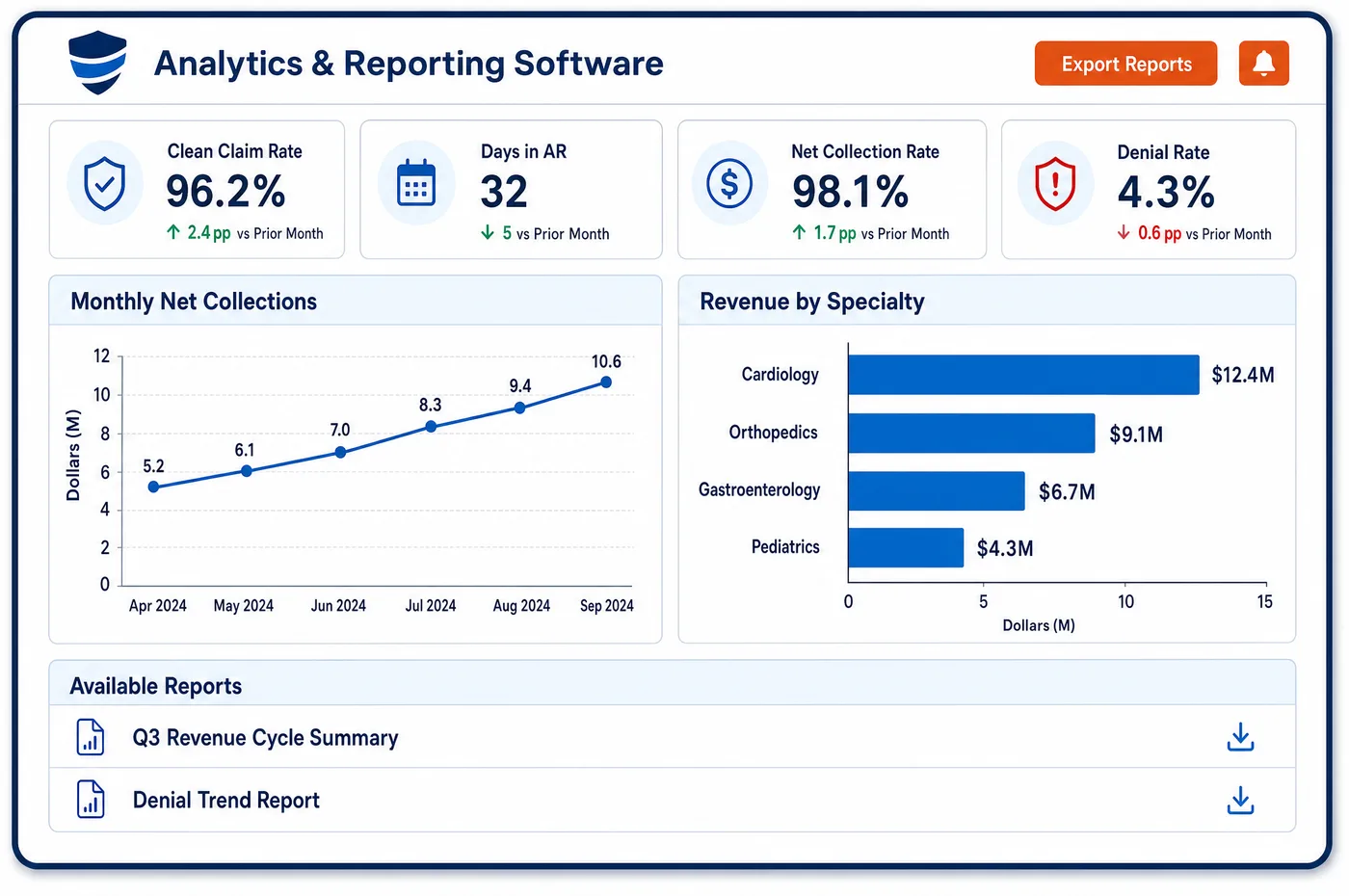
Platform System Design in a Oncology Practice
Medical oncology data is deep and linked. One treatment day ties a regimen order to compounded doses, given and discarded amounts, infusion times, drug and administration claim lines, payer remittances and journal entries. The platform system design keeps those links in one model, so a drug line can be traced from purchase to payment. The practice loads its quarterly fee schedules, and staff check the ASP limit in force on the date of service. Each site has its own chairs, stock and cost center, with 340B sites reported apart, while reports roll up across every location. The platform runs on HIPAA-compliant, high-availability cloud hosting with redundant, real-time offsite backups. Data is encrypted with AES-256 in transit and at rest. Staff work in a web browser, with access by role and an audit trail on records. New sites, users and links scale without new servers in the clinic.
Why Is Platform System Design Different in Oncology?
Oncology puts more weight on the data model than most specialties. A visit is not one charge but a chain: order, dose, waste, administration codes, claim lines, payments and cost. If those pieces live in separate systems joined by exports, the chain breaks, and nobody can say for sure whether a vial was billed or a payment covered its cost. Design decides whether that question has a quick answer.
Growth adds sites. Many oncology groups run several clinics, each with its own infusion chairs, drug stock and staff, and some have sites tied to a hospital's 340B program. The platform has to keep each site's stock, cost and rules apart while giving owners one view. Adding a site should mean setting it up, not standing up another server or copying a database.
The stakes for uptime and security are high. Treatment days run on tight schedules, and an outage can hold up approvals, check-ins and charge capture at every chair. Cancer records are also sensitive, and the HIPAA Security Rule asks for audit controls, a backup plan and protection of data at rest and in transit. Good platform system design treats these as basic needs, not add-ons.
What Oncology Platform System Design Handles
- Audit controls (45 CFR 164.312(b))
- The HIPAA Security Rule requires audit controls that record and examine activity in systems holding electronic PHI. The platform keeps an audit trail on records and financial entries, so a change to a dose, charge or payment can be traced to a user and time. (eCFR: 45 CFR Part 164, Subpart C, Security Standards for the Protection of Electronic Protected Health Information)
- Contingency and data backup (45 CFR 164.308(a)(7))
- The Security Rule requires a contingency plan, including a data backup plan. Data is copied to redundant, real-time offsite backup clusters, so a local failure does not mean lost treatment or billing records. (eCFR: 45 CFR Part 164, Subpart C, Security Standards for the Protection of Electronic Protected Health Information)
- Encryption at rest and in transit (45 CFR 164.312)
- Encryption of electronic PHI is an addressable specification under the Security Rule, both for stored data and for data in transit. The platform encrypts data with AES-256 in transit and at rest. (eCFR: 45 CFR Part 164, Subpart C, Security Standards for the Protection of Electronic Protected Health Information)
- Quarterly rate limits and dates of service
- CMS sets Part B drug payment limits each quarter from ASP data. The practice keeps the quarterly fee schedule in the system, and staff check a claim, a margin report or a reprocessed line against the limit in force on its date of service. (CMS: Medicare Part B Drug Average Sales Price)
- Site-level 340B status
- Since 2025, 340B covered entities report the TB modifier on Medicare Part B claims for 340B-acquired drugs. Each site has its own cost center, and staff use a report or payer rule the practice sets to apply the right modifier and cost basis to 340B drugs. (CMS MLN4800856: Medicare Part B Inflation Rebate Guidance, Use of the 340B Modifier)
- Given and discarded amounts kept apart
- Medicare Part B wants discarded drug from single-dose containers on its own JW line. The data model stores the given and discarded amounts as separate quantities tied to the same dose, so claims, stock and reports agree. (CMS: Discarded Drugs and Biologicals (JW and JZ modifiers))
How Does Oncology Platform System Design Work?
1. Set up sites and cost centers
Each clinic is set up with its chairs, providers, drug stock and cost center, and 340B sites are reported apart. Owners see each site alone or all sites together.
2. Load the rule tables
Payer rules, fee schedules and quarterly ASP limits are loaded by the practice. Staff check the version in force for each date of service.
3. Connect outside systems
The EHR, clearinghouse, labs and warehouse connect through the oncology interoperability layer. New links are tested in a sandbox before live data moves.
4. Grant access by role
Users get access by role, such as nurse, coder, biller, counselor or owner. Every change to a record is logged with the user and time.
5. Run, back up and scale
The platform runs in high-availability cloud hosting with threat monitoring. Data is backed up offsite in real time, and capacity grows as sites and users are added.
Oncology Platform System Design vs. Generic Software
| Area | Generic approach | Unlimited Systems |
|---|---|---|
| Data model | Clinical, pharmacy and billing data in separate systems. | One model from order to dose, claim line, payment and ledger. |
| Multiple sites | A separate database or server per clinic. | Every site on one platform, with its own stock and cost center. |
| Rate history | Fee tables overwritten each quarter. | Quarterly rate limits kept in the system and checked by date of service. |
| Security | Shared logins and local file shares. | Access by role, audit trails and AES-256 encryption. |
| Backup and uptime | Nightly tape or local backups. | Redundant, real-time offsite backups in high-availability hosting. |
Who Uses It in a Oncology Practice
- IT lead: Cloud hosting, backups, encryption and threat monitoring run by the platform, with browser access and no clinic servers to patch.
- Compliance officer: Audit trails on records and financial entries, and access by role, to support HIPAA Security Rule reviews.
- CFO or owner: One platform across sites, with cost centers by site and provider that tie to oncology accounting and roll up for the whole group.
Oncology Platform System Design FAQs
Platform system design decides whether the links between orders, doses, claims, payments and costs hold together. In medical oncology those links carry most of the practice's revenue and cost. A single data model on a secure cloud platform lets staff trace any drug line from purchase to payment, at any site, without stitching exports together.
Each clinic is set up on the same platform with its own chairs, providers, drug stock and cost center, and 340B sites are reported apart. Owners can see one site or all of them. Adding a site means setting it up in the system, not adding a server or copying a database.
Data is encrypted with AES-256 in transit and at rest, and users get access by role. Every change to a record is logged with the user and time, which supports the audit controls the HIPAA Security Rule requires. Threat monitors watch the hosting setup, and staff reach the system through a web browser.
The platform runs in high-availability cloud hosting with redundant, real-time offsite backup clusters. If one part fails, others take over, and data is not tied to a single machine in the clinic. This supports the contingency and data backup plan that the HIPAA Security Rule asks covered practices to keep.
Part B drug payment limits change every quarter, and payer contracts change on their own dates. The practice keeps each quarter's fee schedule in the system, and staff check a claim, a reprocessed line or a margin report against the rate that applied on the date of service.
Data can be shared and exported through standard APIs, FHIR feeds and warehouse syncs. That matters for reporting, for moving between systems and for federal information blocking rules, which say providers must not interfere with access to or exchange of electronic health information without an exception.
Related Oncology Software
Platform & AI
In the revenue cycle
Platform System Design for related specialties
Sources
- eCFR: 45 CFR Part 164, Subpart C, Security Standards for the Protection of Electronic Protected Health Information
- CMS: Medicare Part B Drug Average Sales Price
- CMS MLN4800856: Medicare Part B Inflation Rebate Guidance, Use of the 340B Modifier
- CMS: Discarded Drugs and Biologicals (JW and JZ modifiers)
- ASTP/ONC HealthIT.gov: Information Blocking
GET STARTED
See Unlimited Systems in Action
Whether you're actively evaluating new technology or simply preparing for your next vendor renewal, Unlimited Systems can help you understand where your current workflows may be creating avoidable revenue risk.