

Billing & claims
Cardiology Charge Validation Software
Check every cardiology charge against NCCI edits, component rules, coverage modifiers and frequency limits before the claim goes out.
Cardiology Charge Validation Software checks each coded heart service against coding edits, modifier rules and payer policy before it reaches the claim. It catches bundled cath lab services, missing component or coverage modifiers, and device checks billed too often. Each problem is shown on the line with the rule that caused it, so staff can fix it fast.



 6,500+ specialty providers

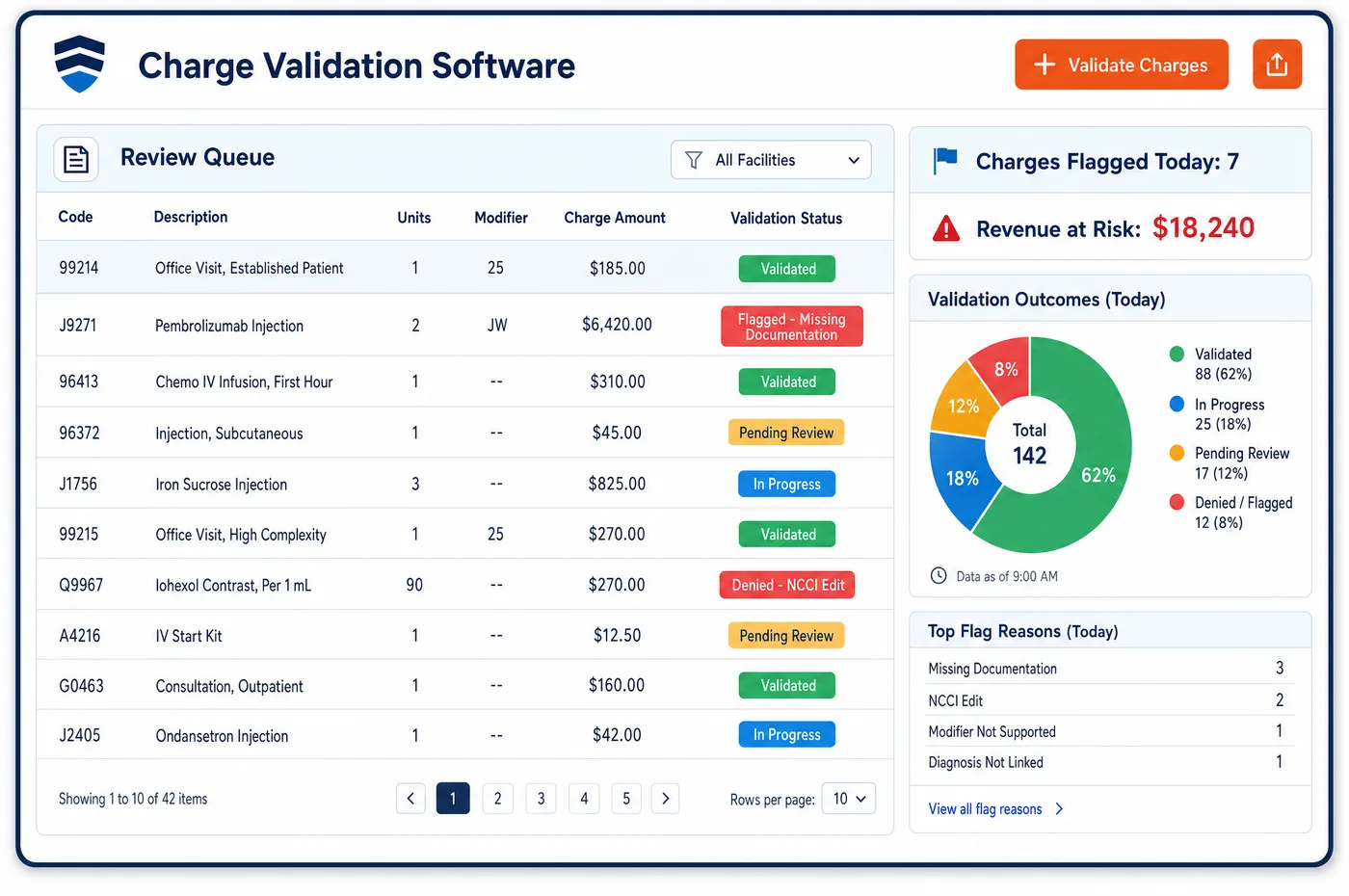
Charge Validation in a Cardiology Practice
Validation in cardiology starts with NCCI. Cath and PCI codes already include vascular access, dye injections, fluoroscopy, ECG strips and ultrasound guidance, so those lines are flagged when they appear beside them. Stress tests include the IV start and the ECG tracings. Cardioversion includes an ICD check done in the same session. A PCI line is checked against the vessel rules, which limit codes per major artery and branch. Next come modifiers. The component modifier must match the site, a separate visit on test day needs modifier 25, and a diagnostic ECG before or after a cath needs 59 or XU. Coverage modifiers come after that, such as KX on a pacemaker insertion. Frequency rules close the loop, since a remote device check can't be billed again until the payer's interval has passed. Cardiology charge validation software runs these checks as charges are entered. Lines that pass go on to the claim, and lines that fail wait in a queue with the reason attached.
Why Is Charge Validation Different in Cardiology?
Cath lab coding has dense bundling rules. Many small services, from the needle stick to the fluoroscopy, are already paid inside the main code. A coder working from a long procedure note can easily add one back. Each added line risks a denial or an overpayment that must be returned later, so the check has to happen before the claim goes out.
Modifiers carry much of the meaning on cardiology claims. A wrong component modifier pays the practice for a technical part it didn't provide. A missing modifier 25 on a test-day visit loses the visit. A missing KX on a pacemaker returns the claim. Charge validation for cardiology has to test the modifier, the site and the coverage rule together, not just the code.
Payer policy adds limits that change over time. Remote device checks have billing intervals, rehab has a session cap, and benefit managers may approve one code but not a related one. Validation needs current rules for each payer and should show the rule that fired, so staff learn the pattern instead of fixing the same error again.
What Cardiology Charge Validation Software Handles
- Ultrasound guidance in the cath lab
- Under NCCI, ultrasound guidance codes such as 76937 and 93318 are not reported for guidance during a cath, PCI or internal cardioversion. Validation flags any guidance line billed with those procedures. (CMS NCCI Policy Manual for Medicare Services, Chapter XI, section I: Cardiovascular Services)
- ECGs around a cath (modifier 59 or XU)
- ECG tracings during a cath or PCI are part of the procedure. A diagnostic ECG done before or after it may be reported with modifier 59 or XU, so validation asks for that modifier and the supporting note. (CMS NCCI Policy Manual for Medicare Services, Chapter XI, section I: Cardiovascular Services)
- Cardioversion and ICD checks
- Cardioversion (92960, 92961) includes ICD interrogation and programming done with it. Validation flags codes such as 93282–93284, 93289 and 93295 billed with a cardioversion. (CMS NCCI Policy Manual for Medicare Services, Chapter XI, section I: Cardiovascular Services)
- Cardiac output with a cath (93598)
- Per CPT instruction, cardiac output measurement 93598 is not reported with cath codes 93451–93461. Validation removes the line or asks the coder to explain it. (CMS NCCI Policy Manual for Medicare Services, Chapter XI, section I: Cardiovascular Services)
- T-wave alternans and stress testing (93025)
- NCCI says stress test codes 93015–93018 are not reported on the same date as microvolt T-wave alternans testing, 93025. Validation flags the pair. (CMS NCCI Policy Manual for Medicare Services, Chapter XI, section I: Cardiovascular Services)
- Remote check intervals (93293–93296)
- Novitas says these codes are reported no more than once every ninety days. Validation compares the date of service with the last billed check before the line can pass. (CMS Medicare Coverage Database, Novitas Billing and Coding Article A56602: Cardiac Rhythm Device Evaluation)
- Component by site
- For hospital patients, the technical part of radiology services is paid to the hospital, not the physician. Validation flags a global or TC line on a nuclear study done for a hospital patient. (CMS Medicare Claims Processing Manual, Chapter 13 (Radiologic Services), section 20: Professional and Technical Components)
How Does Cardiology Charge Validation Software Work?
1. Run NCCI edits as charges post
Each line is checked against NCCI edits as soon as it is entered. Bundled access, imaging and ECG lines are flagged beside cath, PCI and stress codes.
2. Check modifiers against the site
Component, visit and distinct-service modifiers are checked against the site and the note. Missing or wrong modifiers, including XE, XS, XP and XU, are shown on the line.
3. Apply coverage and frequency rules
Device, rehab and structural heart lines are checked for KX, SC, Q0 or Q1 as each payer requires. Remote checks and rehab sessions are counted against their limits.
4. Hold and explain failures
Lines that fail are held with the rule that fired and the fix it needs. Coders can correct the line or document why it stands.
5. Release and learn
Clean lines go to the claim. Patterns in held lines feed cardiology denial management and the charge build in cardiology charge assembly.
Cardiology Charge Validation Software vs. Generic Software
| Area | Generic approach | Unlimited Systems |
|---|---|---|
| Bundling | Edits found on the denial. | NCCI edits run as charges are entered. |
| Modifiers | Checked by eye. | Checked against the site and the note. |
| Coverage rules | KX and SC added from memory. | Coverage modifiers checked per payer. |
| Frequency | Remote checks billed early. | Last billed date checked first. |
| Feedback | Same error fixed again and again. | Patterns sent back to the charge build. |
Who Uses It in a Cardiology Practice
- Coder: Edits shown on the line with the rule and the fix, so corrections are quick and consistent.
- Compliance lead: Bundled cath lab lines stopped before they bill, with a record of each held line and how it was resolved.
- Billing manager: Fewer denials for modifiers and bundling, and a clear view of which rules fire most often.
Cardiology Charge Validation Software FAQs
Charge validation for cardiology checks each line against NCCI edits, modifier rules, coverage requirements and payer frequency limits. It flags bundled cath lab services, wrong component modifiers, missing modifier 25 on test-day visits, missing KX on pacemaker lines, and device checks billed too soon. Each flag shows the rule and the fix.
Cath and PCI codes include vascular access, dye injections, fluoroscopy, ECG strips and ultrasound guidance. Cardiac output measurement is also bundled into cath codes. A PCI includes the coronary cath and dye injections unless a separate diagnostic study was needed first. Validation flags any of these bundled services billed as separate lines.
A history and limited exam tied to the stress test are part of the test. A separate visit can be billed only when the cardiologist provides a significant, separately identifiable service, reported with modifier 25. Validation checks for that modifier and prompts the coder to confirm the note supports a separate service.
PCI lines are checked against NCCI's vessel rules. Only one PCI code is reported for all work in a major coronary artery through the native circulation. Up to two branches of a major artery can be reported, though Medicare doesn't pay separately for branch PCI. Validation compares the lines with the vessels in the cath report.
Validation compares each remote device check with the date of the last billed check. When the payer's interval hasn't passed, the line is held with the date it becomes billable. That keeps the practice from sending claims that will deny for frequency and from having to resend them later.
Charge validation reads the site from the visit. For a hospital patient, a nuclear study billed globally or with TC is flagged, because the hospital is paid for the technical part. For an office study, a professional-only line is flagged in case the practice is leaving the technical part unbilled.
Related Cardiology Software
Billing & claims
In the revenue cycle
Charge Validation for related specialties
Sources
- CMS NCCI Policy Manual for Medicare Services, Chapter XI, section I: Cardiovascular Services
- CMS Medicare Coverage Database, Novitas Billing and Coding Article A56602: Cardiac Rhythm Device Evaluation
- CMS Medicare Claims Processing Manual, Chapter 13 (Radiologic Services), section 20: Professional and Technical Components
GET STARTED
See Unlimited Systems in Action
Whether you're actively evaluating new technology or simply preparing for your next vendor renewal, Unlimited Systems can help you understand where your current workflows may be creating avoidable revenue risk.