

Billing & claims
Cardiology RCM Software
Run the cardiology revenue cycle end to end, from benefit manager approvals and the professional-technical split to device claims, denials and patient balances.
Cardiology RCM Software runs a heart practice's full revenue cycle, from the first referral to the last patient payment. It ties approvals, coverage rules, coding by component, claims, remittances, denials and patient balances into one platform. Its reports show which service lines and payers slow cardiology revenue down, and why.



 6,500+ specialty providers

RCM in a Cardiology Practice
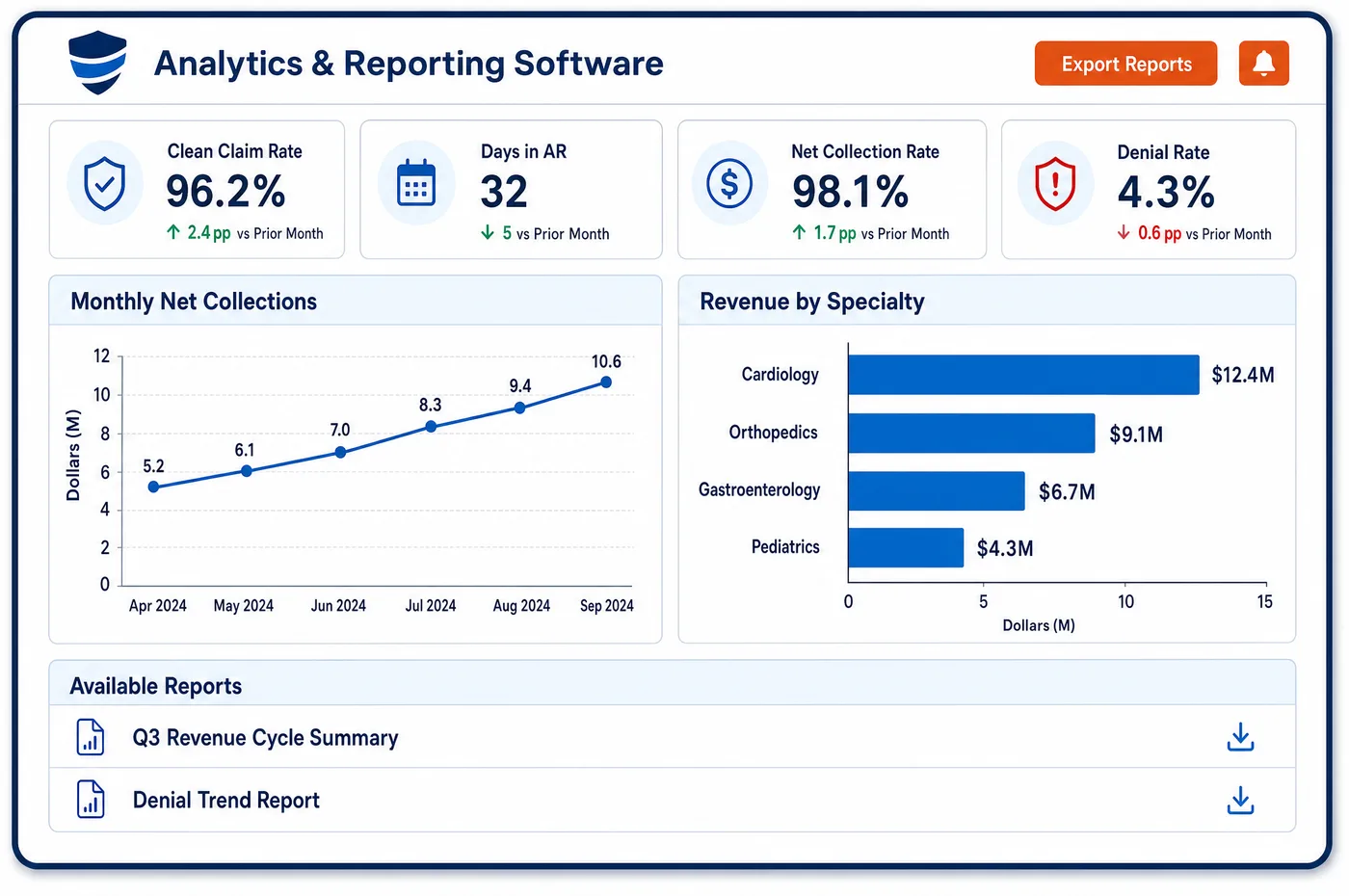
A cardiology revenue cycle has several service lines inside it. Office visits, in-office imaging, hospital reads, cath and EP procedures, device clinic checks and cardiac rehab each follow their own rules. The cycle starts at booking, where the plan and any benefit manager approval are confirmed. It runs through the service, where the site decides whether the practice bills the global service or only the professional part. Then charges are built, checked against NCCI edits and coverage rules, and sent as claims. Remittances post, denials are sorted by cause, and patient balances are collected. Cardiology RCM software keeps those steps on one record, so a problem found at the end traces back to where it started. A denial for a missing approval points to clearance. A bundling denial on a cath points to charge capture. Leaders track the cycle with a short list of measures: approval rates for imaging, collections by component, denial rates by service line, and days in AR.
Why Is RCM Different in Cardiology?
Most cardiology revenue is earned in a few high-value services. A nuclear study, a cath with PCI or a device implant can be worth more than a day of office visits. One missed approval or one wrong modifier on those claims costs far more than an error on a routine visit. RCM in cardiology has to protect those services at every step, from booking to posting.
The professional-technical split adds a second layer. The same echo or nuclear study is billed globally in the office but only as a professional read in the hospital. A practice that reads for a hospital and also runs its own lab handles both kinds of claims every day. Reports that mix them hide where the money comes from, so collections need to be tracked by component.
Cardiology groups also run in many models. Some are independent, some are hospital-employed, and many read studies for hospitals under contract. Some bill in-house while others use an outside service. In each case, someone has to know the benefit managers, the coverage rules for devices and structural heart care, and the NCCI edits for the cath lab. Cardiology RCM software gives that team one place to work and one set of numbers to judge it by.
What Cardiology RCM Software Handles
- Professional and technical components
- For hospital patients, Medicare pays the hospital for the technical part of radiology services, and the physician bills the professional part. The RCM record tags each service by site, so collections can be tracked by component. (CMS Medicare Claims Processing Manual, Chapter 13 (Radiologic Services), section 20: Professional and Technical Components)
- PCI coding by coronary vessel
- NCCI recognizes five major coronary arteries, and only one PCI code may be reported for all PCIs of a major artery through the native circulation. Coding reviews check PCI lines against the cath report before the claim goes out. (CMS NCCI Policy Manual for Medicare Services, Chapter XI, section I: Cardiovascular Services)
- Benefit manager approvals
- Carelon warns that failing to get approval for radiology or cardiology services may result in claim denial. Approval rates and missing-approval denials are tracked by plan as a front-end measure. (Carelon Medical Benefits Management: Radiology and cardiology program FAQ)
- Pacemaker coverage modifiers
- WPS returns pacemaker claims for 33206–33208 as incomplete when they lack KX or SC. Device claims are checked for the right modifier before they leave. (CMS Medicare Coverage Database, WPS Billing and Coding Article A54958: Single Chamber and Dual Chamber Permanent Cardiac Pacemakers)
- Clinical trial and registry claims
- Medicare claims for qualifying trial and coverage-with-evidence services need the 8-digit trial number, diagnosis Z00.6 and modifier Q0 or Q1. Structural heart and trial claims are tracked as their own group. (CMS Medicare Claims Processing Manual, Chapter 32, section 69: Qualifying Clinical Trials)
- Global surgery packages
- Medicare counts a cardiac cath suite as an operating room for global surgery rules, so a return trip for a complication can be billed separately. The cycle tracks which device and procedure patients are inside a global period. (CMS MLN Booklet: Global Surgery (MLN907166))
How Does Cardiology RCM Software Work?
1. Clear the service before it happens
Eligibility, benefit manager approvals and coverage rules are checked at booking by cardiology financial clearance. Patients get an estimate for their share.
2. Tag site and component
Each service is tagged with its site, so the practice bills the global service or only the professional part. Hospital reads and office studies are kept apart from the start.
3. Build and check the claim
Charges are built from the documentation and checked against NCCI edits and coverage modifiers. Clean claims go out through cardiology medical billing.
4. Post and sort what comes back
Remittances post to the ledger, and denials are sorted by cause and service line. Each one routes to cardiology denial management with the next step attached.
5. Measure and fix upstream
Leaders review approval rates, collections by component, denial rates by service line and days in AR. Problems are fixed where they started, not just worked at the end.
Cardiology RCM Software vs. Generic Software
| Area | Generic approach | Unlimited Systems |
|---|---|---|
| Service lines | One blended view of all revenue. | Office, hospital reads, cath lab, device clinic and rehab tracked apart. |
| Component billing | Global and professional claims mixed together. | Each service tagged by site and component. |
| Approvals | Missing approvals found on the denial. | Approvals checked at booking and tracked by plan. |
| Device and trial claims | Modifiers added from memory. | KX, SC, Q0 and Q1 checked before submission. |
| Root causes | Denials appealed one at a time. | Denials grouped by cause and fixed upstream. |
Who Uses It in a Cardiology Practice
- Billing director: One worklist and one set of measures across every cardiology service line, from imaging approvals to device claims.
- Physician owner: A clear view of what each service line earns and where revenue is lost, with revenue cycle KPIs by component and payer.
- Practice manager: Front-end measures, such as approval rates and registration errors, tied to the denials they cause.
Cardiology RCM Software FAQs
RCM software for a cardiology practice runs the full revenue cycle on one platform. It checks approvals and coverage at booking, tags each service by site and component, builds and checks claims, posts remittances, sorts denials and collects patient balances. Its reports show which service lines and payers are losing revenue, and where in the cycle the loss starts.
Cardiology practices bill some studies globally in the office and only the professional read in the hospital. Mixing those claims in one report hides where revenue comes from. Tracking by component shows whether office imaging is paying as expected and whether hospital reads are being billed and collected on every study.
Useful measures in cardiology RCM include approval rates for imaging and procedures, denial rates by service line, collections by component, clean claim rates and days in accounts receivable. Device clinic revenue and rehab session counts are worth tracking too. Each measure should point back to the step in the cycle that drives it.
Both models can work. The work is the same either way: approvals, component billing, device and trial modifiers, NCCI edits for cath lab codes, and denial follow-up. An in-house team uses the software to do that work directly. A group that outsources can use the same reports to check its billing partner's results.
Many cardiologists read echoes, stress tests or nuclear studies for hospitals. When the practice bills Medicare for the professional part, those reads become claims with modifier 26. Work the hospital pays for under a contract, such as supervision or medical director duties, is billed by invoice. Both belong in the same revenue picture.
Structural heart and trial claims follow extra Medicare rules, such as trial numbers, diagnosis Z00.6 and modifier Q0 or Q1. The cycle flags these patients at registration and keeps their claims in a separate group. That way the extra steps happen every time, and problems in this small but valuable group are easy to see.
Related Cardiology Software
Billing & claims
RCM for related specialties
Sources
- CMS Medicare Claims Processing Manual, Chapter 13 (Radiologic Services), section 20: Professional and Technical Components
- CMS NCCI Policy Manual for Medicare Services, Chapter XI, section I: Cardiovascular Services
- Carelon Medical Benefits Management: Radiology and cardiology program FAQ
- CMS Medicare Coverage Database, WPS Billing and Coding Article A54958: Single Chamber and Dual Chamber Permanent Cardiac Pacemakers
- CMS Medicare Claims Processing Manual, Chapter 32, section 69: Qualifying Clinical Trials
- CMS MLN Booklet: Global Surgery (MLN907166)
GET STARTED
See Unlimited Systems in Action
Whether you're actively evaluating new technology or simply preparing for your next vendor renewal, Unlimited Systems can help you understand where your current workflows may be creating avoidable revenue risk.