

Billing & claims
Cardiology Charge Assembly Software
Turn cath reports, stress test records, echo studies and device clinic notes into complete, coded cardiology charge lines.
Cardiology Charge Assembly Software turns each documented heart service into coded charge lines. It reads what was done in the cath lab, the stress lab, the echo lab and the device clinic, and builds the procedure, add-on, drug and supply lines the claim needs. Nothing documented is left off, and nothing is billed twice.



 6,500+ specialty providers

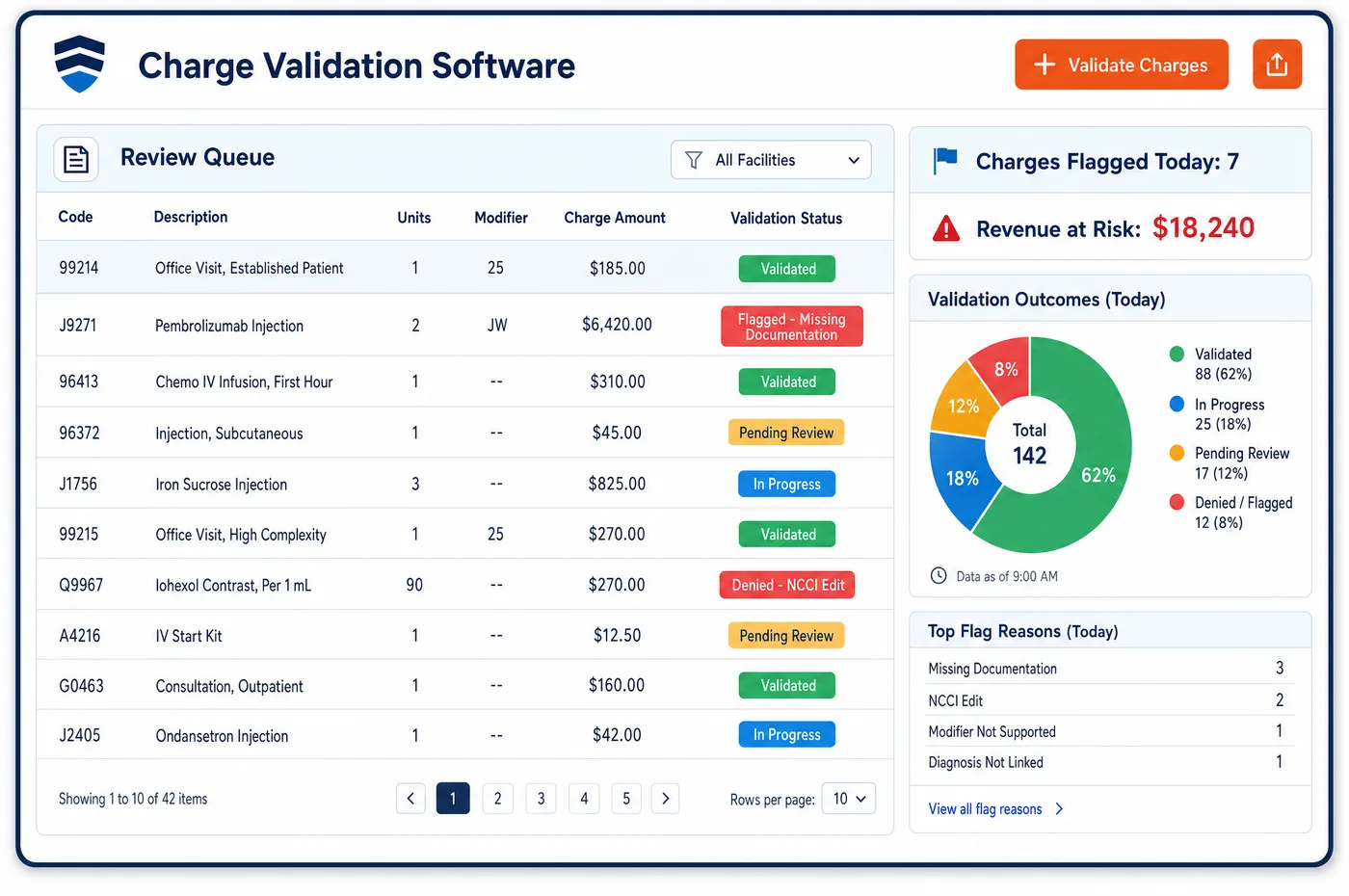
Charge Assembly in a Cardiology Practice
Charge assembly in cardiology starts with the report, not a superbill. A cath report names the heart chambers entered, the vessels imaged and any grafts, and those facts pick one code from 93451 to 93461. If a PCI follows a diagnostic study, the stent or balloon work becomes its own line for each treated major artery, while the cath stays only when the diagnostic study was needed. A nuclear stress test yields the stress test codes, the imaging code and lines for the stress drug and the isotope. An echo can add Doppler or contrast lines. A device clinic visit produces an interrogation or programming code for each device checked. Cardiology charge assembly software maps each documented element to its line, adds the component modifier from the site, and links the diagnosis. The coder reviews a draft built from the report instead of starting from a blank screen. Each line then moves on to rule checks before it joins the claim.
Why Is Charge Assembly Different in Cardiology?
Cardiology procedures pack many billable parts into one session. A cath can include left and right heart work, graft imaging, an aortogram on the way out and a closure device at the end. Some of those parts are separate lines and some are bundled. Building the charge from the full report is the only way to catch every separate part without adding bundled ones.
The same test splits differently by site. A stress test done in the office is billed as a global service. In the hospital, the cardiologist bills the supervision and the read, while the hospital bills the tracing. Charge assembly for a heart practice has to know where the test happened before it can choose the codes.
Drugs and supplies add more lines. Drug-based stress tests use a stress agent, nuclear studies use an isotope, and contrast echoes use a contrast agent. Each needs its own code and units when the practice buys and bills it. Missing those lines leaves money on the table, and billing them for a hospital test, where the facility supplied them, is an error.
What Cardiology Charge Assembly Software Handles
- Diagnostic cath before PCI (93454–93461)
- NCCI bundles coronary catheterization and dye injections into PCI. A diagnostic cath may be billed separately only when a medically necessary diagnostic angiogram came first. The draft keeps the cath line only when the report shows that study. (CMS NCCI Policy Manual for Medicare Services, Chapter XI, section I: Cardiovascular Services)
- Renal or iliac angiography during a cath (G0278)
- Dye injected to check the renal or iliac arteries while the catheter is withdrawn may be reported with G0278. Full aortography codes such as 75625 are used only when a complete study is done and read. (CMS NCCI Policy Manual for Medicare Services, Chapter XI, section I: Cardiovascular Services)
- Closure devices (G0269)
- Placing a closure device in the access site after a cath may be reported with G0269. NCCI says not to add a separate imaging code for it, so the draft adds G0269 alone. (CMS NCCI Policy Manual for Medicare Services, Chapter XI, section I: Cardiovascular Services)
- Stress test components (93016, 93017, 93018)
- CMS lists 93015 as the global stress test, 93016 as supervision only, 93017 as the tracing only and 93018 as the interpretation and report only. For a hospital test, the cardiologist's lines are usually 93016 and 93018, with the tracing billed by the hospital. (CMS MLN Medicare Quarterly Provider Compliance Newsletter, Volume 6, Issue 2 (cardiovascular stress test and nuclear cardiology codes))
- Stress echo contrast (93352)
- Add-on code 93352 covers echo contrast during a stress echo and is reported with 93350 or 93351. It is not paid separately under the hospital outpatient system, so the draft adds it only where the site allows. (CMS NCCI Policy Manual for Medicare Services, Chapter XI, section I: Cardiovascular Services)
- Cardiac rehab units (93797, 93798)
- One unit of 93797 or 93798 needs at least 31 minutes of rehab, and two units need at least 91 minutes in a day. Short periods in one day are added together before units are counted. (CMS Medicare Claims Processing Manual, Chapter 32, section 140: Cardiac Rehabilitation Programs)
- Device evaluation units
- Novitas reports codes 93260, 93261 and 93279 through 93292 per procedure. Each device check or programming session documented in the clinic note becomes its own line. (CMS Medicare Coverage Database, Novitas Billing and Coding Article A56602: Cardiac Rhythm Device Evaluation)
How Does Cardiology Charge Assembly Software Work?
1. Read the report
The cath, stress, echo or device clinic report is the source. Each documented element, such as the chambers entered or the vessels treated, is pulled into the draft.
2. Map elements to codes
Elements map to procedure and add-on codes. Bundled parts are left off, and separate parts get their own lines.
3. Add drugs, isotopes and supplies
When the practice supplied a stress agent, isotope or contrast agent, its line is added with units. For hospital tests, those lines are left to the facility.
4. Set component and diagnosis
The site sets the component modifier, using modifier 26 for hospital reads. Diagnoses from the report are linked to each line.
5. Send for review and validation
A coder reviews the draft, then lines move to cardiology charge validation for edit checks. Approved lines go on to the claim in cardiology medical billing.
Cardiology Charge Assembly Software vs. Generic Software
| Area | Generic approach | Unlimited Systems |
|---|---|---|
| Source | Superbill ticked by hand. | Draft built from the procedure report. |
| Cath lab coding | Coder rebuilds the case from the note. | Chambers, vessels and add-ons pulled from the report. |
| Drugs and isotopes | Often left off. | Added with units when the practice supplied them. |
| Site split | Global billed for hospital tests. | Component set from the site. |
| Device clinic | One code per visit. | One line per documented device check. |
Who Uses It in a Cardiology Practice
- Coder: A draft built from the report, so time goes into review instead of data entry.
- Interventional cardiologist: Every documented part of the case captured, from graft imaging to the closure device, without extra paperwork.
- Billing manager: Fewer missed lines and fewer bundled lines billed by mistake, tracked with charge capture measures.
Cardiology Charge Assembly Software FAQs
Charge assembly for a cardiac cath reads the report and pulls out the chambers entered, the vessels and grafts imaged, and any added work, such as an aortogram or a closure device. Those elements map to one cath code and any separate lines. The coder reviews the draft, and the lines move on to edit checks.
A diagnostic cath is billed with a PCI only when a medically necessary diagnostic study came first. When the cath is only the route for the intervention, NCCI bundles it into the PCI. The draft keeps the cath line only when the report supports a diagnostic study, and the coder confirms that before the line moves on.
An office nuclear stress test usually produces the stress test lines, the myocardial perfusion imaging code, and lines for the stress drug and the isotope when the practice supplied them. In the hospital, the cardiologist's lines are the supervision, the stress test read and the imaging read, with the technical parts billed by the facility.
Each documented device check or programming session becomes its own line, since device evaluation codes are reported per procedure. The note shows which device was checked and whether it was programmed. Remote checks are built from the transmission record and the cardiologist's review, within the payer's allowed interval.
Drug, isotope and contrast lines are added when the practice bought and supplied them, with units from the record. When the test took place in a hospital that supplied them, those lines are left off, because the facility bills them. That rule keeps office charges complete and hospital charges clean.
Charge assembly builds the lines from what was documented. Charge validation then checks those lines against NCCI edits, modifier rules and payer policy. In cardiology, assembly makes sure every part of a cath or stress test is captured, and validation makes sure nothing bundled or out of policy goes out.
Related Cardiology Software
Billing & claims
In the revenue cycle
Charge Assembly for related specialties
Sources
- CMS NCCI Policy Manual for Medicare Services, Chapter XI, section I: Cardiovascular Services
- CMS MLN Medicare Quarterly Provider Compliance Newsletter, Volume 6, Issue 2 (cardiovascular stress test and nuclear cardiology codes)
- CMS Medicare Claims Processing Manual, Chapter 32, section 140: Cardiac Rehabilitation Programs
- CMS Medicare Coverage Database, Novitas Billing and Coding Article A56602: Cardiac Rhythm Device Evaluation
GET STARTED
See Unlimited Systems in Action
Whether you're actively evaluating new technology or simply preparing for your next vendor renewal, Unlimited Systems can help you understand where your current workflows may be creating avoidable revenue risk.