

Billing & claims
Cardiology Invoicing Software
Bill payers, hospitals, nursing facilities, study sponsors and patients, and track every cardiology claim and invoice to payment.
Cardiology Invoicing Software produces and tracks the bills a heart practice sends to payers and to other parties. It formats claims for each payer, and builds invoices for hospital service contracts, nursing facility imaging, clinical trial sponsors and patients who pay their own way. Cardiology invoicing then follows each bill until it is paid.



 6,500+ specialty providers

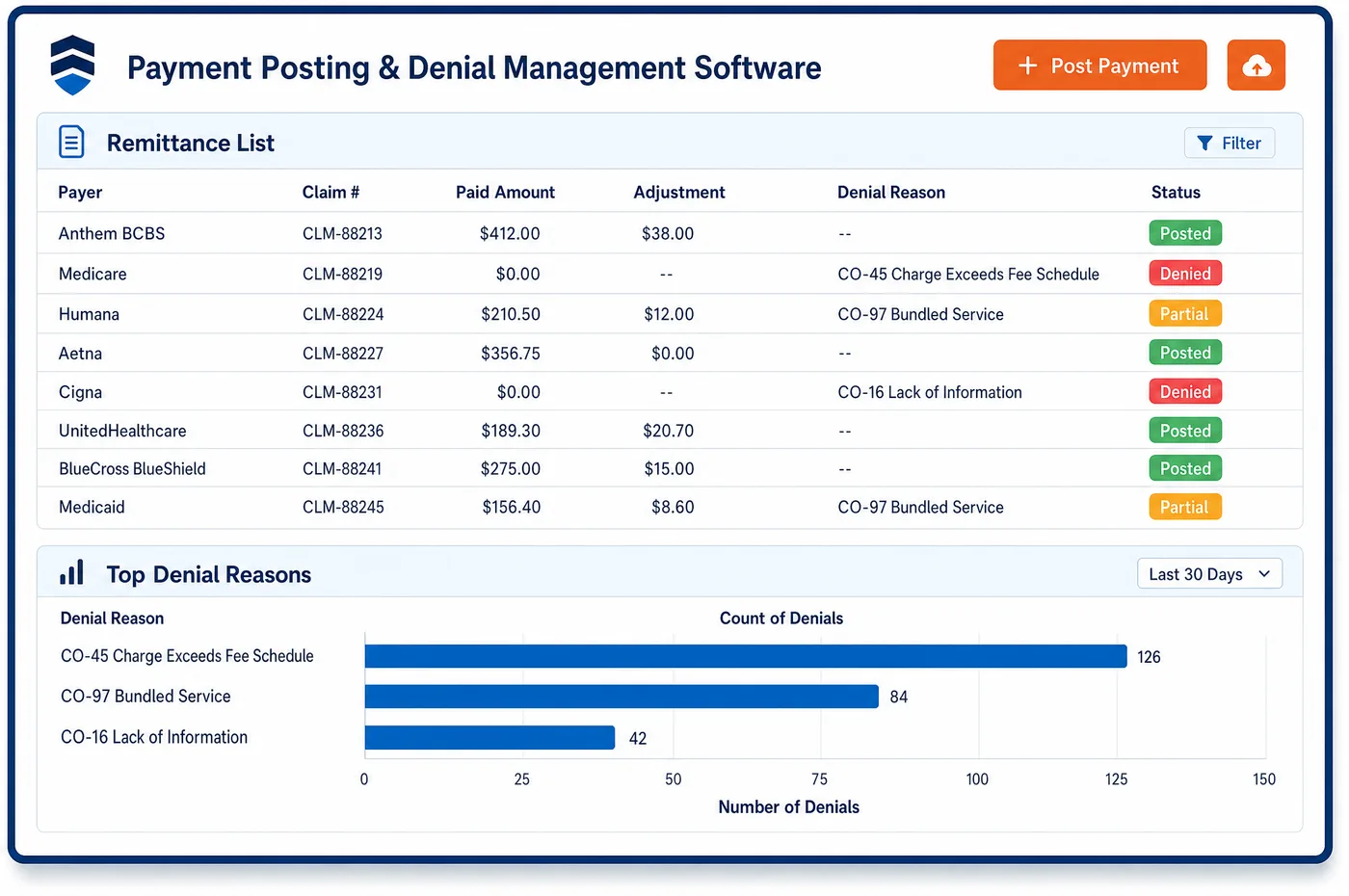
Invoicing in a Cardiology Practice
Claims still carry most of a heart practice's revenue, so invoicing begins with them. Each claim is formatted to the payer's rules and sent through the clearinghouse. But a heart practice also bills outside the claim. A group that supervises a hospital's nuclear lab bills the hospital under a service contract, since Medicare pays the hospital for that work. A nursing facility whose Part A resident had a nuclear study pays the practice for the technical part, because the facility bills Medicare for it. A research sponsor pays for the study visits and tests the trial covers. A self-pay patient gets an invoice that matches the estimate they received. Each of these is drawn from the same account record by the cardiology invoicing software. It sends patient invoices by email or text, keeps contract and sponsor invoices on their own schedules, and shows every claim and invoice in one view until paid.
Why Is Invoicing Different in Cardiology?
A heart practice often works inside other organizations. Its cardiologists may direct a hospital's nuclear lab, cover call, or read studies under contract. Medicare pays the hospital for some of that work, such as supervision, so the practice can't bill Medicare for it. The practice is paid by invoicing the hospital under the agreement, and those invoices need the same care as any claim.
Research is part of many cardiology programs. Structural heart, device and drug trials often pay for study-only visits and tests, while Medicare covers routine care billed with trial modifiers. A practice that sends a sponsor's tests to Medicare risks a refund. A practice that forgets to invoice the sponsor loses income. Invoicing in cardiology has to split each trial patient's care correctly between the two.
Patient bills can be larger than patients expect. A self-pay calcium score, or an echo under a high deductible, can surprise a patient. Uninsured and self-pay patients must get a good faith estimate for scheduled care, and their invoice should match it. When Medicare denies a service the patient agreed to pay for on an ABN, the patient invoice should show why.
What Cardiology Invoicing Software Handles
- Hospital supervisory and administrative services
- Medicare pays the hospital, as a provider service, for physicians' administrative or supervisory radiology services to the hospital. Practices that supervise a hospital nuclear lab bill that work to the hospital by invoice. (CMS Medicare Claims Processing Manual, Chapter 13 (Radiologic Services), section 20.2.1: Hospital and SNF Patients)
- Imaging for skilled nursing facility residents
- Medicare Part B does not pay for the technical part of radiology services to SNF residents in a covered Part A stay, and the SNF bills it instead. The practice invoices the SNF for the technical part and bills only the professional read. (CMS Medicare Claims Processing Manual, Chapter 13 (Radiologic Services), section 20.2.1: Hospital and SNF Patients)
- Clinical trial routine costs
- Medicare claims for routine costs in a qualifying trial carry the trial number, diagnosis Z00.6 and modifier Q0 or Q1. Staff split each trial visit, so study-only services covered by the sponsor's contract are invoiced to the sponsor. (CMS Medicare Claims Processing Manual, Chapter 32, section 69: Qualifying Clinical Trials)
- ABN patient liability (GA)
- Under WPS policy, pacemaker claims that don't meet coverage criteria carry GA or GZ and are denied. With GA and a signed ABN, the denied amount can move to the patient's invoice. (CMS Medicare Coverage Database, WPS Billing and Coding Article A54958: Single Chamber and Dual Chamber Permanent Cardiac Pacemakers)
- Self-pay estimate check
- CMS says patients who aren't using insurance must get a good faith estimate for care scheduled far enough ahead. The self-pay invoice is compared with the estimate before it is sent. (CMS Medical Bill Rights: Good faith estimate guide for patients who are not using insurance)
How Does Cardiology Invoicing Software Work?
1. Sort each charge by who pays
Each charge is routed to the payer, the hospital, a facility, a sponsor or the patient. Contract terms and trial budgets set which charges go where.
2. Send payer claims
Claims for payers go out through cardiology medical billing. Their status shows next to the invoices for the same account.
3. Build contract and facility invoices
Hospital and SNF invoices are built from the services each agreement covers. Each invoice lists the dates, the services and the contract rate.
4. Invoice sponsors and patients
Sponsor invoices follow the trial budget. Patient invoices go out by email or text with a link to pay, and balances follow the patient to cardiology patient billing.
5. Track every bill to payment
Claims and invoices sit in one view by payer type and age. Overdue invoices are flagged for follow-up in AR management.
Cardiology Invoicing Software vs. Generic Software
| Area | Generic approach | Unlimited Systems |
|---|---|---|
| Hospital contracts | Spreadsheets built at month end. | Invoices built from the services each contract covers. |
| SNF imaging | Technical part billed to Medicare in error. | Technical part invoiced to the facility. |
| Trial patients | Study tests billed to Medicare by mistake. | Study services invoiced to the sponsor. |
| Self-pay patients | Bill doesn't match the estimate. | Invoice checked against the good faith estimate. |
| Follow-up | Invoices tracked outside the billing system. | Claims and invoices tracked in one view. |
Who Uses It in a Cardiology Practice
- Billing manager: One view of claims and invoices, with overdue contract and sponsor invoices flagged.
- Research coordinator: Trial visits split between the sponsor invoice and the Medicare claim, with the trial data on each.
- Physician owner: Contract income from hospitals and facilities tracked as closely as claim revenue, with totals passed to healthcare accounting.
Cardiology Invoicing Software FAQs
Cardiology invoicing covers payer claims and the bills a practice sends outside the claim system. That includes hospital invoices for contract work such as lab supervision, facility invoices for imaging done for nursing home residents, sponsor invoices for trial services, and patient invoices. Each one is tracked until it is paid.
Medicare pays the hospital, not the physician, for a physician's administrative or supervisory radiology services to the hospital. A cardiologist who directs or supervises a hospital nuclear lab is paid for that work under the practice's agreement with the hospital. The practice bills it by invoice, and reads for individual patients are still billed with modifier 26.
For a trial patient, each visit is split. Routine care goes to Medicare with the trial number, diagnosis Z00.6 and modifier Q0 or Q1. Services the sponsor pays for under the study contract are invoiced to the sponsor. Keeping both sides on one account helps avoid billing Medicare for study-only care.
When a resident in a covered Part A nursing facility stay has a radiology service such as a nuclear study, the facility bills Medicare for the technical part. The practice invoices the facility for that part under their agreement and bills only the professional read. Registration flags these patients so the split happens every time.
Uninsured and self-pay patients get a good faith estimate for scheduled care, and the invoice is checked against it before it goes out. If the bill is higher, staff can see why before the patient does. Patients get the invoice by email or text with a link to pay online.
Patient invoices can go out by email or text with a link to view and pay the balance. The invoice reads from the same ledger staff use, so it shows the current amount after insurance. Staff can note patients who prefer mail or who have not agreed to digital contact, and those patients are not texted.
Related Cardiology Software
Billing & claims
Invoicing for related specialties
Sources
- CMS Medicare Claims Processing Manual, Chapter 13 (Radiologic Services), section 20.2.1: Hospital and SNF Patients
- CMS Medicare Claims Processing Manual, Chapter 32, section 69: Qualifying Clinical Trials
- CMS Medicare Coverage Database, WPS Billing and Coding Article A54958: Single Chamber and Dual Chamber Permanent Cardiac Pacemakers
- CMS Medical Bill Rights: Good faith estimate guide for patients who are not using insurance
GET STARTED
See Unlimited Systems in Action
Whether you're actively evaluating new technology or simply preparing for your next vendor renewal, Unlimited Systems can help you understand where your current workflows may be creating avoidable revenue risk.